
What Is the 5-Minute Mold Test (and Can You Trust It?)
The “5-minute mold test” usually refers to a short-duration mold air sample.
It’s not a special kind of mold test or a separate technology. In most cases, it means an inspector uses an air pump to pull air through a sampling cassette for a short period, then sends that sample to a lab for analysis.
That can be useful, but it can also be misunderstood.
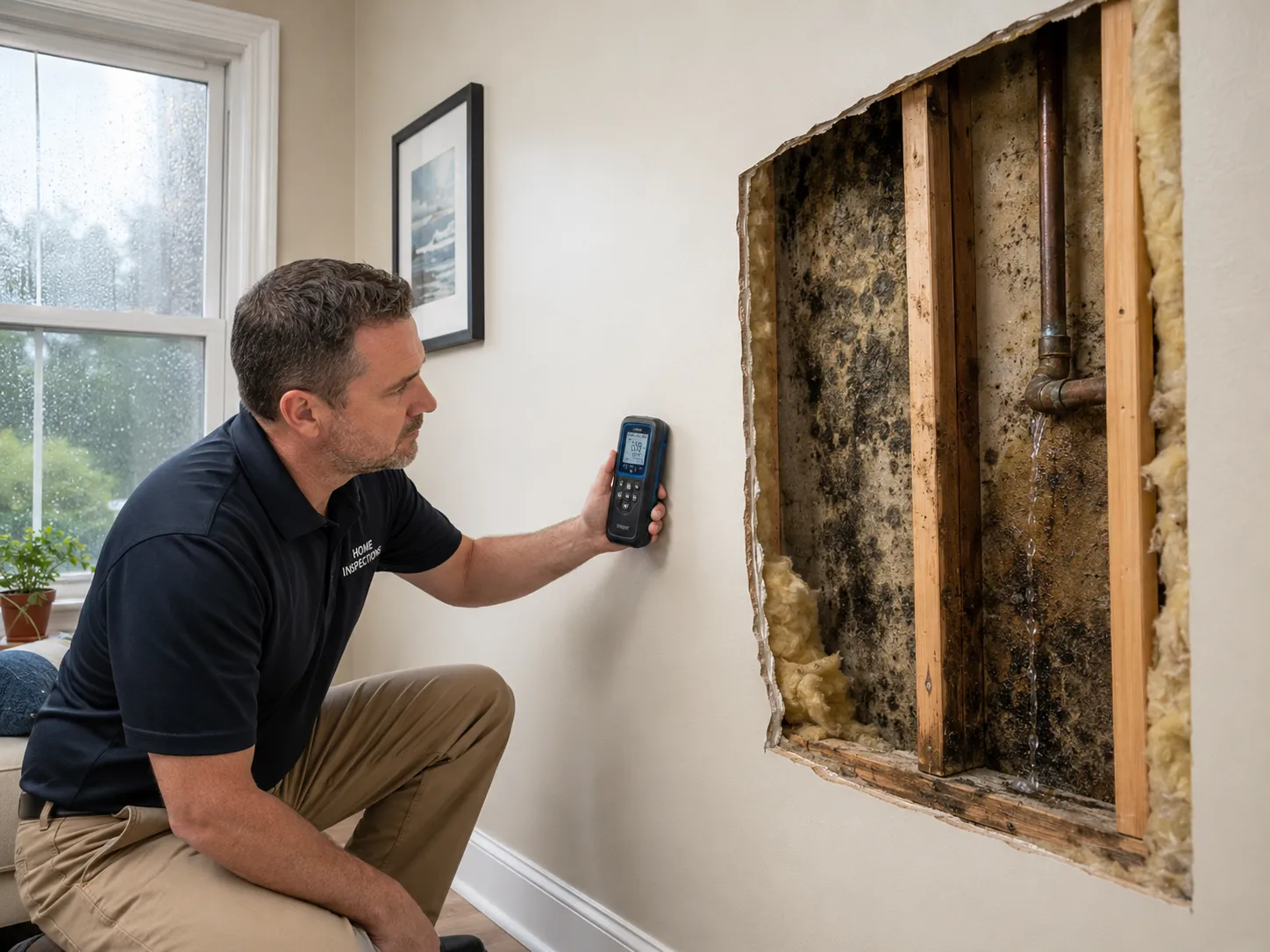
A 5-minute mold test may tell you what mold spores were floating through the sampled air during that short window. It may not tell you whether mold is hidden behind walls, under flooring, behind cabinets, inside insulation, or in HVAC-related areas.
That’s why Caleb Jones, co-owner of Mold Dog Network, is careful about how homeowners interpret short air samples.
“You’re hoping the spores travel through the air capture during that five-minute test.”
Caleb Jones
So, can you trust a 5-minute mold test?
You can trust it for what it actually measures. But you shouldn’t treat it as proof that hidden mold isn’t present.
How a 5-Minute Mold Test Works
A typical short-duration mold air sample works by pulling a measured amount of air through a collection device. That device captures particles from the air, including mold spores. The sample is then sent to a laboratory, where it’s analyzed.
The lab may identify mold spore types and provide counts based on what was captured.
Often, the indoor sample is compared against an outdoor baseline sample. The idea is to see whether indoor mold levels appear elevated compared with the outdoor environment.
That sounds straightforward, but there’s an important limitation: the test only measures what was in the air during the sample window.
It does not inspect the full home.
It does not locate mold behind finished materials.
And it does not tell you whether a hidden cavity is mold-free.
The EPA says water-damaged areas and items should be dried within 24–48 hours to help prevent mold growth. Source: EPA
That matters because hidden mold often starts after a moisture event. A small leak, roof issue, plumbing problem, or damp cavity can create mold growth that may not be visible and may not show up in a short air sample.
Understanding how the test works is the first step to understanding what it can (and can’t) tell you.
Related read: Mold testing vs mold dog inspections – which is better?
Why a Five-Minute Air Sample Doesn’t Always Tell the Whole Story
The biggest issue with a 5-minute mold test is that it relies on airborne spores being in the right place at the right time.
Hidden mold doesn’t always cooperate.
A mold colony may be active behind a wall but not releasing many spores into the living space during the sample. Mold under flooring may stay mostly trapped below the surface. Mold behind cabinets may create odor and material damage without sending spores directly through the air capture.
Caleb explains the limitation clearly:
“Air testing is just so dependent on so many different factors.”
Caleb Jones
Hidden mold isn’t always airborne
If mold is sealed inside a wall cavity, beneath flooring, or behind cabinets, it may not release enough spores into the room during the test.
That means the 5-minute mold test could look normal while mold is still present.
Timing changes everything
Air sampling is a snapshot. If spores aren’t floating through the sampled air during that short window, the test may not catch them.
This can be especially frustrating when the home has intermittent odors or symptoms that come and go.
Air movement affects results
HVAC use, closed doors, open windows, pressure changes, and room selection can all affect results.
A sample taken in one area may not reflect what’s happening behind a bathroom wall, under a kitchen cabinet, or inside another part of the home.
That’s why a short air test may be helpful, but it shouldn’t be treated as a complete hidden mold investigation.
A five-minute sample may tell you what was in the air that day, but not necessarily what’s hidden in your home.
Related read: Why mold air samples come back normal when mold is still present
When the 5-Minute Mold Test Is Useful
A 5-minute mold test isn’t worthless. It just needs to be used for the right reason.
Air sampling can help when you need information about airborne mold spores. It may be useful for documenting indoor conditions, comparing indoor and outdoor samples, or supporting a broader mold assessment.
Lab testing can also identify mold types in the sample, which may be useful for homeowners working with environmental professionals or healthcare providers.
Caleb is clear that testing still has a place.
“Laboratory testing still has a very valuable use.”
Caleb Jones
A short air sample may be useful when:
- you need airborne spore information
- you’re comparing indoor and outdoor air
- you’re documenting conditions before or after remediation
- you’re working with an industrial hygienist
- you need lab-identified mold types
- you’re using testing as one part of a wider inspection
The key phrase is “one part.”
A 5-minute mold test can support the process, but it shouldn’t be the only tool used when the concern is hidden mold.
If you already know where the issue is, testing may help document it. If remediation has already been completed, testing may help with verification. But if nobody knows where the mold is hiding, air sampling may leave you with more questions.
Air sampling has value, provided it’s answering the right question.
When a Mold Dog Inspection Makes More Sense
A mold dog inspection often makes more sense when the problem is hidden mold.
That’s because a mold dog inspection is source-focused. Instead of measuring spores floating through the air, a trained mold detection dog searches for the odor produced by active mold growth.
During the inspection, the dog works through the home with a trained handler. When the dog detects mold odor, the handler documents the alert location.
That gives the homeowner same-day, location-focused information.
“The canine inspection is just an inspection-based service that will show you where the mold is on the same day.”
Caleb Jones
A mold dog inspection may be a better next step if:
- your 5-minute mold test came back normal, but the home still smells musty
- your air test showed mold, but nobody knows where it’s coming from
- you suspect mold behind walls, floors, cabinets, or ceilings
- there was past water damage
- you’re buying a home and want to check for hidden mold
- you want answers before opening walls
- you need same-day findings
- you’ve already spent money on testing without clear direction
This is especially important for homeowners who feel stuck between test results and lived experience.
Maybe the lab report says one thing, but your home still doesn’t feel right. Maybe you’ve had a visual inspection, but nothing obvious was found. Or maybe you’re worried that remediation will only address the visible area while hidden mold remains elsewhere.
A mold dog inspection helps narrow the search.
It doesn’t replace every other tool. It simply answers a different question: where is the hidden mold odor strongest?
If you’re trying to find hidden mold, and not just measure airborne spores, a mold dog inspection is often the better tool.
Which Test Should You Choose?
The right choice depends on what you need to know.
| If you want to… | Best option |
| Measure airborne spores | Air sample |
| Identify mold species | Laboratory testing |
| Locate hidden mold | Mold dog inspection |
| Create a remediation scope | Industrial hygienist |
| Verify remediation | Lab testing plus inspection |
This is where many homeowners accidentally choose the wrong next step.
They ask for a mold test because they want to know where mold is. But most mold testing doesn’t locate hidden mold. It gives information about a sample.
Caleb explained that limitation when talking about traditional testing:
“It tells you if you have a problem. It just doesn’t tell you where…”
Caleb Jones
So if your question is, “Are there spores in this air sample?” a 5-minute mold test may help.
If your question is, “What type of mold is this?” lab testing may help.
If your question is, “What scope should a remediation company follow?” an industrial hygienist may help.
But if your question is, “Where is the hidden mold?” a mold dog inspection is often the more direct option.
That’s the simplest way to think about it.
Choose the inspection method that answers your actual question, not just the one that’s most familiar.
Related read: Can air testing miss hidden mold?
Final Thoughts
The 5-minute mold test isn’t bad.
It’s limited.
A short-duration air sample can tell you what mold spores were captured during that testing window. It may help document airborne conditions or support a wider mold assessment. But it should not be treated as proof that hidden mold isn’t present.
If your home still has a musty smell, past water damage, or concerns that don’t match your test results, the next step should focus on finding the source.
Mold dog inspections are designed for that. They help locate active mold odor behind walls, under floors, behind cabinets, and in other areas that may not show up during a short air sample.
Need to know where hidden mold is growing? Schedule a mold dog inspection with Mold Dog Network today.