
Why Mold Air Samples Can Come Back Normal When Mold Is Still Present
Yes, mold air samples can come back normal even when mold is still present.
That’s one of the most frustrating situations for homeowners. You know something doesn’t feel right. Maybe there’s a musty smell in one part of the house. Maybe symptoms seem worse indoors. Maybe there was a leak, flood, roof issue, or plumbing problem in the past.
But then the mold air sample comes back “normal.”
That result can feel reassuring for a moment, but if the smell or concern doesn’t go away, it can also leave you feeling stuck. Are you imagining it? Did the test miss something? Is there still mold somewhere you can’t see?
Caleb Jones, co-owner of Mold Dog Network, has seen this happen more than once.
“I’ve actually had that happen to me before and on several occasions.”
Caleb Jones
The issue is that air sampling measures airborne spores during a short window of time. It doesn’t inspect behind walls, under floors, inside cabinets, or inside hidden cavities.
So the better question is not just, “Was the air sample normal?”
It’s: Has anyone actually found the source?
Air Samples Only Capture a Moment in Time
A mold air sample is a snapshot.
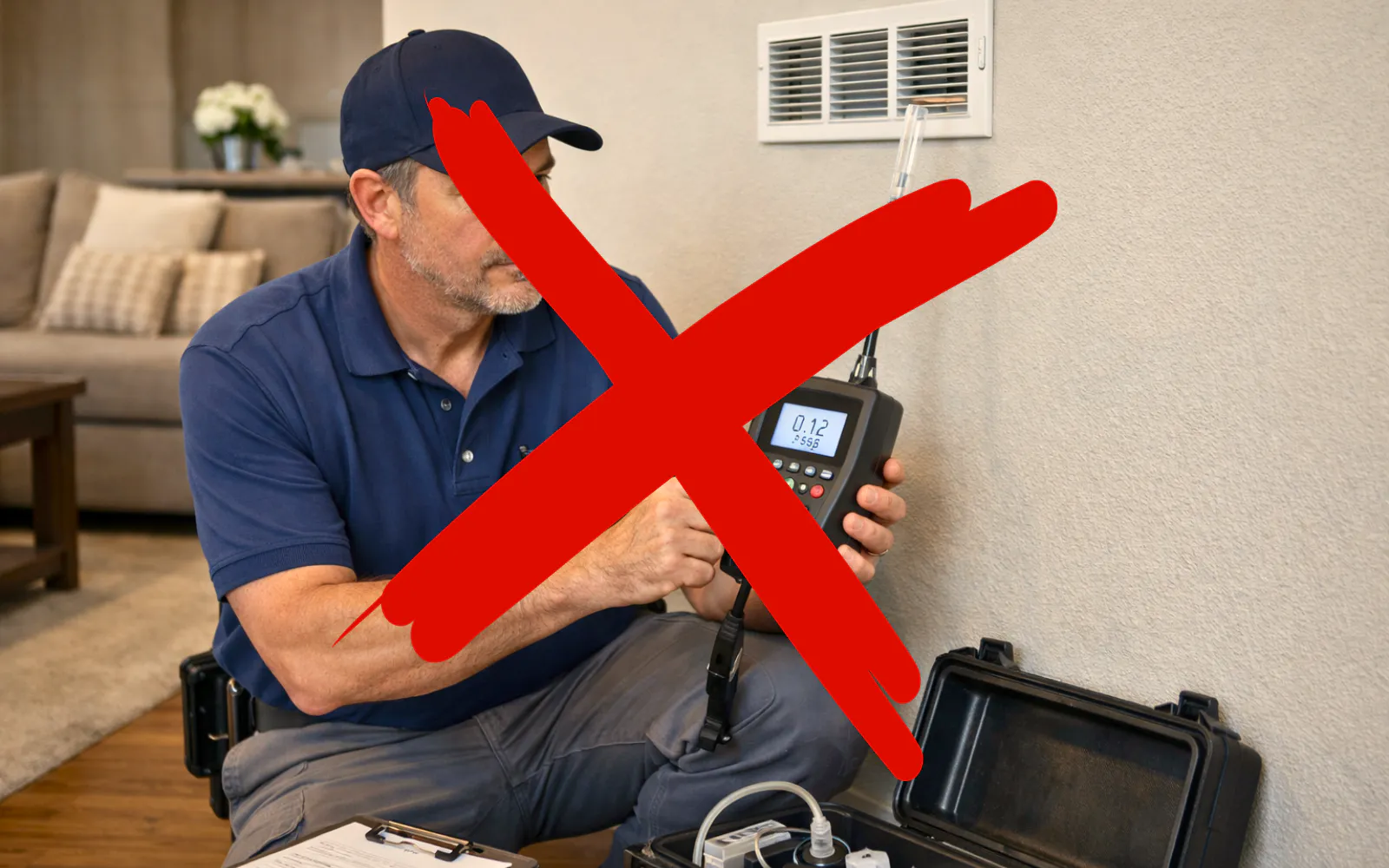
During the test, air is pulled through a sampling device for a set period of time. That sample is then sent to a lab, where it’s reviewed for mold spores. The result may show what types of spores were captured and how indoor levels compare with an outdoor baseline.
That can be useful information.
But it’s still only a measurement of what passed through that device during that short testing window.
Caleb explains the problem simply:
“You’re hoping the spores travel through the air capture during that five-minute test.”
Caleb Jones
If spores weren’t moving through that exact area at that exact time, the sample may look normal even if mold is growing somewhere else in the home.
Air samples can be affected by:
- whether the HVAC system was running
- where the sample was taken
- how air was moving through the home
- whether windows or doors were open
- outdoor mold levels
- whether the mold colony was releasing spores into the living space
- whether the mold was hidden behind building materials
That’s why a normal air sample shouldn’t automatically end the investigation if other warning signs are still present.
If your air sample came back normal but the home still smells or feels wrong, it may be time to investigate the source directly.
Related read: Mold Testing vs Mold Dog Inspections
Hidden Mold Doesn’t Always Reach the Sample
Hidden mold doesn’t always behave in a way that makes air sampling easy.
A colony behind drywall may be active, but spores may stay mostly inside the wall cavity. Mold under flooring may not release much into the room above. Mold behind cabinets may affect the surrounding materials without sending enough spores into the sampled air to trigger a concern.
That’s why mold air samples can come back normal when mold is still present.
“Air testing is just so dependent on so many different factors.”
Caleb Jones
The mold is sealed behind materials
If mold is growing behind finished materials, the living space may not show high airborne spore levels at the time of testing.
That doesn’t mean the mold isn’t there. It may simply mean the spores didn’t escape into the air sample at that time.
This can happen behind:
- drywall
- baseboards
- cabinets
- insulation
- subflooring
- ceilings
- trim
- built-ins
Airflow carries spores away from the sample
Air movement matters too.
The HVAC system, open doors, closed rooms, pressure differences, and natural airflow patterns can all affect where spores move. A sample taken in one room may not reflect what’s happening inside another room, behind a wall, or near an HVAC component.
The sample is taken in the wrong room
A mold air sample is only as useful as its placement.
If the source is behind a bathroom wall but the sample is taken in the hallway, the result may not capture the issue. If the source is under a kitchen cabinet but the sample is taken across the room, the reading may not tell the full story.
This is one reason homeowners sometimes end up with normal results while still smelling mold.
The test didn’t necessarily “fail.” It just may not have been the right tool for finding a hidden source.
A normal air sample shouldn’t be the end of the investigation if your home still has mold warning signs.
Related read: Can air testing miss hidden mold?
What “Normal” Mold Results Can and Can’t Tell You
A normal mold result usually means the sample did not show elevated spores compared with the testing criteria or outdoor baseline.
That’s useful to know.
But it does not prove every part of the home is mold-free.
A normal mold air sample does not necessarily tell you:
- whether there’s mold behind a wall
- whether a leak caused hidden growth
- whether mold is under flooring
- whether cabinets are hiding moisture damage
- whether mold is inside an inaccessible cavity
- whether the HVAC system has a localized issue
- whether a musty smell has a hidden source
This is where homeowners can get stuck. The test may answer one narrow question, but not the bigger one.
Caleb puts it this way:
“It tells you if you have a problem. It just doesn’t tell you where that you have a problem or how severe of a problem that you have.”
Caleb Jones
That’s the key limitation.
Even a positive mold air sample may still leave you asking, “Okay, but where is it?”
And a normal mold air sample may leave you asking, “Then why does my house still smell like this?”
Both situations point back to the same issue: air sampling is not designed to fully locate hidden mold.
When mold is visible, testing may be easier to target. When mold is hidden, testing becomes more dependent on timing, placement, airflow, and whether spores are moving into the sampled area.
So if your results don’t match what you’re experiencing, don’t ignore that disconnect. A test result is one data point. Your home’s odor, moisture history, and ongoing concerns matter too.
If your results don’t match what you’re noticing at home, don’t ignore that disconnect. Look for the source.
Related read: Do mold tests tell you where the mold is?
When a Mold Dog Inspection Makes More Sense Than Another Air Sample
Sometimes another air sample isn’t the clearest next step.
If you’ve already tested and still don’t know where the mold is, you may need a source-location method instead.
That’s what a mold dog inspection is designed for.
Mold detection dogs are trained to detect the odor produced by active mold growth. During an inspection, the dog works through the home with a trained handler. When the dog identifies mold odor, the handler documents the alert location.
Instead of waiting for spores to pass through a testing device, the inspection focuses on finding where the mold odor is strongest.
A mold dog inspection may make sense when:
- your air sample came back normal, but a musty smell continues
- your test showed mold, but nobody knows where it’s coming from
- your home has a history of leaks, water damage, or humidity issues
- you suspect mold behind walls, floors, cabinets, or ceilings
- visual inspections haven’t found anything obvious
- you want same-day, location-focused findings
- you want to avoid unnecessary exploratory demolition
This is especially valuable in residential homes where hidden mold can affect bedrooms, kitchens, bathrooms, basements, crawlspaces, and HVAC-related areas.
A residential mold dog inspection can help homeowners move from broad concern to identifying specific areas worth investigating.
And that’s the part that often changes everything.
When you know where the likely source is, remediation can be more targeted. You’re not opening random walls. You’re not paying for repeated testing without a clear direction. You’re not living in the constant stress of wondering whether the problem is still hiding somewhere.
If you’re tired of testing without answers, schedule a mold dog inspection to find where hidden mold may be growing.
When Air Sampling Still Has a Role
Air sampling can still be useful.
This isn’t about saying mold air samples are worthless. They’re not. They just need to be used for the right purpose.
Air sampling may help when you need information about airborne spore levels. Lab testing can help identify mold types. Testing may also be important after remediation, especially when the goal is to confirm whether the work was successful.
Caleb is careful not to dismiss testing entirely.
“Laboratory testing still has a very valuable use.”
Caleb Jones
Air sampling may be useful for:
- comparing indoor and outdoor spore levels
- identifying airborne mold spores
- documenting conditions
- supporting post-remediation validation
- giving additional information to medical or environmental professionals
But when the main issue is hidden mold, air sampling may not be enough on its own.
A better approach is to use each tool for what it does best.
Use mold testing when you need sample-specific data. Use a mold dog inspection when you need help finding the source.
Use air sampling for what it does well, but don’t rely on it alone when hidden mold needs to be located.
Final Thoughts
Mold air samples can come back normal when mold is still present.
That doesn’t mean every normal result is wrong. It means the result has limits. It reflects what was captured in the air during the sample window, not necessarily what’s hiding behind walls, under flooring, behind cabinets, or inside inaccessible cavities.
If your home still has a musty smell, a history of water damage, or ongoing concerns that don’t match the test result, it’s reasonable to keep investigating.
A mold dog inspection gives you a more source-focused next step. Instead of asking whether spores happened to be in the air sample, the inspection helps identify where active mold odor may be coming from.
Still unsure after normal air sample results? Book a mold dog inspection with Mold Dog Network and get clearer, location-focused answers.