
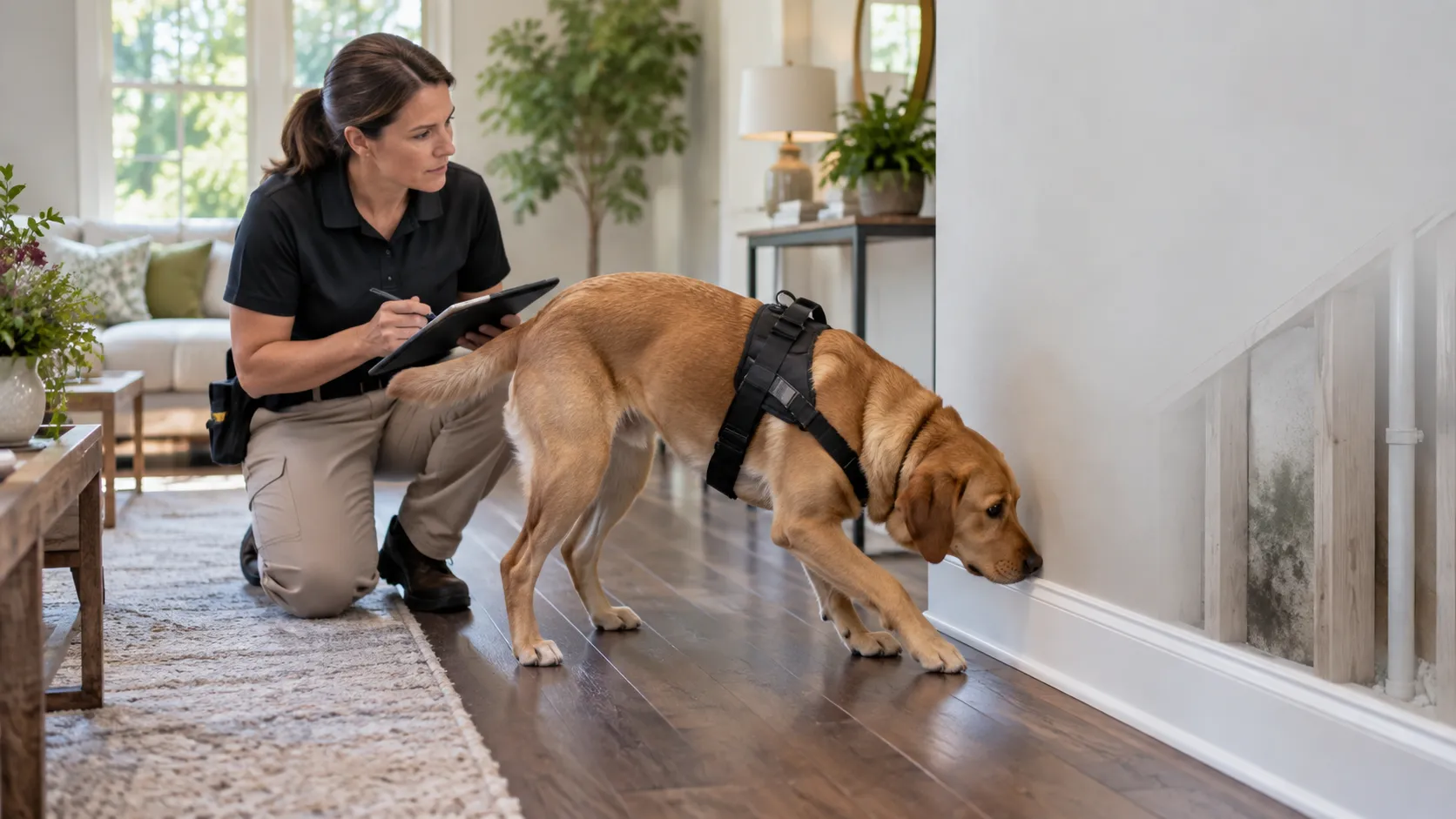
Mold Exposure Symptoms: When Your Home Could Be Part of the Problem
Maybe you wake up with a headache that seems to clear once you leave the house. You’re constantly tired, even after a full night’s sleep. Your sinuses never seem right. You’re struggling to concentrate. Or perhaps you simply have the nagging feeling that you feel worse at home than you do anywhere else.
Then you start wondering: could there be mold in the house?
It’s a question Mold Dog Network hears from families who have often spent weeks, months or even longer trying to work out what’s going on.
“We get the calls from families who’ve really been through the ringer.”
Tina Craig
Those concerns deserve to be taken seriously. But they also need to be approached carefully.
Mold exposure symptoms aren’t a diagnosis. Headaches, fatigue, congestion, skin irritation, trouble concentrating and many other symptoms can have numerous causes. Feeling unwell at home doesn’t automatically mean mold is responsible, and a mold inspection can’t tell you what’s causing a medical condition.
What it can do is answer a different question:
Is there hidden mold in the environment, and where is it?
Your healthcare provider should handle the medical side, but Mold Dog Network helps investigate the building.
If you and your healthcare provider suspect that your environment could be contributing to the way you feel, finding out whether hidden mold is present can give you one more piece of the puzzle.
- What Mold Exposure Symptoms Do People Commonly Notice?
- Why Mold Symptoms Can Look Completely Different From One Person to Another
- Why Do I Feel Better Away From Home?
- When There’s No Visible Mold, Look at the House’s History
- Doctor or Mold Inspector? They Answer Two Different Questions
- When Does It Make Sense to Inspect Your Home for Hidden Mold?
- Your Symptoms Matter. So Does Knowing What They Can – and Can’t – Tell You
What Mold Exposure Symptoms Do People Commonly Notice?
One of the first things Tina notices when families contact Mold Dog Network is how varied their concerns can be.
Some people talk about respiratory irritation. Others mention skin issues. Some are exhausted all the time, while others struggle to sleep at all.
“They’re sleeping constantly. And then we see the very opposite of that, where they’re so wired that they can’t go to sleep and they have insomnia.”
Tina Craig
That doesn’t mean every symptom they describe has been caused by mold. Tina and the Mold Dog Network team aren’t doctors, and they don’t tell clients otherwise.
There are, however, several health effects that have established associations with damp or moldy environments.
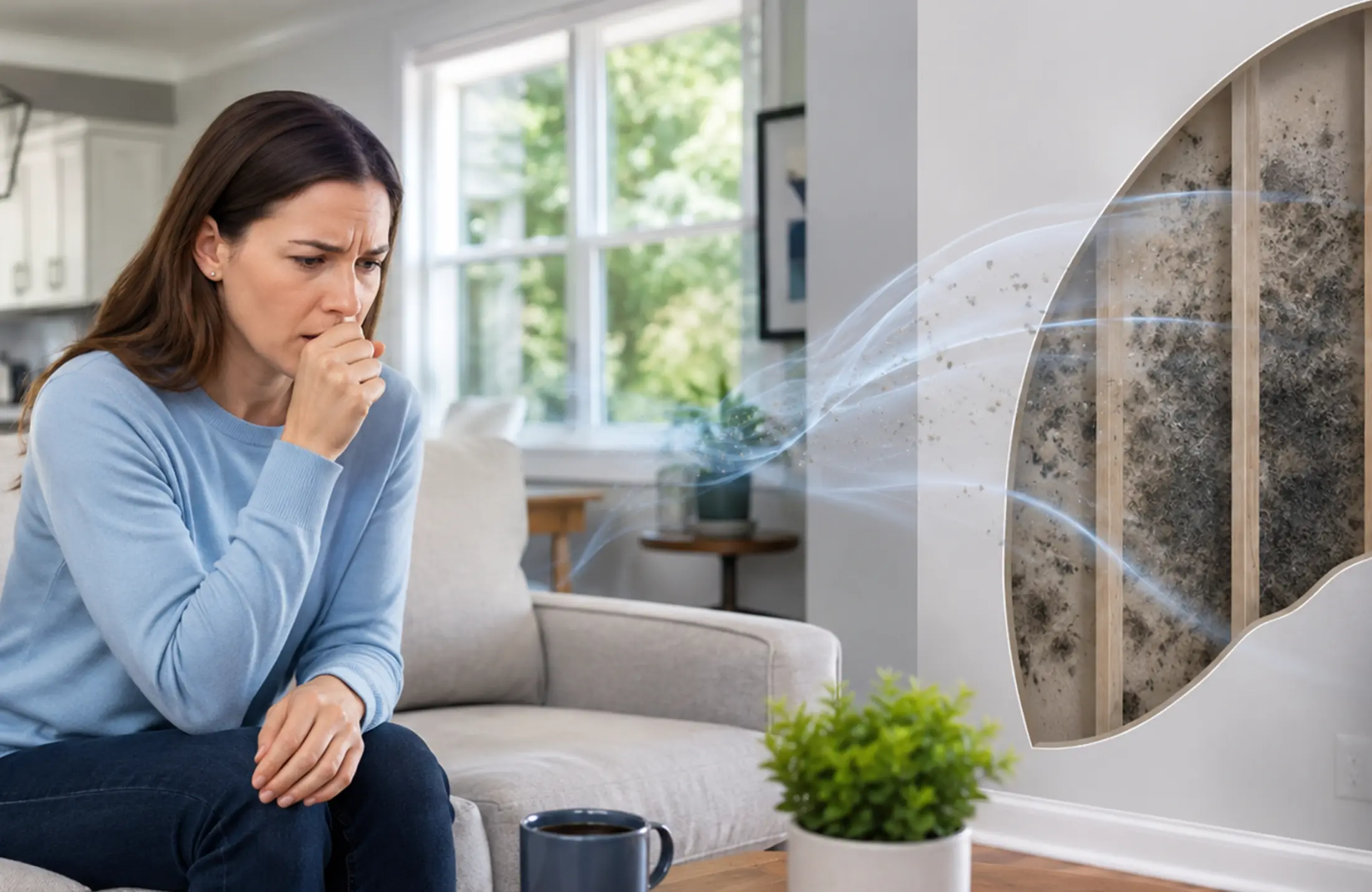
Respiratory and allergy-type symptoms
According to the CDC, exposure to damp and moldy environments may cause symptoms including:
- Stuffy or runny nose
- Sore throat
- Coughing
- Wheezing
- Burning or irritated eyes
- Skin rash
People with asthma or mold allergies may experience stronger reactions, while people with chronic lung disease or compromised immune systems can face additional risks.
The CDC also cites the Institute of Medicine’s conclusion that there was sufficient evidence linking indoor mold exposure with upper respiratory symptoms, cough and wheezing in otherwise healthy people, as well as asthma symptoms in people who already have asthma. CDC: Mold and possible health effects
The World Health Organization has reported that people living or working in damp or moldy buildings may have up to a 75% greater risk of respiratory symptoms and asthma. That doesn’t mean 75% of people in a moldy building will develop asthma. It means the research found a substantially higher respiratory risk among occupants of damp or moldy buildings compared with those without that exposure. World Health Organization guidance on dampness and mould
What about headaches, fatigue and brain fog?
This is where the conversation becomes less straightforward.
Mold Dog Network regularly hears from clients who mention headaches, exhaustion and difficulty concentrating. Tina describes meeting people who simply feel like they’re functioning through a fog.
But these symptoms are nonspecific. They can occur with many medical conditions, medications, sleep problems, stressors and other environmental exposures.
That’s why an article on mold exposure symptoms shouldn’t become an online diagnostic checklist. That said, things like mold, endotoxins caused by water damage or other causes of body toxicity can and is very often the root cause of these otherwise unexplained symptoms.
If you’re experiencing ongoing or worsening symptoms, talk with an appropriate healthcare professional. If those symptoms also seem connected to a particular building, investigate the environment too rather than trying to diagnose the house from symptoms alone.
Why Mold Symptoms Can Look Completely Different From One Person to Another
One reason mold exposure becomes so confusing is that two people living in the same home may not feel the same way.
One person might complain about their sinuses. Another may notice skin irritation. Someone with asthma may experience worsening respiratory symptoms, while another family member may have no obvious reaction at all.
That variation is something Tina sees regularly.
“One person might have bloody noses. While the next person is just covered in rashes in different places throughout their body that they can’t explain.”
Tina Craig
Again, that’s an observation from families Mold Dog Network has worked with – not evidence that mold caused those specific symptoms.
People respond differently to environmental exposures. Existing allergies, asthma, immune health, duration of exposure and numerous other individual factors can change the picture. There may also be completely unrelated medical issues happening at the same time.
That’s why searching for a universal list of mold exposure symptoms can lead people down the wrong path.
You may have seen articles promising a definitive list of “10 signs you have mold toxicity.” Those search terms are popular because people want something concrete to compare their experience against. But symptoms alone can’t establish the cause.
Research does show a meaningful relationship between damp indoor environments and certain respiratory outcomes. One U.S. analysis estimated that 21% of current asthma cases could potentially be attributable to residential dampness and mold exposure, with a reported 95% confidence interval of 12–29%. That figure is a population-level estimate based on an assumed causal relationship; it isn’t a way to determine whether mold caused one individual’s asthma. PubMed: Public health and economic impact of dampness and mold
That distinction matters because good information should reduce uncertainty, not create unnecessary fear.
And if you suddenly develop severe symptoms, breathing difficulties, neurological symptoms or anything else that feels urgent, seek medical attention. A mold inspection is never a substitute for medical care.
Instead of asking, “Do these symptoms prove I have mold exposure?” ask two separate questions: “What does my healthcare provider think is happening?” and “Is there evidence of a moisture or mold problem in my environment?”
Why Do I Feel Better Away From Home?
For some homeowners, the thing that first gets their attention isn’t one particular symptom.
It’s the pattern.
You feel rough in the morning, leave for work and gradually feel better.
You go away for a weekend and notice a difference.
You spend several days visiting relatives and realize that you haven’t felt this clear in months.
Then you get home and start feeling off again.

That pattern doesn’t prove mold is the cause. Plenty of things change when you leave your home, from sleep and stress to allergens, pets, workplace exposures, diet and daily routine.
But it can be useful information.
“The indoor living environment, we are not paying attention to that anymore… we don’t know any better.”
Tina Craig
When homeowners contact MDN about mold exposure symptoms, Tina’s team wants to understand not only what they’re experiencing but also what has happened in the building.
Was there a roof leak?
Has the basement flooded?
Did a plumbing line break inside a wall?
Has the HVAC system had persistent condensation problems?
Did you move into the property and immediately notice a musty odor?
Do your concerns change when you spend time elsewhere?
Research gives us good reason not to ignore the building itself. A prospective study followed 7,104 adults in 13 countries for nine years. Researchers reported a 46% higher risk of new asthma among participants reporting home water damage and a 30% higher risk among those reporting indoor mold at baseline. Those are associations at a population level – not proof that water damage or mold caused asthma in any particular person – but they reinforce why damp indoor environments deserve attention. PubMed: Dampness, mould and onset of asthma
If you’re trying to work out whether there’s a location-based pattern, it can help to keep simple notes for a week or two.
Write down where you spend your time, when symptoms become noticeable, whether they improve elsewhere and whether anything changes after heavy rain, HVAC use or time in a particular room.
You aren’t trying to diagnose yourself. You’re looking for information that may be useful to you and your healthcare provider.
If you consistently feel worse in one environment and better away from it, don’t assume you know the cause – but don’t ignore the pattern either. It may be worth investigating what’s happening inside the building.
When There’s No Visible Mold, Look at the House’s History
One of the biggest misconceptions about mold is that you’ll always be able to see it.
You won’t.
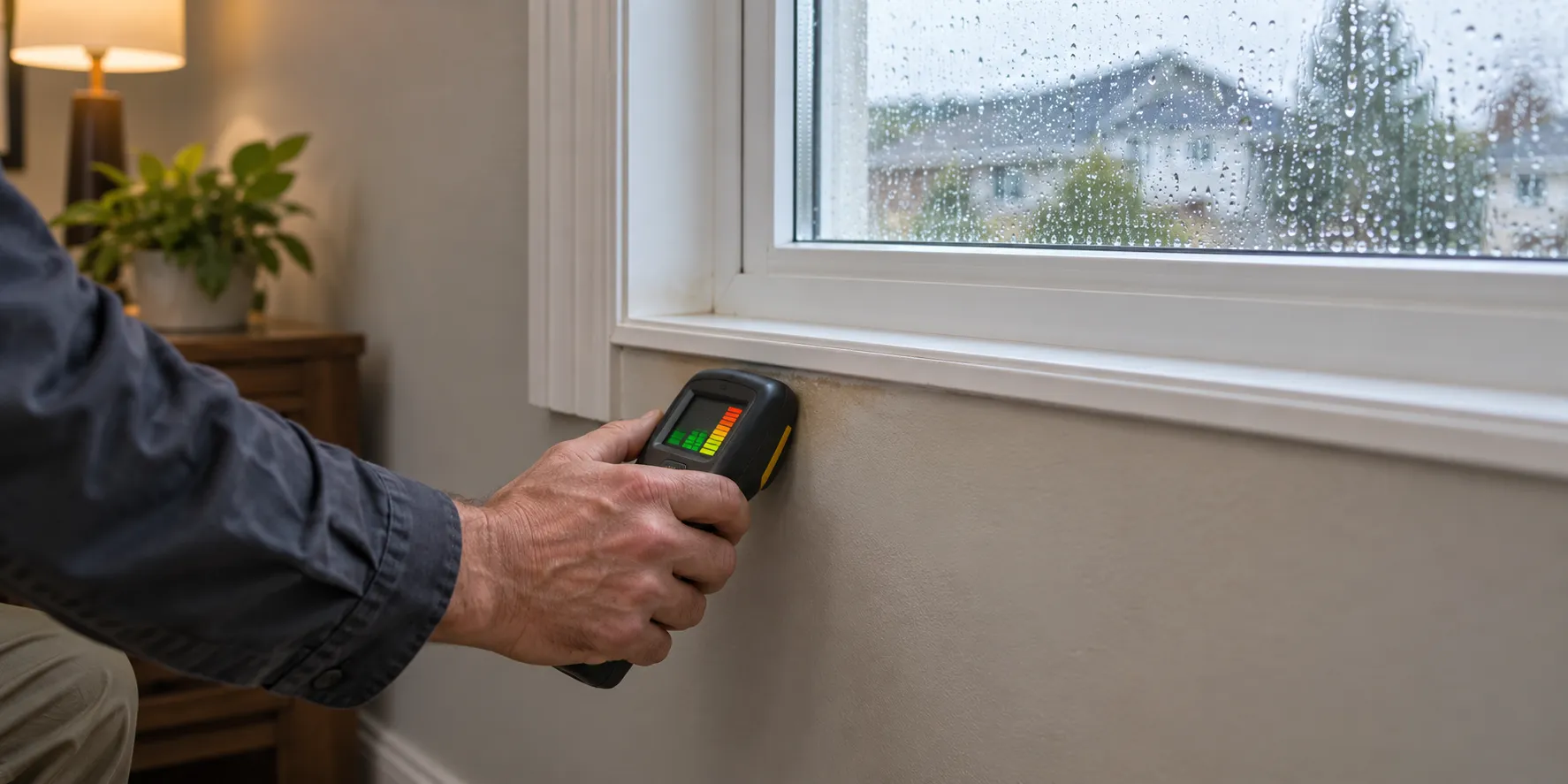
Mold can develop behind drywall, beneath flooring, around windows, inside cabinetry, above ceilings and in other enclosed areas where moisture has been trapped.
By the time something is clearly visible on a finished surface, a hidden problem may already have been developing elsewhere.
Tina puts it simply:
“Seeing it and smelling it are the two main ways, but boy does it have to be pretty bad for you to be visually seeing it and or smelling it. Whereas the dog does not need that.”
Tina Craig
So if mold exposure symptoms are part of your concern but the house looks clean, the next thing to examine is the history of the building.
Has there been water intrusion?
One of Tina’s first questions is often whether the property has experienced water damage.
Maybe the roof leaked during a storm. Maybe a window has been letting water into the wall cavity. Maybe a bathroom leak was repaired but nobody knows whether the materials inside the wall were properly dried.
Water doesn’t always stay where you first see it.
Tina described one family where mold had already been confirmed through laboratory testing, but they still didn’t know where the full problem was. A suspected roof leak meant water may have travelled through structural areas and into wall cavities.
The challenge wasn’t proving that some mold existed.
It was finding where it was hidden.
During the mold dog inspection, the dogs alerted in multiple areas, giving the homeowners much more specific locations to investigate.
That’s the part of the story MDN can speak to with confidence.
The inspection provided information about the building. Conclusions about what caused anyone’s medical symptoms belong with medical professionals.
Is there an unexplained odor?
A persistent musty smell deserves attention even when you can’t find anything visually obvious.
It doesn’t automatically mean a major hidden mold problem is present, but it’s a reason to look deeper – particularly when combined with water damage or other moisture issues.
Has previous testing left you with more questions?
An air sample can provide useful information about what was in the sampled air at that time. It doesn’t necessarily tell you precisely where concealed growth is located.
That can leave homeowners in a frustrating position: they know there may be an issue, but they still don’t know which wall, floor or enclosed area needs attention.
If there’s a history of water damage, a persistent musty odor or another credible reason to suspect mold, don’t let normal-looking drywall convince you that there’s nothing more to investigate. Hidden mold is hidden for a reason.
Doctor or Mold Inspector? They Answer Two Different Questions
This is one of the most important distinctions in this entire conversation.
When a homeowner calls Mold Dog Network because they’re worried about symptoms, Tina makes MDN’s role clear from the beginning.
“We right up front, we let them know that that is not our area. Our area is to help them bridge the gap.”
Tina Craig
There are really two separate questions.
The medical question
What is causing my symptoms, and what medical evaluation or treatment do I need?
That belongs with a qualified healthcare professional.
Depending on your health history and symptoms, a doctor may consider allergies, asthma, respiratory conditions, infections and many other possible explanations. They may decide testing is appropriate, or they may investigate other causes entirely.
Mold Dog Network doesn’t diagnose mold illness, interpret medical tests or recommend treatment or detox protocols.
The property question
Is hidden mold present in this building, and where might it be located?
That’s the question an environmental investigation is trying to answer.
And knowing that distinction can be incredibly freeing.
You don’t need the mold dog to tell you why your head hurts.
You need the dog to help determine whether there’s mold hidden around the window, underneath the floor, behind a section of drywall or elsewhere in the property.
Then you have concrete information about the building that you can act on.
For some families, that information also becomes useful context in conversations with their healthcare provider.
Tina talks about the issue as solving for two separate things: the house and the person.
“You’ve got the house that you have to solve for. But once the house is good, now you need to get the body well.”
That doesn’t mean MDN is claiming one caused the other. It means you can’t expect a building inspector to practice medicine, and you can’t expect your doctor to tell you which wall cavity has hidden mold inside it.
You don’t have to choose between taking your health seriously and investigating your home. They’re two different parts of the same fact-finding process, and each should be handled by the right professional.
When Does It Make Sense to Inspect Your Home for Hidden Mold?
Not every headache means you need a mold inspection.
Not every bad night’s sleep means something is hiding behind the drywall.
But when mold exposure symptoms are appearing alongside real environmental warning signs, investigating the property becomes a much more reasonable next step.
That may include situations where:
- You feel noticeably worse at home and better elsewhere
- Your healthcare provider has asked about possible environmental exposures
- Your home has experienced a leak, flood or other water intrusion
- There’s a persistent musty odor with no obvious source
- Mold has been found somewhere, but you don’t know how far it extends
- Previous testing suggested a problem without locating the source
- A visual inspection didn’t explain what you’re experiencing
- You’re worried mold may be hidden behind walls, beneath floors or inside other enclosed areas
This is where Mold Dog Network’s role is deliberately narrow:
We find the mold.
Our trained mold detection dogs search accessible areas of the property for the target odor associated with mold growth. When a dog detects that odor, it gives its trained alert and the handler documents the location.
The purpose isn’t to diagnose your symptoms. It isn’t to turn the handler into your remediation contractor or medical consultant.
It’s to give you better information about the property.
“You get a digital photo report that’s given to you that day. And that’s a wonderful tool because now you have the knowledge. We can say, ‘Here’s the report. And here’s all the places the mold is.’”
Tina Craig
That can make the next stage far more focused.
Instead of opening walls throughout the house just to see what’s there, you have specific areas of concern to investigate.
Instead of telling a mitigation company, “I think there’s mold somewhere,” you can show them where the dog alerted.
Instead of spending months chasing the elusive beast, as Tina puts it, you can work from an actual map of the areas identified during the inspection.
Mold Dog Network currently describes its mold dog inspections as fast, non-invasive and focused specifically on locating hidden mold in areas such as walls, flooring, ceilings and HVAC-related spaces. Learn more about mold dog inspections for hidden mold
And Mold Dog Network works with a realistic 90–95% accuracy range for mold detection in areas canine-handler teams are able to inspect. That doesn’t mean dogs are perfect or that every inaccessible part of a structure can be evaluated. There’s always room for error. But when the problem is finding where hidden mold may be located, scent detection gives homeowners a powerful additional tool.
If you feel worse at home and there are credible reasons to suspect the environment, stop trying to diagnose the house from your symptoms alone. Find out whether hidden mold is actually there – and where it is.
Your Symptoms Matter. So Does Knowing What They Can – and Can’t – Tell You
When you haven’t felt like yourself for months, uncertainty can become exhausting.
You want an answer.
You want to know whether the house is involved.
You want somebody to tell you what to fix so you can get back to living normally.
Mold exposure symptoms can be part of the reason you start asking those questions, particularly when they occur alongside water damage, persistent odors, known mold growth or a clear pattern of feeling worse in one environment.
But symptoms aren’t proof of mold exposure, and finding mold isn’t proof that mold caused a medical condition.
That distinction protects you from wasting time on the wrong assumption while still giving your concerns the attention they deserve.
Work with the right healthcare professional to investigate what’s happening in your body.
And if your home is part of the question, investigate the home.
At the end of the day, that’s what Tina says families are really looking for:
“They want peace of mind. And so that’s what Mold Dog Network is delivering. It’s delivering peace of mind.”
You shouldn’t have to keep staring at clean-looking walls and wondering what might be behind them.
If you have reason to suspect hidden mold, a mold dog inspection can help you stop guessing and start working with real locations.