
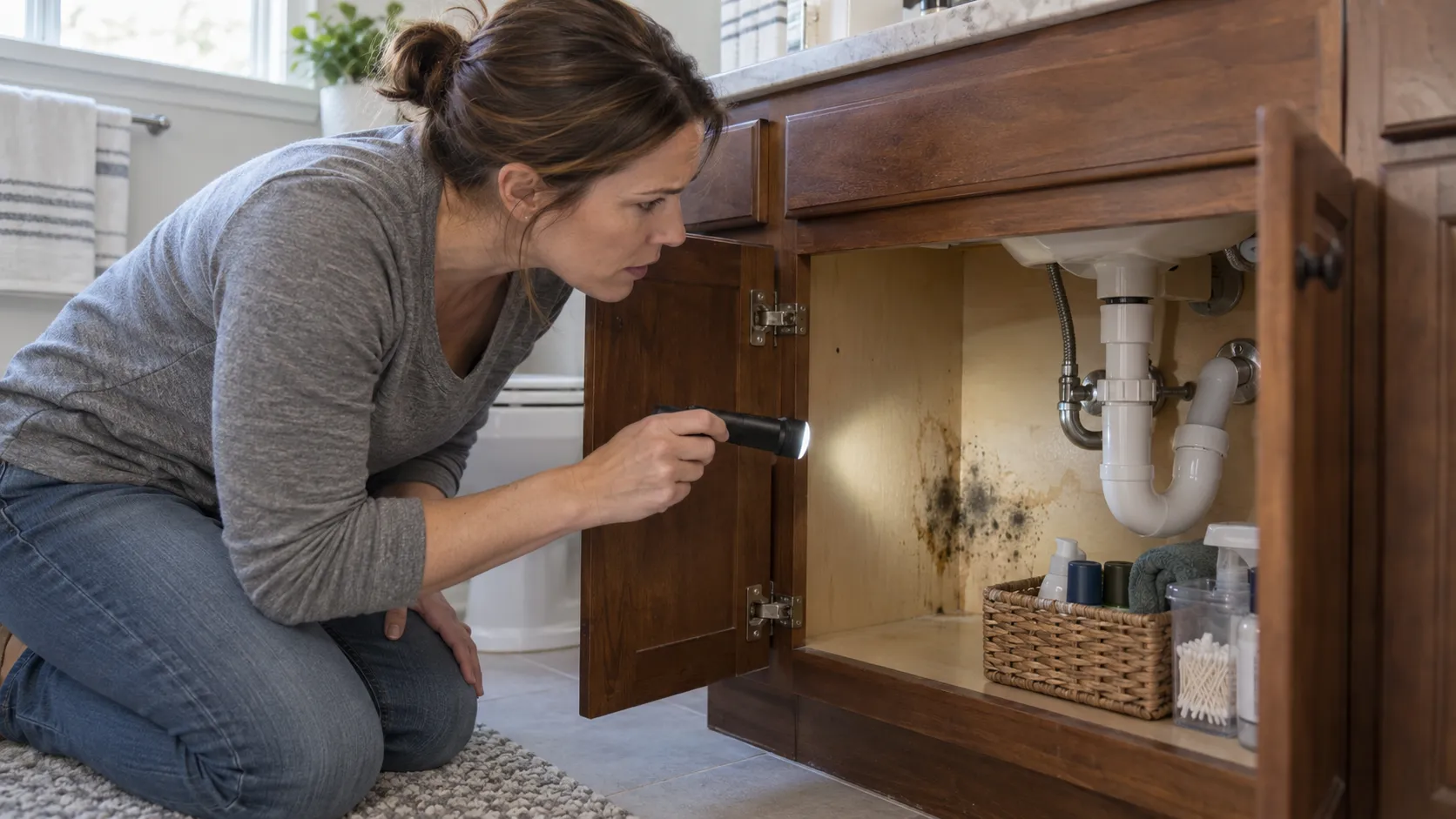
Feeling Sick at Home but Fine Elsewhere? How to Investigate Your Indoor Environment
You leave home in the morning feeling congested, exhausted or foggy.
A few hours pass and you gradually start feeling more like yourself.
Then you come home, spend the evening inside and there it is again.
After this happens a few times, it’s hard not to wonder:
Is something in my house making me feel sick?
The pattern is worth paying attention to. But it doesn’t automatically tell you what the cause is.
Mold is one possible indoor environmental factor. So are allergens, excessive humidity, poor ventilation, combustion pollutants, volatile organic compounds and other sources.
The EPA specifically recommends paying attention to when and where symptoms occur. If symptoms fade when you’re away from home and return after you come back, it says you should make an effort to identify possible indoor sources.
At Mold Dog Network, Tina Craig speaks with families who have often spent a long time trying to work out exactly what’s happening.
“We get the calls from families who’ve really been through the ringer.”
Tina Craig
If you’re trying to understand the broader health picture first, read our guide to mold exposure symptoms and when your home could be part of the problem.
- Feeling Better Away From Home Is a Clue – Not a Diagnosis
- Start by Tracking What Actually Changes
- When Does Hidden Mold Become More Worth Investigating?
- Don’t Assume Every Indoor-Air Problem Is Mold
- What If You Suspect Mold but Still Can’t Find It?
- Feeling Sick at Home but Fine Elsewhere? Replace Guessing With Better Information
Feeling Better Away From Home Is a Clue – Not a Diagnosis
There’s a reason the where of your symptoms can matter.
If you consistently experience a problem inside one environment and it eases after you leave, that gives you information about a possible exposure pattern.
It still doesn’t tell you what that exposure is.
Mold and dampness are one possibility. But indoor air can also be affected by dust, pets, cleaning products, building materials, smoke, carbon monoxide, radon, outdoor pollution entering the property, poor ventilation, temperature and humidity. EPA identifies many of these as factors that can influence indoor air quality.
And symptoms caused by different exposures can look surprisingly similar.
Congestion can resemble seasonal allergies.
Headaches can have countless causes.
Fatigue might have nothing to do with the house.
That’s why feeling sick at home but fine elsewhere shouldn’t become an automatic mold diagnosis.
Tina’s experience has made her much more conscious of the environment people spend their lives in:
“The indoor living environment, we are not paying attention to that or we don’t know any better.”
Tina Craig
That’s an observation from working with families who suspect environmental problems, not a claim that every unexplained symptom begins at home.
The better approach is to stay curious.
What changes when you leave the house? What changes when you return? And what evidence is there that something in the building needs attention?
If you repeatedly feel better away from home, don’t jump straight to a mold diagnosis. Use the pattern as a reason to investigate your environment more carefully.
Start by Tracking What Actually Changes
It’s easy to tell your doctor, “My house makes me feel sick.”
It’s much more useful to arrive with specifics.
For a week or two, consider noting four things.
Where were you?
Was it the entire house, or do symptoms seem particularly noticeable in the bedroom, basement or home office?
When did you notice a change?
Immediately after entering? After several hours? Overnight? After the HVAC starts running? Following heavy rain?
What were you experiencing?
Congestion? Coughing? Headaches? Fatigue? Irritated eyes? Something else?
What happens when you leave?
Do symptoms disappear completely, improve slightly or stay exactly the same?
You’re not creating your own diagnostic test.
You’re looking for a pattern that can help both your healthcare provider and whoever investigates the property.
And because we spend so much of our lives inside, indoor patterns are worth taking seriously. The EPA estimates that people spend roughly 90% of their time indoors.
Tina has questioned whether the home environment gets enough attention when people are discussing ongoing health concerns:
“Medicine is not accustomed to asking people about their homes or the place that the body goes to to regenerate every night.”
Tina Craig
That’s Tina’s experience rather than a statement about every doctor. But you can help make the environment part of the conversation by bringing useful information with you.
Our guide to how doctors investigate whether mold could be affecting your health explains what that medical conversation may involve.
Track the pattern before trying to explain it. Knowing when and where symptoms change can be much more useful than simply saying, “I think it’s mold.”
When Does Hidden Mold Become More Worth Investigating?
Symptoms alone don’t make a strong mold case.
Symptoms plus evidence of a moisture problem are different.
When people contact Mold Dog Network convinced there’s something wrong with the property, Tina says they often have a reason.
“People typically know that they have an issue because they have had a water intrusion that they know they did not do it right… Or they have an odor.”
Tina Craig
Those are tangible building clues.
There’s been water damage
A roof leak, plumbing failure, flooded basement, overflowing appliance or leaking window can introduce water into places you can’t easily inspect.
NIOSH notes that moisture sources may be obvious, such as a broken pipe or leaking roof, or concealed, such as wet insulation above a ceiling.
There’s a musty smell you can’t locate
CDC notes that mold can have a musty odor, and mold can grow on drywall, insulation, carpet, wood and other materials where sufficient moisture is present.
You can smell something, but you can’t find it is a much stronger reason to investigate hidden growth than a headache on its own.
You know mold exists, but you don’t know how far it goes
Perhaps you found growth around a window after a leak.
The question then becomes whether you’re seeing the entire problem or only the visible portion.
The same room repeatedly seems to be involved
Again, that doesn’t prove mold is causing your symptoms.
But if a room smells musty, suffered previous water damage and happens to be where you repeatedly notice a change in how you feel, there’s a concrete property question worth answering.
Tina described one family where laboratory testing had already confirmed mold, but they still couldn’t find its full extent after a suspected roof leak. The difficulty was working out which concealed wall areas had been affected.
If headaches, fatigue or concentration problems are part of your experience, read our article on brain fog, fatigue and headaches with possible mold exposure.
Symptoms may start the question. Water damage, dampness, musty odors and other building evidence are what make hidden mold a much more concrete property issue.
Don’t Assume Every Indoor-Air Problem Is Mold
Sometimes the house really is part of the problem.
And the problem still isn’t mold.
That’s why going into an investigation determined to prove a mold theory can send you in the wrong direction.
Indoor air quality is affected by multiple sources. EPA lists carbon monoxide, smoke, radon, mold, particulate matter and volatile organic compounds among common indoor pollutants.
Basic environmental checks matter too.
Make sure your home has functioning smoke and carbon monoxide alarms. Pay attention to fuel-burning appliances, unusual odors, ventilation, humidity and strong chemical sources.
If several members of a household suddenly develop headache, dizziness, weakness, confusion or other acute symptoms, don’t assume hidden mold and wait for an inspection. Carbon monoxide and other hazards can be urgent, and sudden or severe symptoms need appropriate medical attention.
Mold Dog Network deliberately doesn’t try to diagnose the person.
Tina puts that boundary plainly:
“We right up front, we let them know that that is not our area. Our area is to help them bridge the gap.”
Tina Craig
That restraint matters.
You want the right answer – not simply the answer you expected before the investigation started.
For context on symptom lists, read the 10 warning signs people commonly associate with mold toxicity.
Investigate your environment with an open mind. The objective isn’t to prove mold. It’s to work out what’s actually happening.
What If You Suspect Mold but Still Can’t Find It?
This is where homeowners often get stuck.
You know the roof leaked.
The room has a musty smell.
You notice a consistent pattern when you spend time there.
But the walls look completely normal.
Tina says visual evidence can appear much later than people expect:
“Visually and smelling it are the two main ways, but boy does it have to be pretty bad for you to be visually seeing it and or smelling it. Whereas the dog does not need that.”
Tina Craig
That’s exactly the problem mold detection dogs are designed to help with.
A trained mold dog searches accessible areas of the property for its trained target odor. When the dog detects it, the dog alerts its handler, who documents the location.
The purpose isn’t to diagnose why you’re feeling unwell.
It’s to answer a much more practical building question:
Where are the areas of concern?
Mold Dog Network’s existing service process is focused on locating hidden mold and documenting those alerts so homeowners have more specific information about where further investigation may be needed.
That can move you from:
“Something feels wrong and I think there might be mold somewhere.”
to:
“These are the specific locations the dog alerted to, so these are the places we need to investigate next.”
Tina explains the value of getting those locations:
“You get a digital photo report that’s given to you that day. And that’s a wonderful tool because now you have the knowledge. Here it is. And here’s all the places it is.”
Tina Craig
This approach also fits NIOSH’s emphasis on identifying and correcting dampness and moisture sources rather than relying solely on indoor air sampling.
Learn more about a mold dog inspection to locate hidden mold.
If you have credible evidence of a moisture problem but can’t locate the suspected mold, stop using symptoms to guess which wall is involved. Find the areas of concern first.
Feeling Sick at Home but Fine Elsewhere? Replace Guessing With Better Information
If you consistently feel worse at home and better after you leave, the pattern is worth paying attention to.
It still doesn’t prove mold is responsible.
Get persistent or concerning symptoms properly evaluated.
Notice when and where they occur.
Consider other possible indoor environmental sources.
Then look at the building itself.
Has there been a leak?
Is the house persistently damp?
Can you smell something musty?
Was mold found previously without determining its full extent?
If the answer to those questions starts pointing toward hidden mold, investigate it directly rather than trying to diagnose the property from your symptoms.
That’s ultimately what Mold Dog Network is there to help families do.
Tina describes the outcome people are really looking for:
“They want peace of mind. And so that’s what Mold Dog Network is delivering. It’s delivering peace of mind.”
The goal isn’t to prove that your house is making you sick.
It’s to replace uncertainty with better information about the environment you’re living in.
If hidden mold remains one of the unanswered questions, schedule a mold dog inspection and find out where the areas of concern may be.