
Mold in Air Ducts and HVAC Systems: What Homeowners Should Know
There’s a musty smell near a vent, and you’re wondering what’s circulating through your home. Is the problem in the ductwork, around the equipment, or somewhere else?
Mold in air ducts is one possibility, but an odor alone doesn’t identify the source. That uncertainty can make choosing an inspection or cleanup service frustrating.
Tina, co-owner of Mold Dog Network, has encountered concealed moisture around HVAC systems in homes old and new. Her examples show why finding the affected area matters before choosing the work. For the broader picture, read our guide to where mold hides in homes and other spaces.
- Where Can Mold Develop In and Around an HVAC System?
- Does a Musty Vent Mean There’s Mold in the Air Ducts?
- Tina’s New-Home Case: Hidden Water in Sagging Ductwork
- How Can a Mold Dog Help Investigate HVAC Concerns?
- Is Duct Cleaning Enough, and What Should Happen Next?
- Find the Moisture Problem Before Choosing the Fix
Where Can Mold Develop In and Around an HVAC System?
An HVAC system includes more than the vents you see in each room. Equipment, drainage components, insulation, and concealed duct runs all deserve consideration when there’s a moisture concern.
These systems are common: the U.S. Energy Information Administration reports that 67% of U.S. homes had central air conditioning in 2020. That doesn’t tell us how many contain mold. It explains why understanding moisture around HVAC equipment is relevant to so many homeowners.
| Location | What may need investigation |
| Condensate pans and drains | Standing water or drainage problems |
| Duct interiors and insulation | Materials affected by moisture |
| Exterior duct surfaces | Condensation and nearby damp materials |
| Equipment platforms, walls, and flooring | Building materials affected by leaks or repeated wetting |
Tina describes alerts around HVAC equipment supported on moisture-affected wood or drywall assemblies.
“If they’re placed on a wooden platform, those platforms will pop hot.”
Tina Craig
“Pop hot” is her informal description of a canine alert. The relevant question is whether those supporting materials have become damp or affected, and what allowed that to happen.
Finding an affected platform doesn’t automatically establish mold in air ducts. The inspection needs to distinguish the equipment from the materials around it.
Ask the person assessing the system to show you the affected location and explain what material is involved. A damp support, wet insulation, and growth inside a metal duct call for different assessments, even when they’re close together in the same equipment area.
Unsure whether the concern is inside the system or around it? Tell Mold Dog Network about the odor and moisture history.
Does a Musty Vent Mean There’s Mold in the Air Ducts?
Not necessarily. An odor at a vent tells you where you noticed it, without establishing where it began. Air movement and concealed spaces can complicate tracing the source.
Tina’s observations repeatedly come back to moisture in places homeowners can’t easily examine.
“That moisture loves to hide.”
Tina Craig
When investigating possible mold in air ducts, useful information includes:
- Which rooms or equipment areas have had a recurring odor.
- When you first noticed it and whether anything changed beforehand.
- Previous leaks, drainage problems, or wet materials.
- What service visits or inspections have already established.
You don’t need to run the system to recreate the smell. The EPA advises against running an HVAC system known or suspected to be contaminated with mold. Arrange appropriate professional evaluation if you suspect contamination.
Dark marks or dust around a register aren’t enough to identify mold, its species, or its extent. Ask a professional to explain what they found and what supports their conclusion.
Likewise, dampness beneath an equipment base may involve nearby flooring. It’s worth understanding the possibility of mold under carpet or flooring instead of assuming the entire concern sits inside the ventilation system.
Can’t trace a recurring vent odor? Contact our team to discuss an inspection and what’s already been checked.
Tina’s New-Home Case: Hidden Water in Sagging Ductwork
Buying a new home doesn’t eliminate the possibility of concealed moisture problems. Tina recalls a client whose home had an issue in a difficult-to-access attic area.
According to her account, ductwork had been routed around other construction work. A section was left with a sag, which she described as a “belly.” Water collected there.
“And so they ran the ductwork in kind of a funny fashion and they left a belly in it, and it created a pool of water.”
Tina Craig
The occupants knew something was wrong, but they struggled to locate the source. The affected section was tucked away where it wasn’t readily visible.
That’s an important lesson when investigating suspected mold in air ducts: the condition of the visible rooms doesn’t establish the condition of every concealed component.
Tina’s account doesn’t explain how the water originally entered that section. What it does illustrate is the value of investigating beyond an accessible vent or a general impression that a new property should be problem-free.
It’s frustrating to have concerns in a home you expected to need very little work. A useful investigation looks at the specific moisture history and installation conditions.
If you’re buying, consider whether a mold inspection before closing could help address particular concerns while there’s time to arrange access and follow-up.
Concerned about overlooked moisture in a new or existing home? Ask whether a residential inspection could help direct further investigation.
How Can a Mold Dog Help Investigate HVAC Concerns?
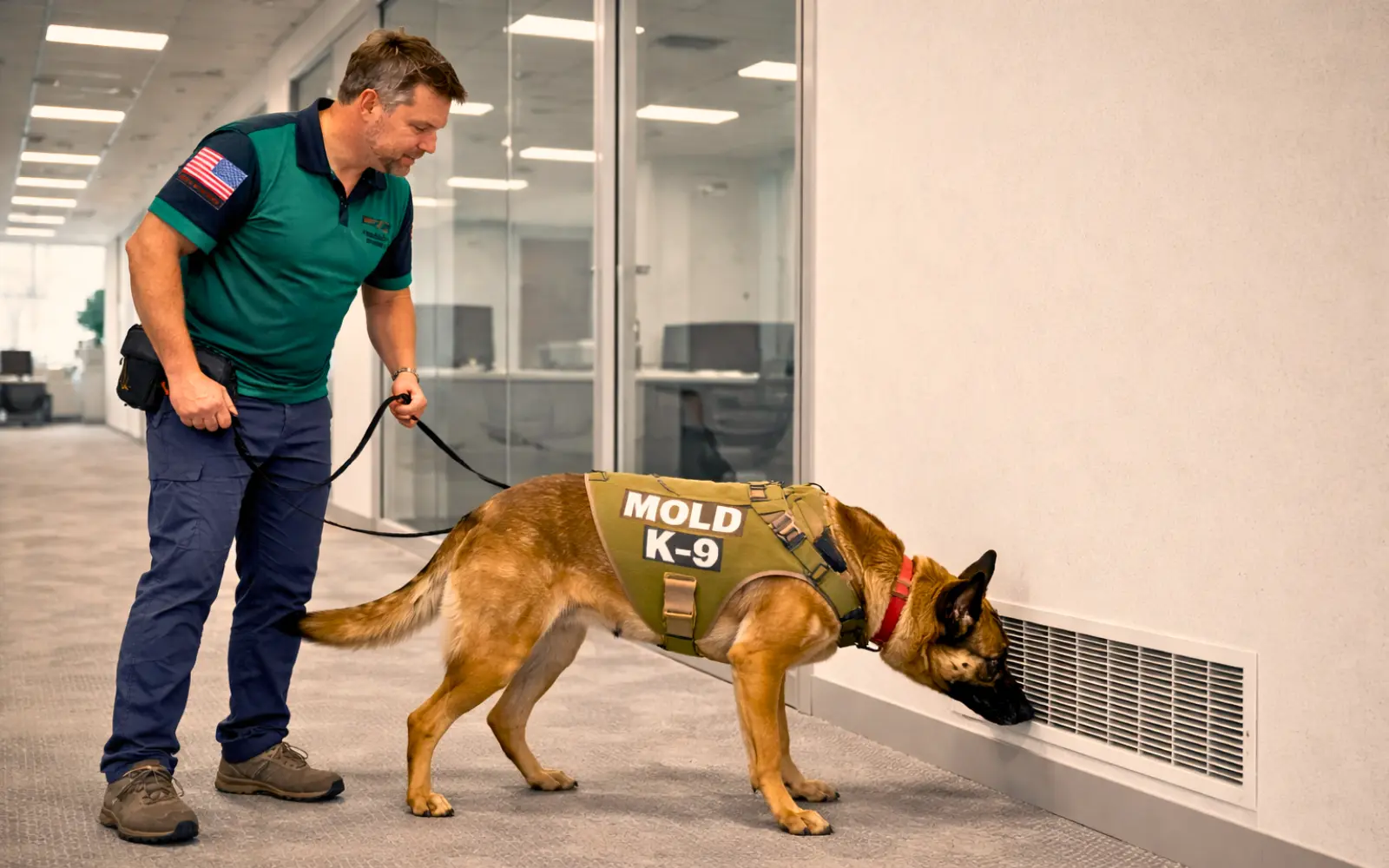
A trained dog and handler use a systematic scent search to investigate accessible areas. The team documents alert locations so you have a record of where further attention may be needed.
Tina explains that the working approach remains consistent across different settings:
“The process is the same. The handler and the dog know exactly what they’re doing.”
Tina Craig
During a residential mold dog inspection, the team may investigate around HVAC equipment and other accessible areas relevant to the concern. Safe access matters, particularly with attic equipment or concealed runs.
An alert can help narrow the investigation without starting with exploratory demolition. It doesn’t mean the dog has inspected every internal component or located every affected surface.
What an alert can and can’t establish
When investigating suspected mold in air ducts, an alert directs attention. It doesn’t identify species, define the full extent of damage, or guarantee the exact origin of an odor. Odor movement can influence the search, and dogs aren’t infallible.
Our role is to help locate suspected hidden mold. An HVAC contractor assesses mechanical conditions, while appropriate professionals plan and perform any required repairs or remediation. Further investigation may be necessary to confirm concealed conditions.
Share previous findings and service records with the inspection team. Those details help explain the question you’re trying to answer.
Want help narrowing the source before arranging work? Schedule a residential mold dog inspection to investigate areas of concern.
Is Duct Cleaning Enough, and What Should Happen Next?
The appropriate work depends on the affected materials and the source of moisture. An odor, visible mark, or canine alert doesn’t by itself determine the cleanup scope.
Match the work to the findings
The EPA recommends duct cleaning as needed rather than as a universal routine measure. Its guidance distinguishes cleanable hard surfaces from wet or moldy internal insulation that may require replacement.
If there’s mold in air ducts, cleaning alone won’t resolve an ongoing moisture source. Equally, an alert near a system doesn’t automatically justify replacing all the ductwork.
Ask what caused the moisture problem
Tina emphasizes the importance of understanding how water intrusion was handled:
“How did they and how fast did they take care of that water intrusion or that humidity level?”
Tina Craig
That question applies to past leaks as well as current drainage concerns. Before agreeing to work, ask:
- What affected materials have been identified?
- What moisture source needs correcting?
- Which components need cleaning or replacement, and why?
- How will the completed work be evaluated?
Keep the inspection findings and proposed repairs together so each professional understands what has been established. A useful plan addresses both the affected materials and the reason they became wet.
Mold Dog Network helps locate areas of concern. The appropriate repair and remediation professionals determine the work those findings require.
Ask who will handle each part of the work before approving a written proposal.
Ready to investigate before committing to a cleanup plan? Contact Mold Dog Network to discuss your inspection options.
Find the Moisture Problem Before Choosing the Fix
A musty vent doesn’t answer every question about your HVAC system. Mold in air ducts, affected equipment components, and damp surrounding materials are different possibilities that deserve careful investigation.
Tina’s examples show how easily concealed moisture can be overlooked, even in a new home. Understanding the history, locating areas of concern, and establishing what needs repair gives you a more useful starting point than choosing a cleanup service on an assumption.
Pay attention to recurring clues, share previous findings, and make sure the moisture source is addressed alongside any affected materials. That’s how the investigation becomes a practical plan for your home.