
Are Mold Sniffing Dogs Legit? What Homeowners Should Know
If someone told you a Labrador or Belgian Malinois could walk into your home and help locate mold you can’t see, you might be skeptical.
That’s fair.
Can a dog really detect mold behind a wall? How does it know what it’s looking for? And how do you know it isn’t just reacting to a musty room or something else in the house?
The short answer is yes, properly trained mold sniffing dogs are a legitimate form of scent detection. But there’s an important difference between a professional detection dog and simply bringing a pet into a property and letting it sniff around.
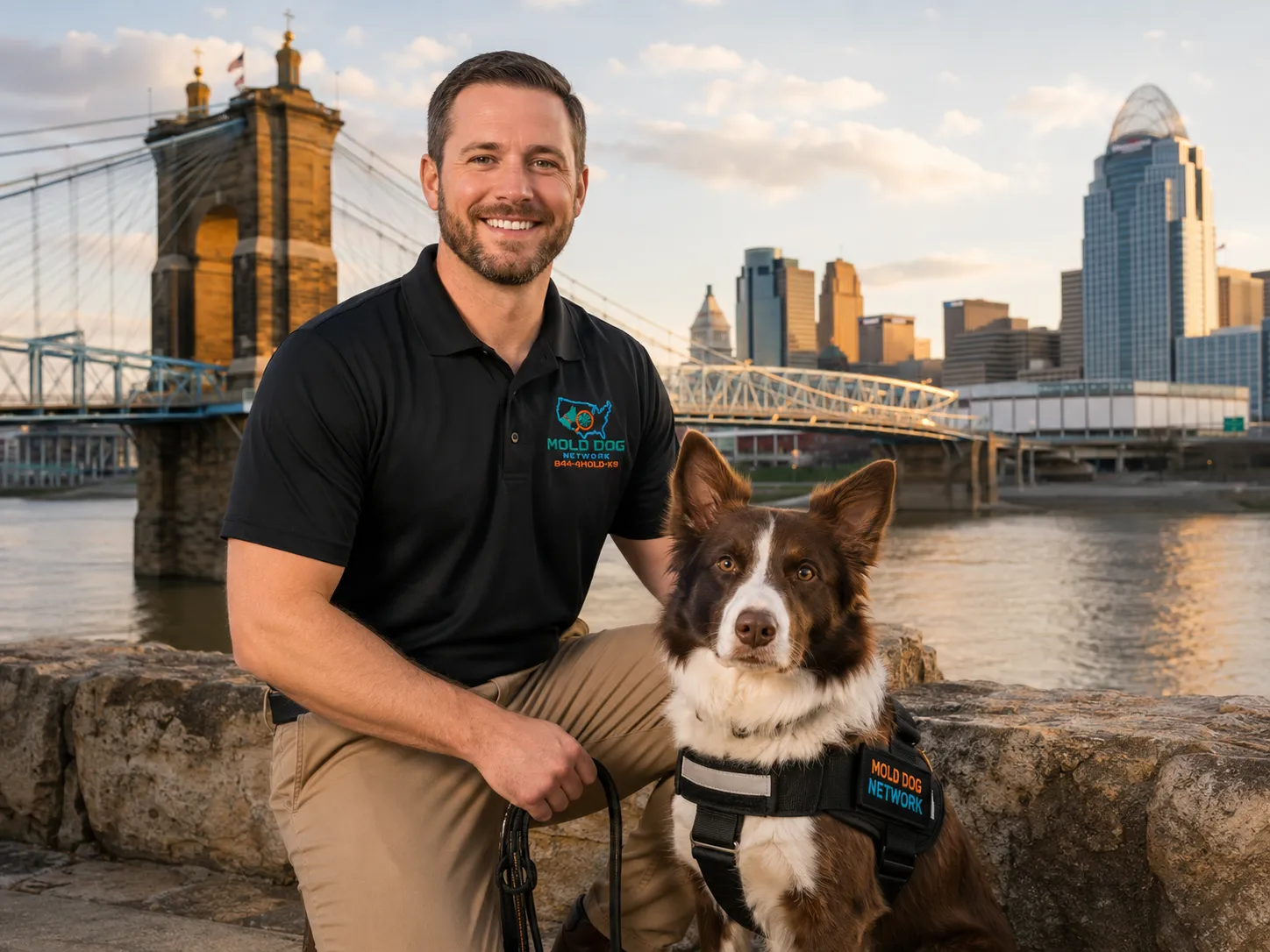
Mold Dog Network’s dogs are selected for their drive to work, trained to recognize specific mold-related target odors and paired with handlers who follow a controlled inspection process.
As MDN co-owner Caleb Jones explains, the underlying training concept isn’t completely different from other types of professional scent-detection work.
“It’s a very similar procedure to how bomb dogs, cadaver dogs, drug dogs are trained.”
Caleb Jones
So the better question isn’t simply, “Are mold sniffing dogs legit?”
It’s what separates a properly trained mold detection team from one you shouldn’t trust?
Yes, Mold Sniffing Dogs Are Legit – But They Have to Be Properly Trained
A dog’s sense of smell is naturally far more sensitive than ours, but that doesn’t mean any dog can walk into a house and start accurately identifying hidden mold.
Professional scent detection relies on teaching the dog to recognize a specific target odor, rewarding it when it finds that odor, and then maintaining those skills over time.
Caleb describes MDN’s process as starting with general obedience and an assessment of whether the dog actually has the temperament and drive for detection work.
Once a canine has shown it’s suitable, scent-specific training begins.
“It’s a very similar procedure to how bomb dogs, cadaver dogs, drug dogs are trained.”
Caleb Jones
The principle is relatively straightforward: the dog is introduced to target mold odors and learns that finding them leads to a reward. Depending on the dog and handler, that reward might be food or a toy.
Caleb says Mold Dog Network trains its dogs across odors associated with 16 mold families commonly relevant to indoor environments.
The dogs aren’t being trained to diagnose individual species. They aren’t expected to stop beside a wall and tell the homeowner, “That’s Stachybotrys.”
Instead, they’re trained to recognize the mold-related odors they’ve been imprinted on and give a consistent alert when they find them.
Research into canine olfaction helps explain why dogs are so well suited to this kind of work. Reviews of canine anatomy estimate that dogs have around 300 million olfactory receptors, compared with roughly 5 – 6 million in humans.
Source: https://pmc.ncbi.nlm.nih.gov/articles/PMC8868339/
That enormous scent-processing capability helps make professional detection work possible.
But an exceptional nose doesn’t make an inspection reliable by itself.
Training quality, ongoing practice, handler experience and the inspection protocol all matter.
If you suspect hidden mold and want more than a visual guess, schedule a Mold Dog Network inspection and let a trained canine-handler team help narrow down where the problem may be.
Not Every Dog Is a Mold Detection Dog
A powerful nose is only part of the equation.
The dog also has to want to work.
Caleb says one of the biggest things MDN looks for is hunt drive – the natural motivation to search, keep searching and earn a reward when the target is found.
“You want a dog that wants to work.”
Caleb Jones
Your family dog may have a great nose. It might detect food before you’ve opened the package or find a treat that rolled beneath the couch.
Professional scent work asks much more of the animal.
The dog needs to stay focused in unfamiliar homes, work around distractions, follow handler direction and continue searching even when the target isn’t immediately obvious.
What MDN looks for in a working mold dog
MDN considers qualities such as:
- strong search drive
- trainability and obedience
- focus in unfamiliar environments
- appropriate behavior around people
- ability to work closely with a handler
- consistency over repeated searches
- willingness to continue working for its reward
Caleb says Mold Dog Network currently works predominantly with Labrador Retrievers and Belgian Malinois because MDN has found those breeds often provide the combination of working drive and trainability the company wants.
That doesn’t mean other breeds can’t perform scent work.
It’s an MDN preference based on the characteristics they want in their own canine teams.
Even within those breeds, Caleb describes spending time with prospective dogs and evaluating their drive before committing to specialized training.
That matters because professional mold detection isn’t a trick learned once and then forgotten.
The training has to be maintained.
The dog has to keep working.
The handler has to stay consistent.
If you’re comparing mold dog companies, look beyond whether they own a trained dog. Ask how the canine was selected, how its training is maintained and who handles it during real inspections.
The Handler and Inspection Process Matter as Much as the Nose
A mold detection dog doesn’t inspect a property alone.
The handler controls the search.
That matters because a working dog is naturally motivated to find the strongest target odor it can. According to Caleb, that can mean heading toward the heaviest scent source first – potentially passing smaller areas that still need attention.
That’s why Mold Dog Network uses leashed inspections.
“We always use leashed inspections because we want the handler to be able to have control over where the canine is going to search.”
Caleb Jones
Rather than letting the dog wander wherever it wants, the handler guides it deliberately around the room.
Caleb describes a systematic search that typically starts around the accessible perimeter so wall areas can be checked in sequence. The handler can then use broader search patterns across the room to incorporate floor and ceiling areas.
If the dog alerts, that location is marked.
Then the team keeps searching.
The process isn’t: Dog enters room → dog finds one smell → inspection over.
It’s more like: handler controls the search → dog evaluates accessible areas → dog alerts → handler marks the location → search continues.
The handler’s responsibility also continues outside the client’s property.
Caleb says MDN has had particular success working with handlers who have previous military, police or other professional canine experience.
“You essentially take your work home with you. You have to take care of this canine. You have to make sure that they’re well fed and exercised and that the training is upkept too.”
Caleb Jones
Previous law-enforcement or military experience isn’t an absolute requirement, but Caleb emphasizes that the handler has to understand what it means to have a working canine partner.
Over time, handlers can also learn subtle differences in how their individual dog behaves.
Caleb gives the example of one MDN handler, Zach, noticing that his dog Mika may sometimes look upward after sitting when she appears to be encountering stronger odor higher in the search area.
That isn’t a universal technical rule.
It shows why the dog and handler need to be evaluated as a team.
If you’re looking for a serious mold inspection rather than a dog simply being allowed to sniff around, choose a canine-handler team that follows a deliberate search process and can explain how its findings are recorded.
Legit Doesn’t Mean Perfect: What Homeowners Should Expect
A professional mold detection dog can be highly effective.
It still isn’t perfect.
And a legitimate mold dog company shouldn’t need to claim 100% accuracy to make the service valuable.
Mold Dog Network states a 90 – 95% operating accuracy range for locating hidden mold in areas its canine-handler teams can properly inspect.
Caleb is equally clear about the other side of that number.
“Nothing is a hundred percent.”
Caleb Jones
Several things can affect the result.
A dog can’t properly inspect an area it can’t access.
If a large piece of furniture can’t be moved away from the wall, that section won’t receive the same search coverage as an open perimeter.
Property preparation matters too.
Caleb explains that MDN asks homeowners to remove or clean obvious sources such as old moldy sponges, shower drains and dirty window tracks.
Why?
Because those items may contain actual mold.
The dog wouldn’t necessarily be wrong to alert on them, but that’s probably not the hidden building problem the homeowner paid to find.
Caleb puts it simply:
“You need to know if mold is hidden somewhere in the house, not that you have a moldy sponge sitting on your sink.”
Caleb Jones
The dog’s alert also has limits.
MDN doesn’t train its canines to identify individual mold species through different behaviors.
“The dog’s not gonna go up and bark a certain way if it’s Stachybotrys or Penicillium. They’re just gonna tell you that the mold that they’re trained to alert on is present in the environment.”
Caleb Jones
An alert doesn’t diagnose illness either.
Some homeowners contact MDN because they feel worse at home, have unexplained symptoms or suspect something in their environment may be contributing to ongoing concerns.
MDN’s role isn’t to make a medical diagnosis.
Its role is much narrower: locate areas where the trained canine detects mold-related target odor.
And Mold Dog Network isn’t trying to turn every inspection into a remediation project.
“Mold Dog Network is exclusively around finding hidden mold within a living environment. Like that’s the company idea, that’s the company service.”
Caleb Jones
That clarity actually helps answer whether mold sniffing dogs are legit.
Credible detection work isn’t about promising that the dog knows everything.
It’s about being very good at the specific job the dog was trained to do, while being honest about the limits.
If you’ve been told there may be mold somewhere but nobody can show you where, schedule a professional mold dog inspection and get more specific locations to work from without pretending any inspection method is infallible.
So, Should You Trust a Mold Sniffing Dog?
Yes, when the dog is properly trained, paired with an experienced handler and used as part of a structured inspection process.
That’s the distinction that matters.
A professional mold detection dog isn’t a pet being asked to wander around until something seems suspicious.
It’s a working animal trained on target odors, guided through the property systematically and conditioned to give a clear alert when it finds what it’s looking for.
At the same time, a credible company should be willing to tell you what its dogs can’t do.
Mold dogs aren’t 100% accurate.
They don’t diagnose illness.
They don’t identify mold species simply by sitting beside a wall.
And they can’t properly search places they can’t access.
What they can do is help answer the question that often matters most when hidden mold is suspected:
Where should we be looking?
If there’s a musty smell you can’t trace, old water damage that was never fully investigated, or previous testing has left you with more questions than answers, locating the source can be the difference between continuing to guess and finally having somewhere specific to focus.
When comparing providers, look for:
- a purpose-selected working dog
- proper target-odor training
- ongoing skill maintenance
- an experienced handler
- a controlled search process
- a clear trained alert
- realistic accuracy claims
- documented findings after the inspection
The dog may be the most memorable part of the service.
But the quality of the entire canine-handler team is what you’re really paying for.
If you’re ready to stop wondering where hidden mold may be, schedule a mold dog inspection with Mold Dog Network and get specific, documented locations you can use to decide what happens next.