
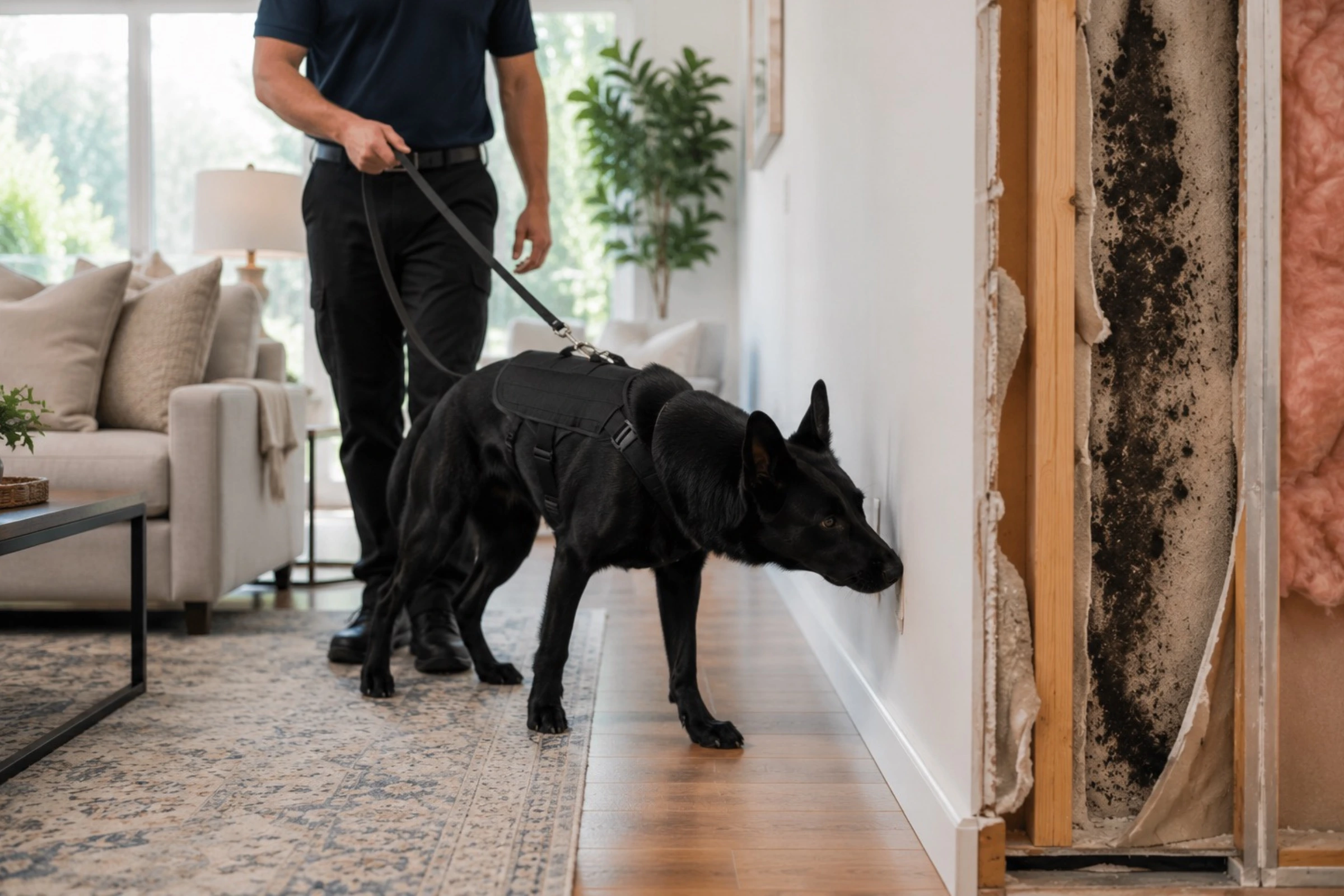
How Accurate Are Mold Detection Dogs?
If you’re considering a mold dog inspection, there’s probably one question sitting above all the others:
How accurate are mold detection dogs, really?
Mold Dog Network works with a 90–95% accuracy range for locating hidden mold in areas its canine-handler teams are able to properly inspect.
But that number needs some context.
It doesn’t mean a dog is guaranteed to find every patch of mold behind every wall, beneath every floor or inside every inaccessible part of a property. And it doesn’t mean that every mold detection dog, regardless of training or handler experience, performs at the same level.
Caleb Jones, co-owner of Mold Dog Network, is very clear about that.
“We list a ninety to ninety-five percent accuracy on finding mold in hidden areas that the canine is passing through. Like you said, nothing is a hundred percent.”
Caleb Jones
That last sentence matters.
If you’ve already spent money on testing, had someone walk through the property, or been told there “might” be mold somewhere without getting a clear location, you probably don’t want another vague promise.
You want to know how dependable the next inspection is likely to be and what could cause it to miss something.
With mold detection dogs, accuracy isn’t just about the dog’s nose. It also depends on training, handler experience, search coverage, access to the areas being inspected and how well the property is prepared before the team arrives.
So rather than treating 90–95% like a magic number, let’s look at what it actually means in a real home.
How Accurate Are Mold Detection Dogs in a Real Home?
For Mold Dog Network, the working answer is 90–95% accuracy for locating hidden mold in areas the canine-handler team is able to properly search.
The wording matters.
MDN isn’t claiming that every mold detection dog in every company performs at 90–95%. It’s also not claiming that a dog can somehow inspect an area it can’t physically reach.
The figure describes MDN’s stated operating range for its own canine inspection process.
Caleb describes mold dogs as particularly effective for location work because they’re searching for scent rather than relying only on what’s visible.
“It’s the highest accuracy rating that you’re gonna get for finding, you know, mold.”
Caleb Jones
That’s Caleb’s assessment based on MDN’s experience, rather than an independent scientific ranking of every mold inspection method.
There is broader scientific evidence showing that professionally trained dogs can perform scent-detection tasks at high levels when the target and protocol are clearly defined.
For example, a triple-blinded study of dogs trained to detect SARS-CoV-2 reported 92% overall accuracy, with 92% sensitivity and 91% specificity.
Source: https://pubmed.ncbi.nlm.nih.gov/35577391/
That study wasn’t about mold, so it doesn’t prove MDN’s 90–95% mold-detection figure.
What it does demonstrate is that high canine scent-detection performance is possible when a dog is appropriately trained for a defined target odor and works under a structured protocol.
That’s also why understanding how mold detection dogs find hidden mold is more useful than looking at the percentage by itself.
The dog has to be trained properly.
The handler has to give it good search coverage.
The relevant surfaces need to be accessible.
And the dog has to give a clear alert when its target odor is encountered.
If your biggest problem is knowing where hidden mold may be located, talk with Mold Dog Network about whether a canine inspection makes sense for your property rather than focusing on the percentage alone.
What Makes Up the Other 5–10%?
If MDN works with a 90–95% accuracy range, it’s just as important to talk about the remaining 5–10%.
Caleb doesn’t try to hide that uncertainty.
“Nothing is a hundred percent.”
Caleb Jones
A mold dog can be highly trained and still be working inside a real building with furniture, inaccessible areas and environmental variables.
Those conditions matter.
The dog can’t inspect an area it can’t reach
One of the clearest limitations is access.
Caleb specifically mentions situations where furniture couldn’t be moved away from the wall or where the canine-handler team couldn’t properly reach a search area.
Imagine a large built-in covering most of a wall.
The dog isn’t somehow able to ignore that barrier and search the concealed area with exactly the same coverage it would get along an open perimeter.
That’s one reason MDN asks homeowners to move furniture roughly two to three feet away from walls where practical.
The more access the team has, the more complete the search can be.
A correct alert can still point to something unhelpful
There’s another complication that can happen even when the dog’s nose is doing exactly what it was trained to do.
Caleb gives examples such as moldy sponges, shower drains and dirty window tracks.
If those places contain actual mold, the dog may correctly alert.
But that may not be the hidden structural problem you’re paying MDN to locate.
“You need to know if mold is hidden somewhere in the house, not that you have a moldy sponge sitting on your sink.”
Caleb Jones
That’s why preparation instructions matter.
Removing obvious nuisance mold sources helps the inspection focus on the areas you’re actually concerned about.
Odor isn’t a painted X on the wall
A mold dog follows scent.
It doesn’t see the precise borders of a hidden colony.
So an alert should be treated as a location signal, not a detailed map showing exactly how far mold extends behind a surface.
The dog is saying, in effect:
“I’m detecting my target odor in this area.”
That’s much more useful than “somewhere in the room,” but it still has limits.
Dogs and handlers are living participants
Neither member of the team is a machine.
Training has to be maintained. The dog needs to remain focused. The handler has to search the property consistently.
This is why what happens during a mold dog inspection has such a direct effect on reliability.
The accuracy percentage matters, but the process behind it matters more.
To get the strongest possible result from a mold dog inspection, follow the preparation instructions and give the canine-handler team access to as much of the search area as you reasonably can.
Why the Handler Can Affect Mold Dog Accuracy
When people hear about mold detection dogs, attention naturally goes to the dog’s nose.
But the handler has a major influence on how thoroughly that nose gets used.
Caleb explains that Mold Dog Network doesn’t simply release a dog into the middle of a room and wait for it to find the strongest scent.
A working dog wants to locate its target and earn its reward.
That means it may naturally head toward the strongest available odor first.
“We always use leashed inspections because we feel that we want the handler to be able to have control over where the canine is going to search so we can make sure that all of the surface areas and stuff that need to be searched are going to be searched.”
Caleb Jones
That controlled route is important.
Caleb says a dog could otherwise move diagonally across a room toward a strong source and potentially pass smaller problem areas along the way.
MDN therefore uses a systematic search.
The handler works around accessible wall areas, incorporates other surfaces into the search and continues after alerts rather than treating the first find as the end of the inspection.
“They could pass over two or three different areas that are having smaller issues but still need to be addressed.”
Caleb Jones
In practical terms, the dog’s nose may be capable of detecting an odor, but it still has to be brought close enough to the relevant area to evaluate it.
That’s particularly important when you’re considering how mold dogs find mold behind walls.
A dog doesn’t magically scan an entire building from one spot.
The handler gives it search coverage.
The dog does the scent work.
The handler also has to understand the individual canine.
Caleb describes how experienced teams begin to notice subtle behaviors after working together repeatedly. One MDN handler, Zach, noticed that his dog Mika may sometimes look upward after sitting when she appears to be encountering stronger odor higher in the search area.
That isn’t a universal rule for every dog.
It’s an example of why the canine and handler need to function as a team.
And that partnership continues between inspections.
Caleb stresses that handlers are responsible for maintaining training, exercise and care because scent-detection skills can’t simply be learned once and then ignored.
So when comparing mold dog providers, don’t ask only:
“What’s your accuracy percentage?”
Also ask:
How is the dog handled? How is each room searched? How is training maintained? And what happens when part of the property can’t be accessed?
Those answers tell you far more about the inspection you’re actually buying.
When comparing mold detection companies, look for a trained canine-handler team with a deliberate search process, not just an impressive percentage on a website.
What Does an Accurate Mold Dog Alert Actually Tell You?
A mold dog alert is valuable because it gives the handler a specific area to document and investigate further.
But it’s important not to turn that alert into more than it is.
Caleb says MDN generally trains its dogs to sit or lie down when they detect their target odor.
“Whenever the canine sits down, that’s a very strong visual tell to tell the handler to stop.”
Caleb Jones
A clear behavior is much easier to recognize than a subtle head movement or brief stare while the dog and handler are moving.
What an alert means
When an MDN canine gives its trained alert, the practical meaning is:
The dog has detected the mold-related target odor it was trained to recognize in that search area.
That can turn:
“Could there be mold somewhere behind this wall?”
into:
“The dog alerted at this particular section of the wall.”
For someone who’s been dealing with uncertainty for weeks or months, that difference matters.
What an alert doesn’t mean
An alert doesn’t automatically tell you:
- the mold species
- the exact size of concealed growth
- exactly how far it extends behind a surface
- whether an entire wall needs to be removed
- what remediation should cost
- whether mold is causing a health problem
Caleb specifically explains that MDN’s dogs aren’t trained to give a different signal for each mold species.
“The dog’s not gonna go up and like bark a certain way if it’s Stachybotrys or Penicillium. They’re just gonna tell you that the mold that they’re trained to alert on is present in the environment.”
Caleb Jones
That’s why mold detection dog accuracy needs to be judged against the job the dog is actually doing.
MDN primarily uses the canine as a location tool.
Afterward, handlers mark, photograph and document the alert locations so the homeowner has something concrete to work with.
If you want to understand what happens from that point, read what happens after a mold dog alerts.
If what you need is a more specific location to investigate, a trained mold dog alert can give you actionable information without pretending one alert answers every mold question.
Accuracy Matters, but So Does Knowing What the Number Means
So, how accurate are mold detection dogs?
For Mold Dog Network, the stated operating range is 90–95% for locating hidden mold in areas the canine-handler team can properly access and inspect.
But the percentage only makes sense when you understand what sits behind it.
Accuracy depends on:
- appropriate scent training
- ongoing skill maintenance
- an experienced handler
- systematic search coverage
- good physical access
- proper property preparation
- realistic interpretation of an alert
And Caleb’s most important point is still the simplest:
“Nothing is a hundred percent.”
Caleb Jones
That’s not an admission that the service doesn’t work.
It’s an acknowledgment that mold detection happens in real homes with furniture, inaccessible spaces, environmental variables and living canine-handler teams.
What mold dogs can offer is a highly focused way to narrow down where hidden mold may be located.
And if you’ve already been told there may be mold somewhere but nobody can tell you where, that’s often the information you’re missing.
A mold dog inspection isn’t supposed to eliminate every possible uncertainty.
It’s designed to reduce a big one:
Where should we be looking?
If you’re ready to stop guessing where hidden mold may be, schedule a mold dog inspection with Mold Dog Network and get clearer, documented locations to work from.