
What Happens After a Mold Dog Alerts?
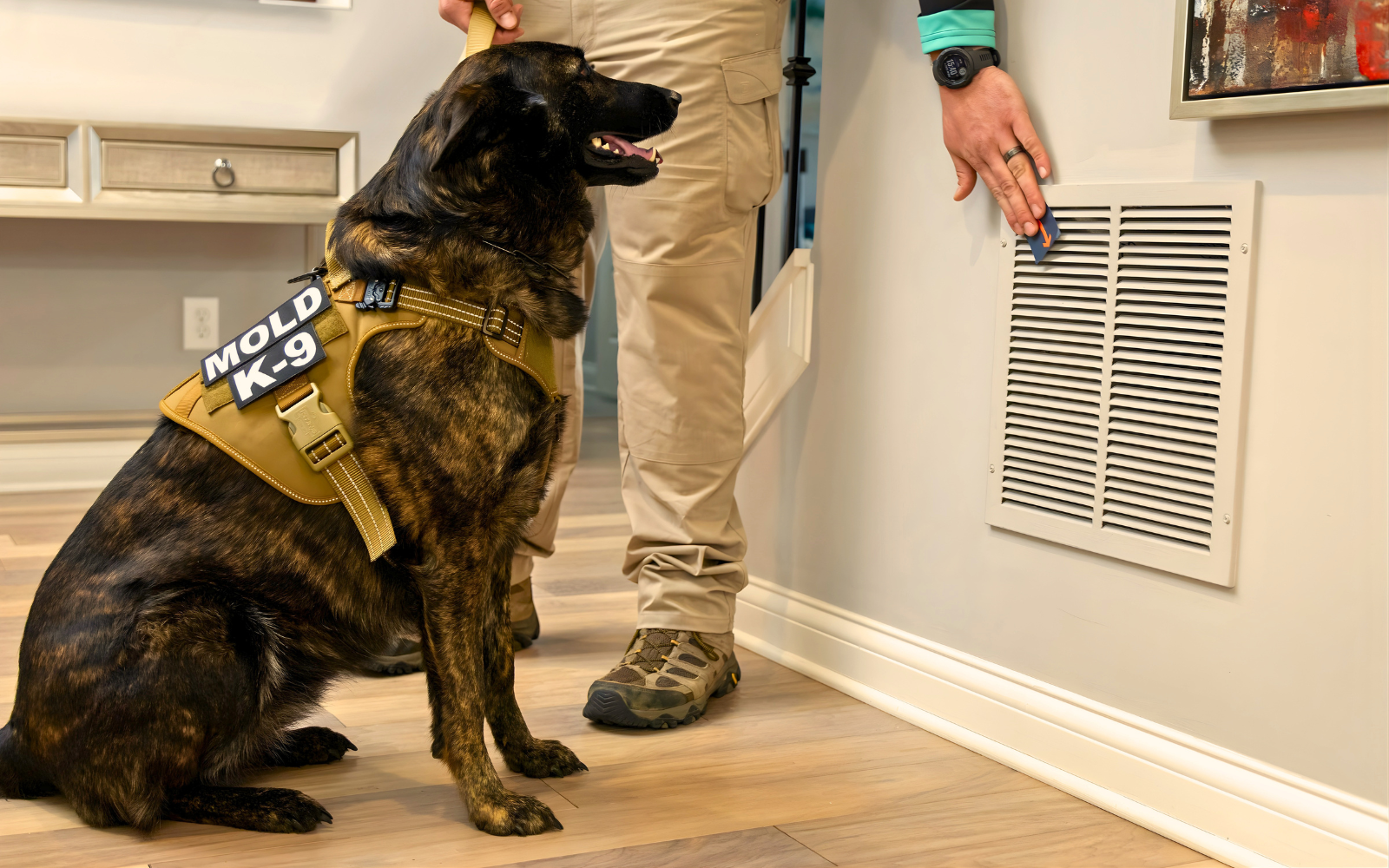
The mold dog stops beside a wall and sits.
For a homeowner who’s spent weeks or months trying to work out where the mold could possibly be, that moment can feel like the answer they’ve been waiting for.
But what happens next?
Does the wall need to come out immediately? Does the alert tell you which mold is there? Should the handler explain how to remediate it? Do you need lab testing before anything else happens?
A mold dog alert gives you something valuable, but it’s important to understand exactly what that something is.
It gives you a location.
Mold Dog Network’s dogs are trained to give a clear alert when they detect their mold-related target odor. The handler marks that area, continues searching the property and later photographs the alerts for the homeowner’s digital report.
From there, the report can help you decide what kind of professional needs to be involved next.
The important thing is not to jump from:
“The dog alerted here.”
straight to:
“We need to tear all of this out.”
Here’s what should actually happen after a mold dog alerts.
- First, the Handler Marks the Alert, Then Keeps Searching
- The Alert Location Is Photographed and Added to Your Report
- Don’t Assume a Mold Dog Alert Means You Should Immediately Open the Wall
- Should You Get Additional Mold Testing After an Alert?
- The Canine Handler Isn’t Your Remediation Contractor
- Your Report Can Help a Remediation Company Focus on the Right Areas
- Mold Dog Network’s Job Is to Find the Mold
- What Happens After a Mold Dog Alerts? You Finally Have Somewhere Specific to Start
First, the Handler Marks the Alert, Then Keeps Searching
Mold Dog Network generally trains its canines to give an obvious sit or down alert when they detect their target odor.
Caleb prefers that kind of clear behavior because it’s much harder for the handler to miss while the team is moving through the property.
“Whenever the canine sits down, that’s a very strong visual tell to tell the handler to stop.”
Caleb Jones
Once the dog alerts, the handler can mark that location.
But the inspection doesn’t necessarily stop there.
That matters because a house may contain more than one hidden mold source.
Caleb explains that a detection dog may naturally be drawn toward the strongest target scent because finding it earns the dog its reward. If the canine were simply allowed to follow that strongest odor and finish, it could potentially pass other areas that still deserve attention.
“They could pass over two or three different areas that are having smaller issues but still need to be addressed.”
Caleb Jones
So the process is:
alert → mark the location → keep searching
rather than:
alert → assume the whole inspection is finished
This is why what happens during a mold dog inspection matters so much. MDN uses a systematic search process specifically because one strong source doesn’t automatically explain every possible issue in the property.
For a homeowner, that’s important.
Maybe the dog alerts near an old window leak in one room and later alerts near the flooring in another.
Those could represent separate areas worth investigating.
If you’re worried there may be more than one hidden source, a systematic mold dog inspection is designed to keep searching after the first alert rather than assuming one finding explains the entire property.
The Alert Location Is Photographed and Added to Your Report
A temporary marker works while the handler is actively moving through the house.
It isn’t a good long-term record.
Caleb says that once a room is complete, the dog can take a short break while the handler returns to each marked alert location.
Those areas are photographed and incorporated into a digital report.
“They’ll go through and they’ll photo document all of the areas that the canine alerted on and we put it into a digital report that we give to the client.”
Caleb Jones
That means you don’t have to remember:
“Was it this side of the window, or the other side?”
You also don’t need to leave stickers attached to walls indefinitely.
The photographs create a more durable record of the canine’s findings.
This is particularly useful if another professional comes to the property later.
Instead of trying to explain that “the dog seemed interested somewhere over here,” you can refer back to the documented alert location.
That’s the core purpose of what a mold dog inspection report includes.
The report isn’t there to make the finding sound more complicated.
It’s there to preserve the location.
You shouldn’t have to rely on memory after an inspection. MDN documents the canine’s alert areas so you have specific locations to refer back to when deciding what happens next.
Don’t Assume a Mold Dog Alert Means You Should Immediately Open the Wall
This is one of the most important things to understand about what happens after a mold dog alerts.
The alert is meaningful.
But it isn’t a demolition order.
A canine alert means the trained dog detected its target odor while searching that area.
It doesn’t automatically tell you:
- exactly how large the hidden mold growth is
- where the affected material begins and ends
- which mold species is present
- whether an entire wall or floor needs to come out
- what remediation will cost
- whether mold is responsible for a particular health symptom
Caleb gives a useful example of why the interpretation matters.
MDN asks homeowners to clean window tracks, shower drains and other obvious mold sources before an inspection. Otherwise, a dog could correctly alert at a location for a reason that has nothing to do with a major hidden building problem.
“You need to know if mold is hidden somewhere in the house, not that you have a moldy sponge sitting on your sink.”
Caleb Jones
That approach helps reduce the risk of turning a correct canine detection into an expensive wrong conclusion.
An alert near a wall may tell you that area deserves further investigation.
It doesn’t tell you to immediately remove twelve feet of drywall.
An alert near flooring doesn’t automatically tell you exactly which layer underneath is affected.
And an alert around an HVAC area doesn’t by itself prove every duct in the system is contaminated.
The dog’s specialty is location.
If you want to understand the limits around that location work more closely, read how accurate mold detection dogs are.
Treat a canine alert as a focused place to investigate next, not permission to start tearing into your home without an appropriate plan.
Should You Get Additional Mold Testing After an Alert?
Sometimes.
A mold dog inspection and laboratory testing answer different questions.
The canine’s primary role is to help locate mold-related target odor.
If you then need additional information—such as laboratory identification or another type of professional assessment—that can be a separate next step.
The important thing is that the canine findings may allow any follow-up work to be more targeted.
Instead of testing or investigating an entire room without knowing where to begin, you now have specific alert locations.
Mold Dog Network’s approved service philosophy reflects this distinction: mold dogs are used to locate hidden mold so homeowners can decide whether remediation, further testing or another professional assessment makes sense afterward.
That doesn’t mean everyone needs every type of testing after every canine alert.
The correct next step depends on what information you still need.
For example:
If you need location: the mold dog report may already have given you the missing information.
If you need laboratory identification: targeted sampling may be useful.
If you need a remediation scope: a qualified remediation or assessment professional may need to evaluate the documented area.
If you’re concerned about health symptoms: that conversation belongs with your healthcare provider rather than the canine handler.
And if the alert is associated with a recent or ongoing water problem, deal with the moisture source quickly. The EPA recommends drying wet or damp materials within 24–48 hours after a leak or spill because, in most cases, prompt drying can prevent mold growth.
Source: U.S. Environmental Protection Agency
If further testing is needed, use the canine’s documented alert locations to make that testing more focused rather than going back to broad guesswork.
The Canine Handler Isn’t Your Remediation Contractor
After the dog alerts, it’s natural to turn to the person standing beside you and ask:
“Okay. What do I do about this?”
But Caleb is very deliberate about the limits of the handler’s role.
“We definitely train the handlers on not giving advice to remediation because that can be a little confusing. That’s not what they’re there for.”
Caleb Jones
That doesn’t mean MDN wants to abandon homeowners once the inspection is finished.
It means the company wants the right person answering the right question.
Caleb explains that MDN’s handlers are trained as canine detection specialists.
“They are trained on handling a canine that can find mold exclusively.”
Caleb Jones
Ask the handler how the dog behaved during the inspection?
Absolutely.
Ask about the alert or how the canine worked a particular room?
That’s directly within their expertise.
Ask the handler how many feet of drywall a remediation contractor should remove?
That’s a different job.
Caleb uses essentially the same philosophy MDN has discussed since onboarding: you wouldn’t expect the person working a bomb-detection dog to also dismantle the bomb. The detection specialist has a very specific skill set.
The same principle applies here.
The handler finds and documents the target locations. An appropriately qualified professional handles the expertise required after detection.
That separation is useful for homeowners because it helps keep a canine alert from turning into an off-the-cuff remediation recommendation.
Use your handler for questions about the canine inspection itself, then take remediation, testing or repair questions to a professional trained specifically in that work.
Your Report Can Help a Remediation Company Focus on the Right Areas
Once the alerts are documented, the report becomes something you can actually take into the next conversation.
Caleb specifically explains that a remediation company can use MDN’s photographs to help identify the source areas highlighted during the canine inspection.
“If they have a remediation company come through, then they can use that to identify the source areas.”
Caleb Jones
That doesn’t mean the remediation contractor should blindly remove everything surrounding a sticker.
They still need to apply their own professional judgment.
But there’s an important difference between arriving at a property and hearing:
“We know there’s a mold problem somewhere, but nobody knows where.”
and hearing:
“Here are the locations where the mold detection dog alerted.”
That can make the next stage more focused.
Caleb says Mold Dog Network also maintains relationships with trusted remediation partners in some markets and continues looking for additional companies that fit the standard they want for clients.
“We have trusted remediation partners and stuff in multiple areas and markets and stuff that we work in.”
Caleb Jones
Availability depends on the market, so homeowners shouldn’t assume MDN will always have a specific contractor to recommend.
The bigger point is that the mold dog inspection gives you location information you can take to whoever handles the next stage.
If remediation is the next step, use your canine report to show the contractor exactly where the dog alerted so their assessment can begin with specific source areas rather than a blank slate.
Mold Dog Network’s Job Is to Find the Mold
After an alert, homeowners often want answers to everything at once.
What kind of mold is it?
How much is there?
How dangerous is it?
What needs to come out?
Who should remove it?
Those questions are understandable.
But Mold Dog Network has deliberately kept its core service narrower.
Caleb describes it this way:
“Mold Dog Network is exclusively around finding hidden mold within a living environment. Like that’s the company idea, that’s the company service.”
Caleb Jones
That focus is important.
MDN’s job is:
find the mold-related target odor → document the alert locations → give you the information
From there, the next professional can do their job.
Caleb says MDN can sometimes help clients think through next steps or connect them with trusted partners, but the company deliberately avoids turning canine handlers into remediation experts.
That’s a healthier boundary than pretending one inspection can answer every question about a mold problem.
If you’ve spent months getting broad answers and still don’t know where the actual source is, location may be the piece you’ve been missing.
Once you know where to focus, the next conversation becomes much more useful.
If you’re still stuck at “we think there’s mold somewhere,” schedule a mold dog inspection and get documented locations you can use to move forward.
What Happens After a Mold Dog Alerts? You Finally Have Somewhere Specific to Start
So, what happens after a mold dog alerts?
The handler marks the location.
The search continues so other possible sources aren’t automatically overlooked.
The alert areas are photographed.
Those findings are incorporated into a digital report.
Then you use that information to decide what comes next.
That may mean bringing in a remediation professional.
It may mean targeted testing.
It may mean investigating a moisture source.
Or it may mean asking another qualified professional to evaluate the documented area before anything is opened or removed.
What it shouldn’t mean is panicking and immediately tearing into the house because the dog sat down.
An alert gives you a location, not an entire remediation plan.
And for homeowners who’ve been living with “something’s wrong, but nobody can tell me where,” a specific location can be a major step forward.
Mold Dog Network’s role is straightforward:
find it, document it, and give you better information for whatever comes next.
Schedule a Mold Dog Inspection