
What Happens After a Mold Inspection Finds a Problem?
Finding out a mold inspection flagged a problem can feel overwhelming.
You may picture walls being torn open, rooms being sealed off, or the whole house being labeled unsafe. But a mold finding doesn’t automatically mean the entire home is a disaster.
The next step is to slow down and understand what was found, where it was found, and what kind of follow-up makes sense.
Caleb Jones, co-owner of Mold Dog Network, said this is especially important after a mold dog inspection:
“Sometimes it can be very intimidating to walk back into your house and see stickers everywhere.”
Caleb Jones
That’s why mold dog inspections are built around source location and documentation. The goal is never to create panic, instead it’s to give homeowners clearer direction on where hidden mold odor may be coming from.
Step 1: Review Exactly What Was Found
Before making decisions, review the inspection findings carefully.
Look at the report, photos, alert locations, visible concerns, and any notes from the inspection. If it was a mold dog inspection, the marked areas show where the dog detected mold odor. That doesn’t always mean every sticker represents a separate mold problem.
Caleb explained that nearby alerts can sometimes point to one source area.
“If there’s a sticker on both sides of one wall, then it’s just one area really that needs to be addressed.”
Caleb Jones
A homeowner may walk into a room, see multiple markers, and assume the entire space needs to be torn apart. But the report may show a more focused pattern.
The goal is to understand what the findings are pointing to. Is there one wall cavity that needs investigation? A cabinet area near old plumbing? Flooring near a known leak? A section of the home connected to past water damage?
For more on how the inspection works, see what happens during a mold dog inspection.
Review the findings carefully before deciding what needs to be opened or removed.
Step 2: Understand What a Mold Dog Alert Means
A mold dog alert means the dog has indicated mold odor in that location.
It’s not the same as a lab result. It doesn’t identify mold species under a microscope. It also doesn’t mean the entire room has to be demolished.
In mold dog inspections, alerts are used to help locate likely source areas. The handler marks the alert location so the homeowner has a clear record of where the dog responded.
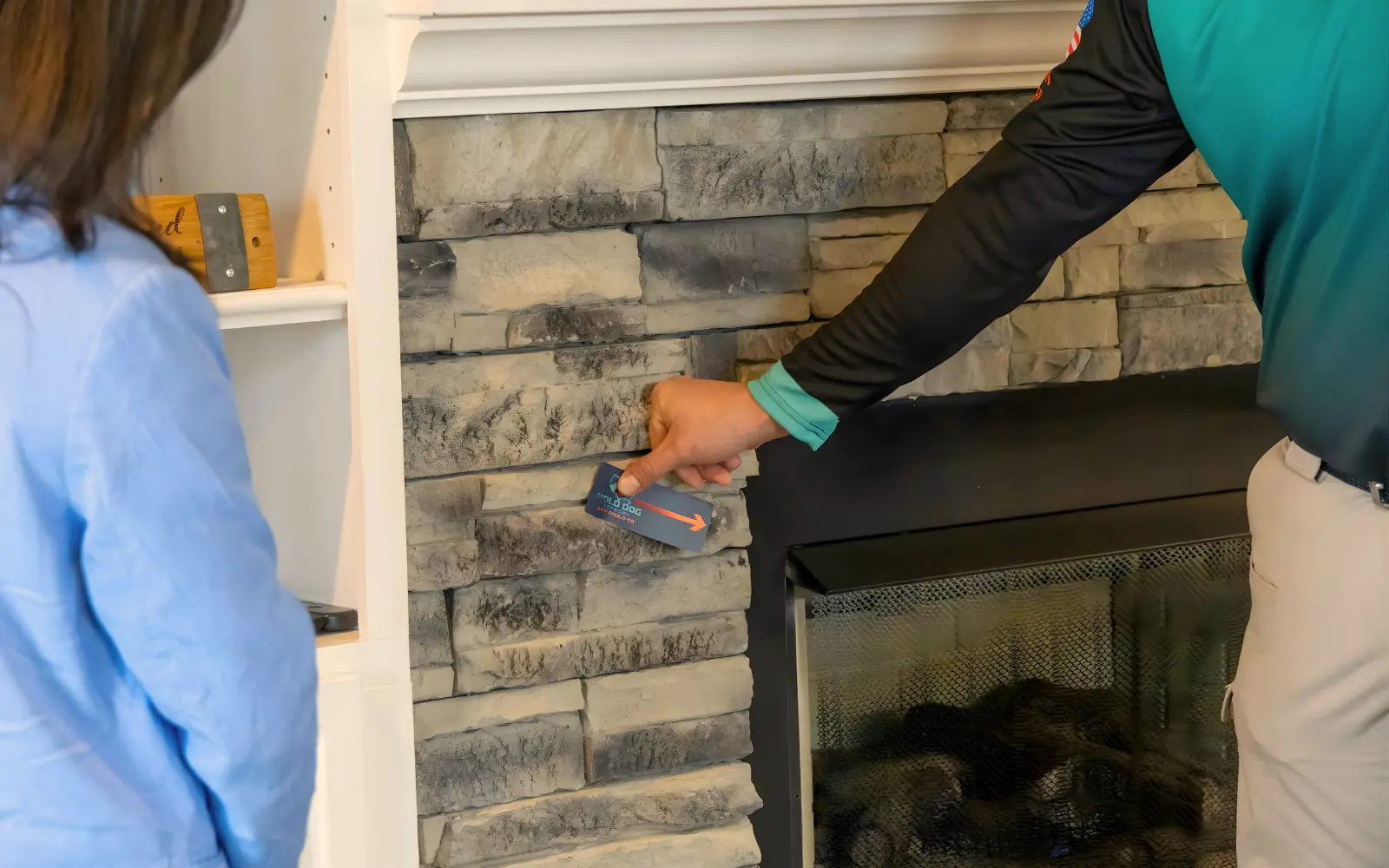
“Whenever Mika [the canine] goes through and she alerts on a cavity or a cabinet or flooring or anything like that, Zach [the handler] will pause and put a sticker, a safe sticker on that area just to mark it and say, she alerted here.”
Caleb Jones
That marked area becomes a place to investigate. It might lead to targeted demolition, further testing, a remediation conversation, or monitoring depending on the situation.
This is the part homeowners often need help understanding: an alert is direction. It’s not a diagnosis of the whole home, and it’s not a reason to start ripping out everything nearby.
The value is focus. Instead of guessing which wall, cabinet, or floor area matters, you have a documented place to start.
Treat alerts as direction, not a reason to tear apart the whole room.
Step 3: Decide Whether Further Investigation or Testing Is Needed
After a mold inspection finds a concern, the next step depends on what kind of information you still need.
Sometimes the next step is opening a specific area to see what’s happening beneath the surface. Sometimes it’s lab testing. Sometimes the visible damage and inspection findings are enough to start a remediation conversation.
Testing can be useful, but it should be targeted. A random swab or air sample may not answer the source question.
Caleb gave a simple example of why:
“You could be swabbing a surface and… an inch to the right is an active mold growing colony.”
Caleb Jones
That’s why finding the source matters. If a dog alerts near a cabinet, wall cavity, or flooring area, any follow-up testing or exploratory opening can be focused there instead of scattered across the home.
Mold Dog Network’s role is to help locate mold odor. It doesn’t replace a lab when species identification is needed, and it doesn’t replace a remediation company when removal is required. But the inspection can make those next steps more precise.
For more detail, see mold inspection vs mold testing.
Use the inspection findings to make testing or opening walls more targeted.
Step 4: Talk to the Right Remediation Professional
If the findings suggest active mold or hidden moisture damage, you may need to talk with a remediation professional.
Mold Dog Network’s job is source location. Remediation is a separate step for a separate business. That separation is helpful because it gives you documentation you can share before work begins, and it keeps MDN’s work focused and ethical.
You should send the report, photos, and alert locations to the remediation company. A good remediator will use that information to plan a targeted investigation. They should want to understand the likely source, the moisture history, and the affected materials before recommending removal.
Be cautious with anyone who jumps straight to tearing everything out without explaining why. The goal isn’t maximum demolition. It’s finding and addressing the affected areas properly.
Caleb described one family that felt more confident once the hidden areas identified by MDN were being addressed through remediation.
“They felt like the [remediation] job was being thoroughly done and we’ve been able to consult with them on that.”
Caleb Jones
For more warning signs during property evaluations, see red flags for mold during a home inspection.
Share your inspection documentation with a remediation professional before work begins.
Step 5: Fix the Moisture Source Before Rebuilding
Mold grows because moisture was present.
That means removal alone may not solve the problem if the moisture source is still active. Before rebuilding, the underlying issue needs to be understood and corrected.
Common moisture sources include plumbing leaks, roof leaks, poor drainage, HVAC condensation, basement moisture, humidity problems, and materials that were closed up before they fully dried.
The EPA says wet or damp materials dried within 24–48 hours after a leak or spill will usually not grow mold. If materials stayed wet longer, especially inside walls, cabinets, insulation, or flooring, hidden mold becomes more likely.
This is why source and extent matter. In the case Caleb shared, hidden mold was found beyond where previous remediation had stopped. If the area had simply been rebuilt, that hidden problem could’ve continued.
Before you replace drywall, flooring, trim, or cabinets, make sure the moisture source is fixed and the affected area is understood.
Don’t rebuild until the moisture source and affected area are understood.
Step 6: Don’t Assume One Finding Means the Whole House Is Lost
A mold finding can feel scary, but it doesn’t automatically mean the whole house is contaminated.
Sometimes the findings are limited. Sometimes there’s one area that needs further investigation. And sometimes an alert points to something small or isolated.
Caleb shared one example that shows why the report needs context:
“We have done houses where [the canine’s] only alerted on a Roomba and a candle.”
Caleb Jones
That kind of result can give a homeowner peace of mind. It shows that mold dog inspections aren’t about creating unnecessary fear. They’re about identifying where the dog detects mold odor and where it doesn’t.
Of course, some homes do have multiple hidden areas that need attention. But even then, documentation helps prioritize areas to target. Instead of assuming everything is ruined, you can look at the alert pattern, moisture history, and report details to decide what matters most.
The point is to move carefully. A mold finding deserves attention, but panic rarely leads to better decisions.
Use the findings to prioritize next steps instead of assuming the worst.
What If Mold Was Found After Failed Remediation?
Failed remediation can happen when hidden mold was missed.
That doesn’t always mean the previous company did everything wrong. Sometimes the visible damage was addressed, but the mold extended farther than expected. Sometimes another source was never found. Sometimes water traveled into an adjacent wall, cabinet, or flooring area and that ingress wasn’t picked up.
Caleb shared a real example from the Cincinnati area. The family had already gone through two remediation attempts, and both failed third-party post-testing. Mold Dog Network sent handler Zach and his canine Mika to inspect the home.
Mika alerted just beyond where the previous remediation had stopped.
“An extra three feet over from where they stopped the remediation, Mika had alerted… and [when the next remediation company started the demolition] it was just black and molded all over it on the backside [of the drywall].”
Caleb Jones
That finding gave the family confirmation and helped the next remediation company focus on the area that had been missed.
If remediation failed, the answer usually isn’t to repeat the same process and hope for a different result. It’s to locate what was missed before spending more money.
For more on timing, see when you should get a mold inspection.
If remediation failed, locate what was missed before paying to repeat the process.
Conclusion: The Right Next Step Starts With Knowing Where the Problem Is
A mold finding can feel stressful, but it’s meant to create direction.
Review the report. Understand what the alert locations mean. Decide whether testing, targeted opening, remediation, or moisture correction makes sense next.
The most important thing is not to guess.
Mold dog inspections help homeowners move from uncertainty to focused action by locating hidden mold odor and documenting where the concern may be.
Ready to stop guessing? Schedule a mold dog inspection with Mold Dog Network and find out where hidden mold may be located.