
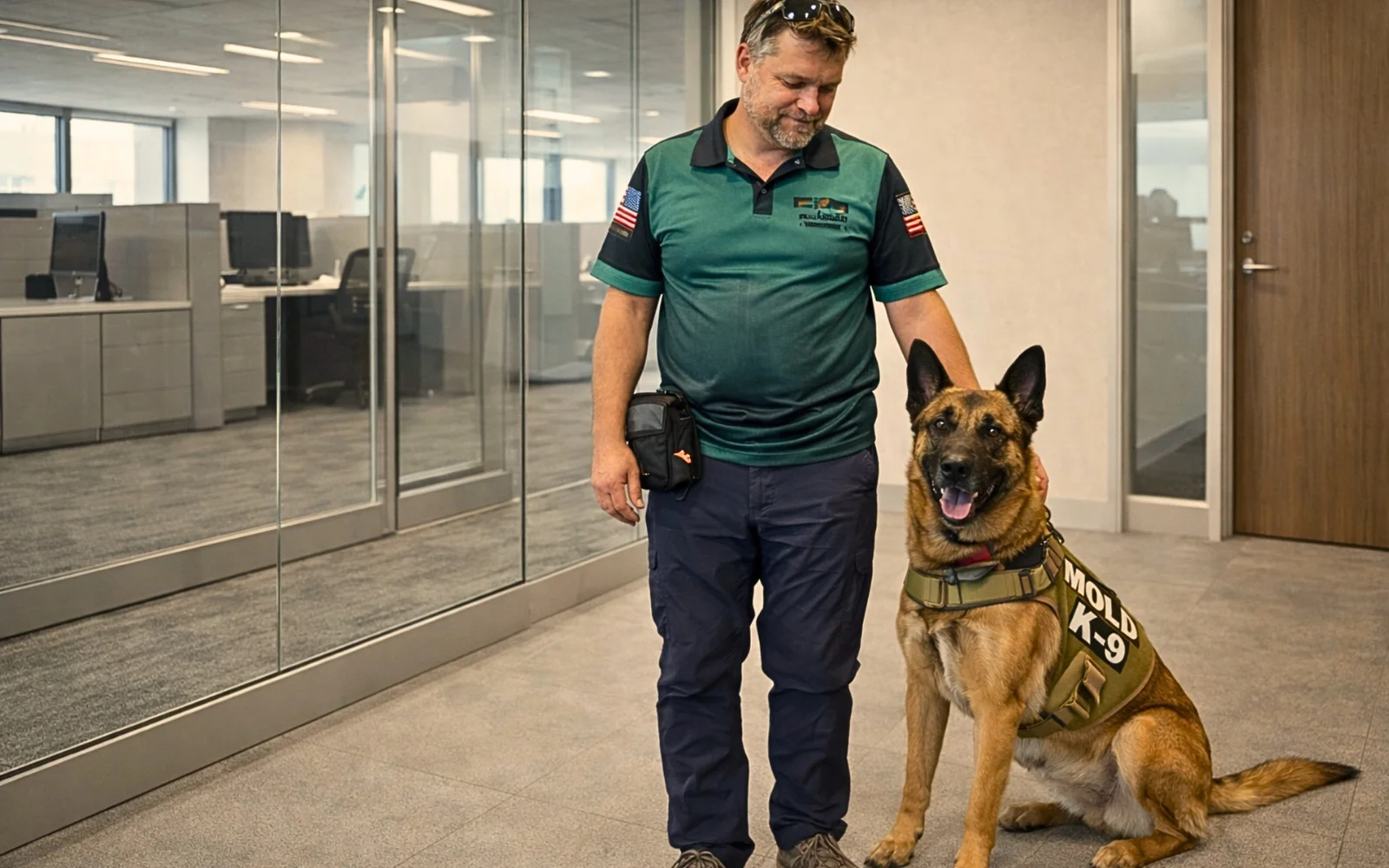
When Should You Get a Mold Inspection? 9 Signs It’s Time
You don’t have to see mold on the wall before a mold inspection makes sense.
Many homeowners wait until there’s visible growth, but hidden mold often starts with smaller clues: A musty smell; A room that always feels damp; A leak that seemed minor at the time; Symptoms that feel worse at home; A mold test that came back “normal,” even though something still feels wrong.
Caleb Jones, co-owner of Mold Dog Network, explained the core problem clearly:
“Mold is not always an easily visible issue.”
Caleb Jones
That’s why mold dog inspections can be so helpful when you suspect mold but can’t see it. A trained mold detection dog searches for the odor of mold growth and alerts the handler where that odor is strongest, giving you a clearer place to start.
Here are nine signs it may be time to schedule a mold inspection.
1. You Smell a Musty Odor, But Can’t Find Mold
A musty smell is one of the most common reasons homeowners start looking for mold.
The frustrating part is that the smell doesn’t always come with visible growth. Mold odor may be coming from behind drywall, under flooring, inside cabinets, around old plumbing, or near HVAC-related areas.
That’s why looking around the room isn’t always enough.
“You can only access and test what you can see.”
Caleb Jones
A visual check can help if the mold is exposed. But if the surface looks clean and the odor keeps coming back, the source may be hidden.
For more on what you can check yourself, see can you inspect for mold yourself.
If the smell keeps coming back, don’t rely on sight alone.
2. Your Home Has Had a Leak, Flood, or Plumbing Problem
Water damage is one of the biggest reasons to schedule a mold inspection.
That includes dishwasher leaks, sink plumbing leaks, roof leaks, basement flooding, toilet overflows, HVAC condensation, and slow leaks that went unnoticed for weeks or months.
The EPA says wet or damp materials dried within 24–48 hours after a leak or spill will usually not grow mold. If materials stayed wet longer, especially inside walls, cabinets, flooring, or insulation, hidden mold becomes more likely.
Caleb shared one example where a home had hidden leaks around the kitchen dishwasher and sink causing hidden mold issues that remained even after remediation attempts. That kind of history matters because moisture can travel farther than the obvious wet spot.
After water damage, inspect before assuming everything dried properly.
3. You Feel Worse at Home and Better Away
Mold Dog Network doesn’t diagnose illness, and mold isn’t the cause of every symptom.
But if you notice a clear pattern where you feel worse at home and better when you leave, it’s worth taking seriously. Homeowners often mention congestion, coughing, wheezing, irritation, headaches, fatigue, or a general sense that the indoor environment doesn’t feel right.
CDC says mold can cause symptoms such as stuffy nose, sore throat, coughing or wheezing, burning eyes, or skin rash in some people.
Caleb described one family who couldn’t figure out where the hidden issues were after previous remediation.
“The wife and the children started to have some health concerns… and they just could not figure out the most effective way to find all of the hidden issues in their home.”
Caleb Jones
If your healthcare provider suspects the home environment may be part of the picture, a mold inspection can help you investigate the space without jumping to conclusions.
If your home seems connected to symptoms, investigate it while working with your healthcare provider.
4. Your Mold Test Came Back Normal, But Something Still Feels Wrong
A normal mold test can feel reassuring, but it doesn’t always answer the full question.
Air testing only captures what’s airborne during the sampling window. If spores aren’t moving through that air at that exact time, the result may not reflect hidden mold inside a wall, under flooring, or in an HVAC-related area.
Caleb explained the limitation this way:
“If the mold spores and stuff just don’t happen to be present in the five minute capture… you’ll come back and you’ll get a negative air quality test.”
Caleb Jones
Swab testing has limits too. It only tests the exact spot sampled. If the active mold is nearby but not on that surface, the result may miss the problem.
If the test didn’t answer the source question, look deeper.
5. Remediation Failed Post-Testing
If remediation failed post-testing, something needs a closer look.
It may mean a mold source was missed, containment didn’t work as intended, or another area of the home still needs to be investigated. Either way, repeating the same approach without finding the source can lead to more frustration.
Caleb shared a real case from the Cincinnati area. The family had already gone through two remediation attempts, and both failed third-party post-testing. Mold Dog Network sent handler Zach and his canine Mika to inspect the home.
Mika alerted beyond where previous remediation had stopped.
“An extra three feet over from where they stopped the remediation, Mika had alerted… and it was just black and molded all over it on the backside.”
Caleb Jones
That’s where mold dog inspections can be especially useful. They can help locate hidden mold odor beyond the obvious work area, so the next step is more targeted.
For more on next steps, see what happens after mold is found.
If remediation didn’t clear the issue, inspect before rebuilding or repeating the same work.
6. You Notice Moisture Damage, Staining, or Warped Materials
Moisture damage doesn’t automatically mean you have mold, but it’s a reason to investigate.
Common warning signs include bubbling paint, stained drywall, soft trim, warped flooring, musty cabinets, ceiling stains, or materials that feel swollen or damp.
These clues suggest water affected the material at some point. If the material stayed wet for more than 24–48 hours, mold becomes more likely, especially if the moisture was trapped inside a wall, floor, or cabinet.
“It’s really the invisible problems and stuff that you need to be addressing.”
Caleb Jones
Painting over a stain or replacing trim may hide the clue without fixing the cause.
Treat moisture damage as a clue, not something to paint over.
7. One Room Feels Damp, Stale, or Humid
A room that always feels damp, stale, or humid deserves attention.
Bathrooms, basements, laundry rooms, crawlspace-adjacent rooms, and poorly ventilated areas are common trouble spots. Sometimes the issue is humidity. Sometimes it’s airflow. Sometimes it’s an old leak or hidden moisture source.
If those issues are ongoing, they can affect your health too. NIOSH says building dampness and mold have been associated with respiratory symptoms, asthma, hypersensitivity pneumonitis, rhinosinusitis, bronchitis, and respiratory infections.
A mold inspection can help you understand whether the room has visible moisture clues or hidden areas worth investigating further.
If one room always feels damp or stale, find out why.
8. You’re Buying or Selling a Home
A standard home inspection doesn’t always uncover hidden mold.
Home inspectors can be helpful, but they’re usually limited to visible and accessible areas. Finished walls, covered flooring, cabinets, and HVAC-related spaces can hide old water damage or mold growth that isn’t obvious during a walkthrough.
For buyers, a mold inspection can provide more confidence before closing, especially if the home has a musty odor, older plumbing, roof history, basement moisture, or signs of past repairs.
For sellers, finding an issue early may help avoid surprises during negotiations.
When there’s a history of leaks or unexplained odor, mold dog inspections can add source-location insight that a standard home inspection may not provide.
For more detail, see what home inspectors may not look for.
Before closing, investigate mold concerns that a standard home inspection may not answer.
9. You Suspect Mold in Walls, Flooring, Cabinets, or HVAC Areas
Some of the most common mold hiding places are also the hardest to inspect.
Wall cavities, flooring, cabinets, plumbing chases, ceiling cavities, and HVAC-related areas can hold moisture without showing much on the surface. A visual inspection may only catch the clues. Air testing may not show where the problem is.
A mold detection dog searches for odor from mold growth, helping identify likely source areas without starting with demolition.
Caleb explained Mika’s role clearly:
“Mika is trained to find mold. That is what she’s trained to find. No matter where that mold is, that is her main target and main focus.”
Caleb Jones
Mold dogs don’t identify mold species like a lab test, and they shouldn’t be treated as perfect. But when the concern is hidden mold, they can give homeowners clearer direction.
If the suspected area is hidden, use a source-location inspection before guessing.
Conclusion: If the Clues Keep Pointing to Mold, Don’t Wait for It to Become Obvious
Visible mold isn’t the only reason to schedule an inspection.
A musty odor, water damage, failed testing, failed remediation, damp rooms, health-related patterns, or suspicious hidden areas can all be signs that it’s time to look deeper.
That’s where mold dog inspections can help. They’re designed to locate hidden mold odor so homeowners have clearer direction before opening walls, rebuilding, or paying for more testing.
Ready to stop guessing? Schedule a mold dog inspection with Mold Dog Network and find out where hidden mold may be hiding.