
Mold Testing vs Mold Dog Inspections: Which Is Better for Finding Hidden Mold?
If you’ve already paid for mold testing and still don’t have clear answers, you’re in good company.
Maybe your air sample came back “normal,” but there’s still a musty smell you can’t explain. Maybe your test confirmed elevated mold, but nobody can tell you where it’s coming from. Or maybe you’ve had a visual inspection, an industrial hygienist, and a remediation company involved, but you still feel like something’s being missed.
That’s where the difference between mold testing vs mold dog inspections counts.
Mold testing can be useful. Air samples, swabs, tape lifts, and lab testing all have a place. But most forms of mold testing are better at answering one question: Is mold present in this sample?
A mold dog inspection answers a different question entirely: Where is the hidden mold coming from?
Mold may be growing behind walls, under flooring, behind cabinets, inside HVAC systems, or in other places nobody can see without opening up the home, so knowing where the mold is growing is incredibly important information.
Watch the full interview here!
As Caleb Jones, co-owner of Mold Dog Network, explains, one of the biggest advantages of a canine inspection is speed and certainty.
“You have the results the same day. You’re not waiting on laboratory test results.”
Caleb Jones
This guide breaks down what mold testing can tell you, where it can fall short, how mold dog inspections work, and which option makes the most sense when your real goal is finding hidden mold.
- Why Mold Testing Can Feel So Confusing
- What Air Tests and Swab Tests Actually Tell You
- Why Air Samples Can Miss Hidden Mold
- How Mold Dog Inspections Are Different
- Industrial Hygienist vs Mold Dog: Which Should Come First?
- When Lab Testing Still Makes Sense
- So, Which Is Better for Finding Hidden Mold?
- Final Thoughts: Testing Has a Place, But Hidden Mold Needs a Location Strategy
Why Mold Testing Can Feel So Confusing
Mold problems rarely start with certainty.
They usually start with little things that don’t feel right like a smell that comes and goes, a room that feels different from the rest of the house, allergy-like symptoms that seem worse at home, a past leak you thought was dried out or a test result that says something is present, but not where it’s hiding.
That’s what makes mold testing so frustrating for homeowners. It can give you data, but not always direction.
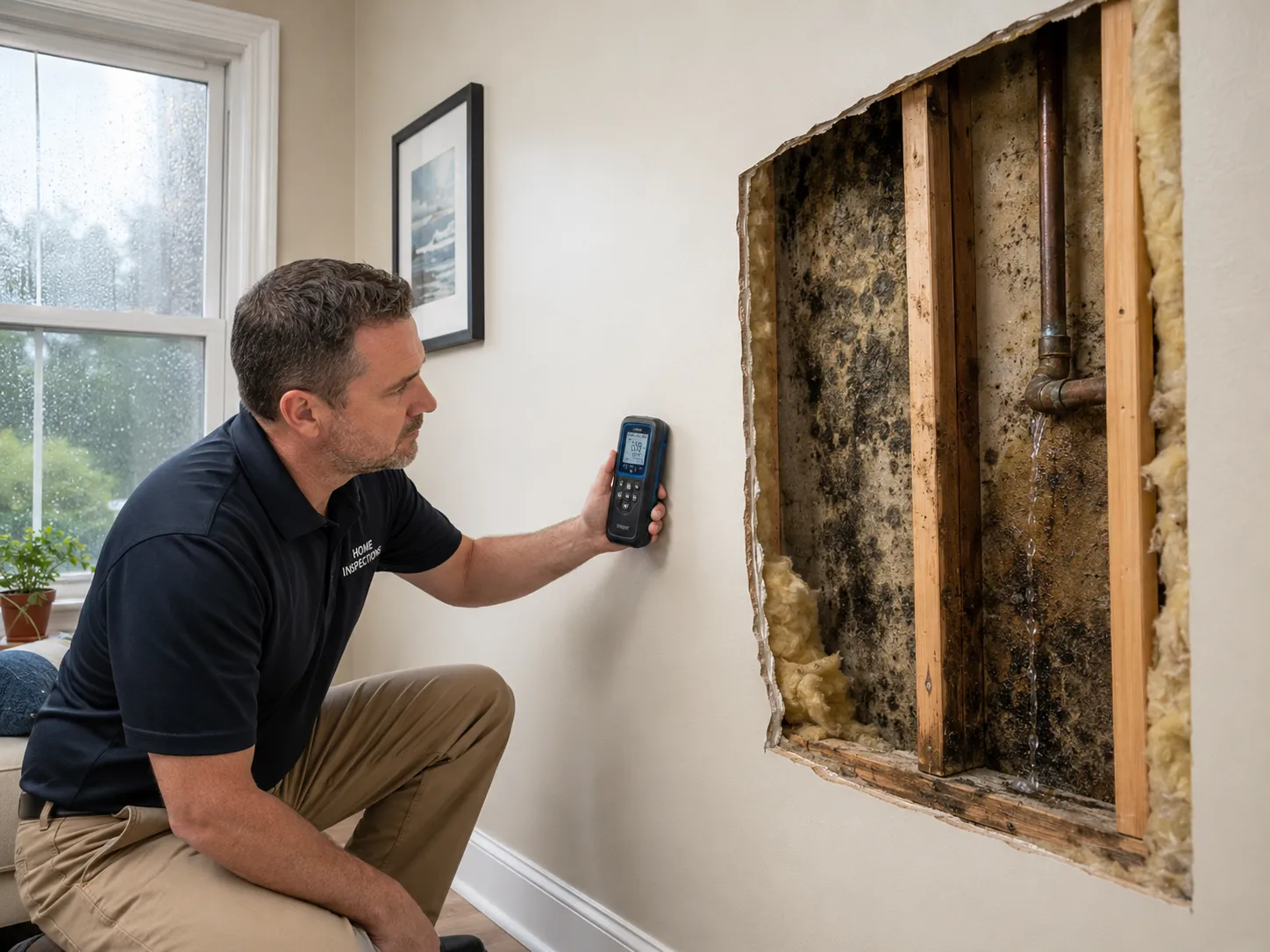
An air sample may show elevated mold spores. A swab may confirm mold on a surface. A lab report may list mold types you’ve never heard of. But after all that, the question often remains:
Okay, but where is it coming from?
That’s especially stressful when there’s no visible mold. You can walk through your home, look at the walls and ceilings, and see nothing obvious. But hidden mold doesn’t need to be visible to be a problem. It can grow behind drywall, inside wall cavities, beneath floors, around windows, inside insulation, behind cabinets, or near HVAC components.
Moisture is the key issue. The EPA says water-damaged areas and items should be dried within 24–48 hours to help prevent mold growth. But in real homes, leaks aren’t always caught quickly. Water can sit behind walls or under flooring long after the surface looks dry.
That’s when homeowners start to feel trapped between “the test says one thing” and “my body, nose, or gut tells me something else.”
Caleb sees this emotional side often.
“People just feel unsafe in the space they should feel the safest.”
Caleb Jones
And that’s the part many traditional inspections don’t fully address. When you’re worried about mold, you don’t just want a report. You want to know whether your home is safe, whether the source has been found, and whether remediation will actually fix the right areas.
Related read: Learn why mold air samples can come back normal even when hidden mold is still present.
That’s where a mold dog inspection can help shift the process from guessing to locating.
Still worried after confusing mold test results? A mold dog inspection can help locate the source instead of leaving you guessing.
What Air Tests and Swab Tests Actually Tell You
Mold testing isn’t useless. It’s just often misunderstood.
The problem isn’t that air tests, swabs, and lab reports have no value. The problem is that homeowners are often led to believe these tests will answer more than they actually can.
Here’s the simplest way to think about it:
Air testing measures what’s floating through the air at the time of the sample. That can be helpful, especially when comparing indoor and outdoor air. But it’s still a snapshot. If hidden mold is sealed inside a wall cavity or not releasing many spores into the air during that test window, the sample may not tell the full story.
Swab testing is more targeted. Caleb actually said he preferred swabs over air captures during his remediation inspection days because they gave him more control over the specific area being tested. But swabs have their own limitation: you have to touch the right spot.
If the mold colony is just out of reach, behind the surface, or even an inch away from where the swab was taken, the result can miss the bigger issue.
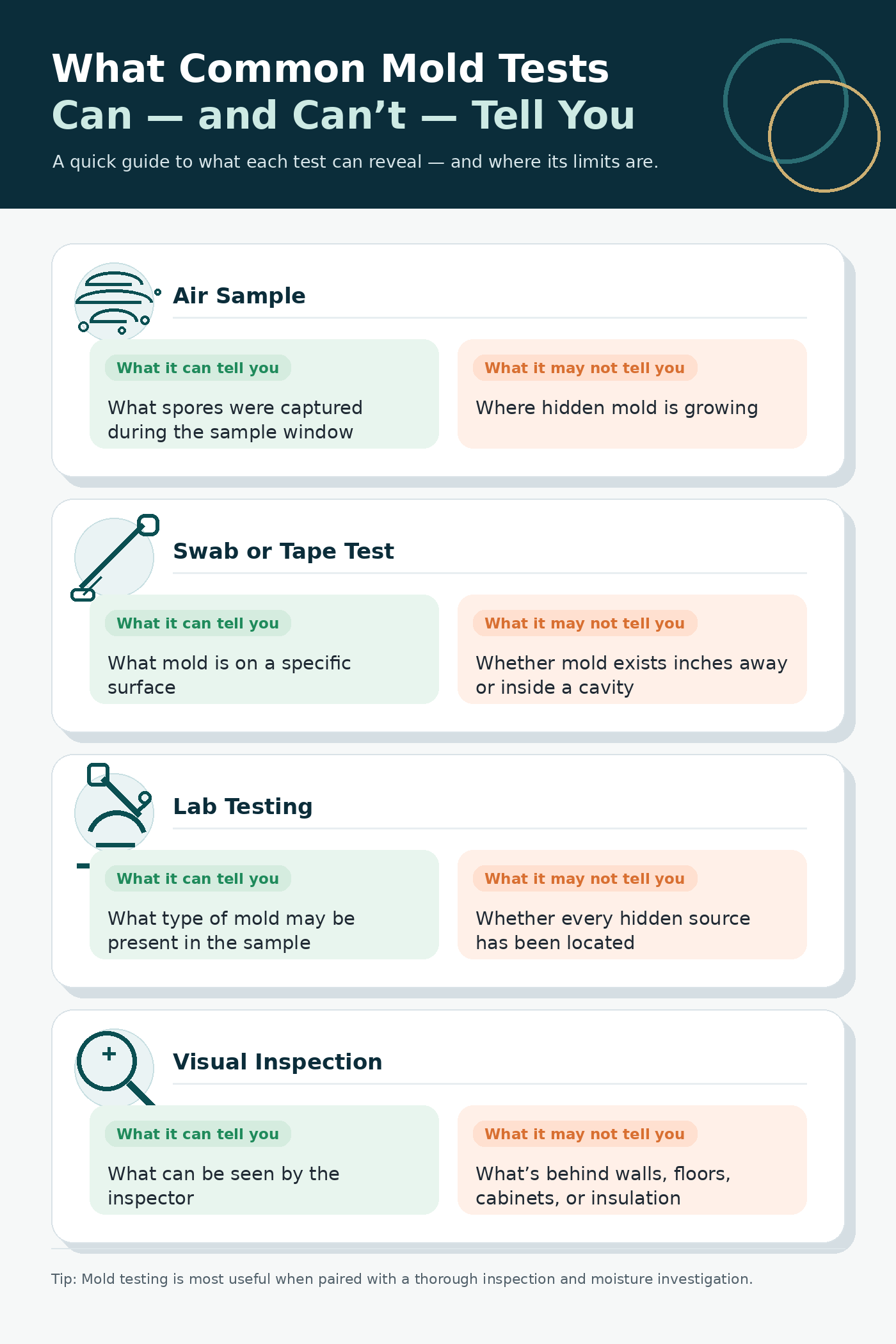
“Air tests and swab tests are good tools, but they definitely have limitations.”
Caleb Jones
That’s why the distinction between mold testing vs mold dog inspections shouldn’t be framed as “one is good and one is bad.” They solve different problems.
Mold testing can help answer:
- What type of mold was captured?
- Was mold present in this air sample?
- Was mold present on this surface?
- Is post-remediation testing showing improvement?
A mold dog inspection is more focused on:
- Where is the active mold odor strongest?
- Is there a hidden source behind a surface?
- Which areas should be investigated first?
- How can remediation be more targeted?
That last point is important. If you know where the problem is, you can reduce unnecessary demolition and avoid chasing mold room by room.
For homeowners dealing with musty smells, confusing lab reports, or symptoms that seem worse indoors, the more useful first question may not be “what species is this?” It may be where is the mold?
Related read: Can air testing miss hidden mold?
If testing has told you there may be mold but not where it is, Mold Dog Network can help narrow down the source.
Why Air Samples Can Miss Hidden Mold
Air samples are one of the most common mold testing methods, but they have a built-in weakness: they depend on what happens to be in the air at the time of the test.
That matters because hidden mold doesn’t always behave conveniently.
A mold colony behind a wall may not release enough spores into the room during the testing window. Mold behind cabinets may be affecting the surrounding materials without sending spores directly into the air capture. Mold under flooring may stay trapped below the surface. Mold near HVAC components may show up inconsistently depending on whether the system is running, how air is moving, and where the sample is taken.
Caleb explained the problem:
“You’re hoping the spores travel through the air capture during that five-minute test.”
Caleb Jones
That’s why homeowners can end up with a “normal” air test even when something still feels off.
This doesn’t mean air testing is pointless, but it does mean air testing has to be interpreted carefully. A negative result doesn’t always mean there’s no mold anywhere in the home. It may only mean the sample didn’t capture elevated spores during that specific moment.
Hidden mold can be especially easy to miss when:
- The mold is behind sealed materials.
- The HVAC system wasn’t running the way it normally does.
- The sample was taken in the wrong room.
- Outdoor baseline conditions affected the comparison.
- The colony is active but not releasing spores into the sampled air path.
- The home has intermittent moisture or odor issues.
The CDC’s NIOSH guidance connects damp buildings with respiratory symptoms and the development or worsening of asthma, which is one reason ongoing moisture and mold concerns shouldn’t be brushed aside simply because one sample looked normal.
For a homeowner, the most frustrating scenario is this:
You smell something. You feel something. You’ve had a leak. You know your home isn’t right. But the test result doesn’t match your lived experience.
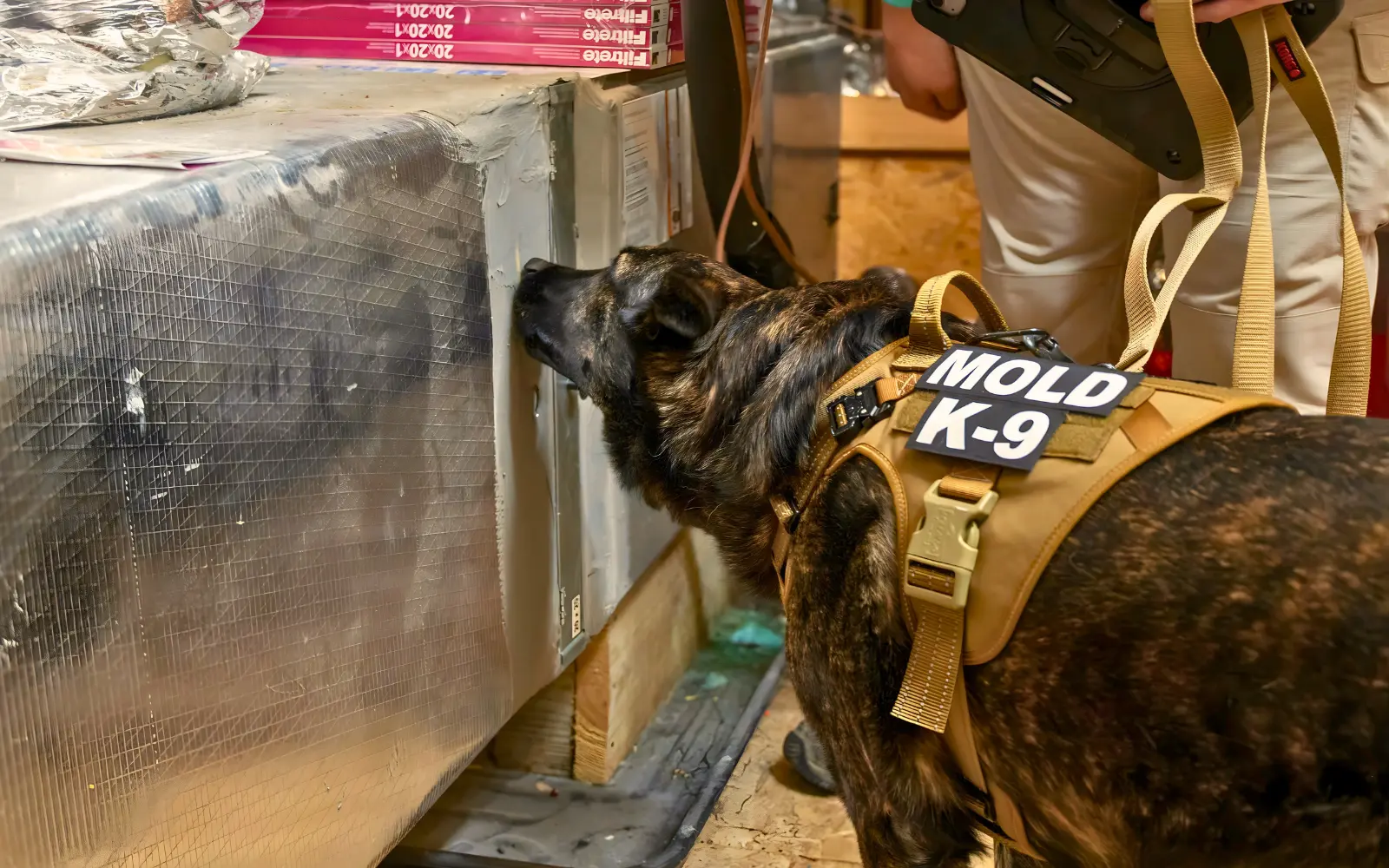
That’s when a mold dog inspection can be a more practical next step. Instead of waiting for spores to pass through a small air capture, a trained mold detection dog works through the property looking for the odor signature of active mold growth.
A dog doesn’t need visible mold on the wall. It doesn’t need the colony to be in the air sample at the perfect moment. It’s trained to follow scent.
That’s the major difference in the mold testing vs mold dog inspections conversation: air testing samples the air; a mold dog searches for the source.
Related read: What to do if your mold test was negative but you still smell mold
A negative air test doesn’t always end the story. If your home still smells off, schedule a mold dog inspection to investigate hidden sources.
How Mold Dog Inspections Are Different
A mold dog inspection is not just a visual inspection with a dog in the room.
The dog is the detection tool.
Mold detection dogs are trained to locate the odor produced by active mold growth. During an inspection, the handler guides the dog through the property, and the dog works the environment using scent. When the dog identifies an area of concern, the handler documents the alert so the homeowner has a clearer idea of where hidden mold may be present.
Caleb has worked in remediation and has used multiple forms of mold testing. That experience shaped why he believes so strongly in canine inspections.
“I have not come across anything that is as accurate as using a canine to find hidden mold.”
Caleb Jones
The biggest difference is that mold dog inspections are location-focused.
A test may say mold spores were present in the air. A mold dog inspection helps identify where the odor is strongest and where the hidden source may be located.
Same-day answers
One of the biggest benefits is that you’re not waiting days for lab results before you have a next step. The handler can document where the dog alerted during the inspection, giving you a same-day understanding of the likely problem areas.
For homeowners who’ve been stuck in uncertainty, that matters. It gives them something practical to act on.
Non-invasive source location
A mold dog can help locate hidden mold without opening walls first. That doesn’t mean demolition will never be needed. If remediation is required, materials may still need to be removed. But the inspection itself can help narrow down where to look before anyone starts tearing into the home.
That can be especially valuable for hidden mold behind:
- Drywall
- Cabinets
- Flooring
- Trim
- Ceilings
- HVAC components
- Built-ins
- Insulation
A better starting point for remediation
One of the most expensive problems in mold remediation is doing work in the wrong place, or doing work in one area while missing another source completely.
Caleb described this as one of the biggest reasons to consider a mold dog inspection earlier in the process. If multiple hidden sources are found at once, the homeowner may be able to plan remediation more strategically instead of paying for repeated rounds of work.
That doesn’t mean mold dogs are perfect: No inspection method is. Mold Dog Network is careful about that, so the goal isn’t to claim magic. The goal is to use a highly trained detection dog and handler team to give homeowners clearer, more targeted information than they may get from testing alone.
For homeowners, especially those dealing with a home that no longer feels safe, that can be the difference between panic and a plan.
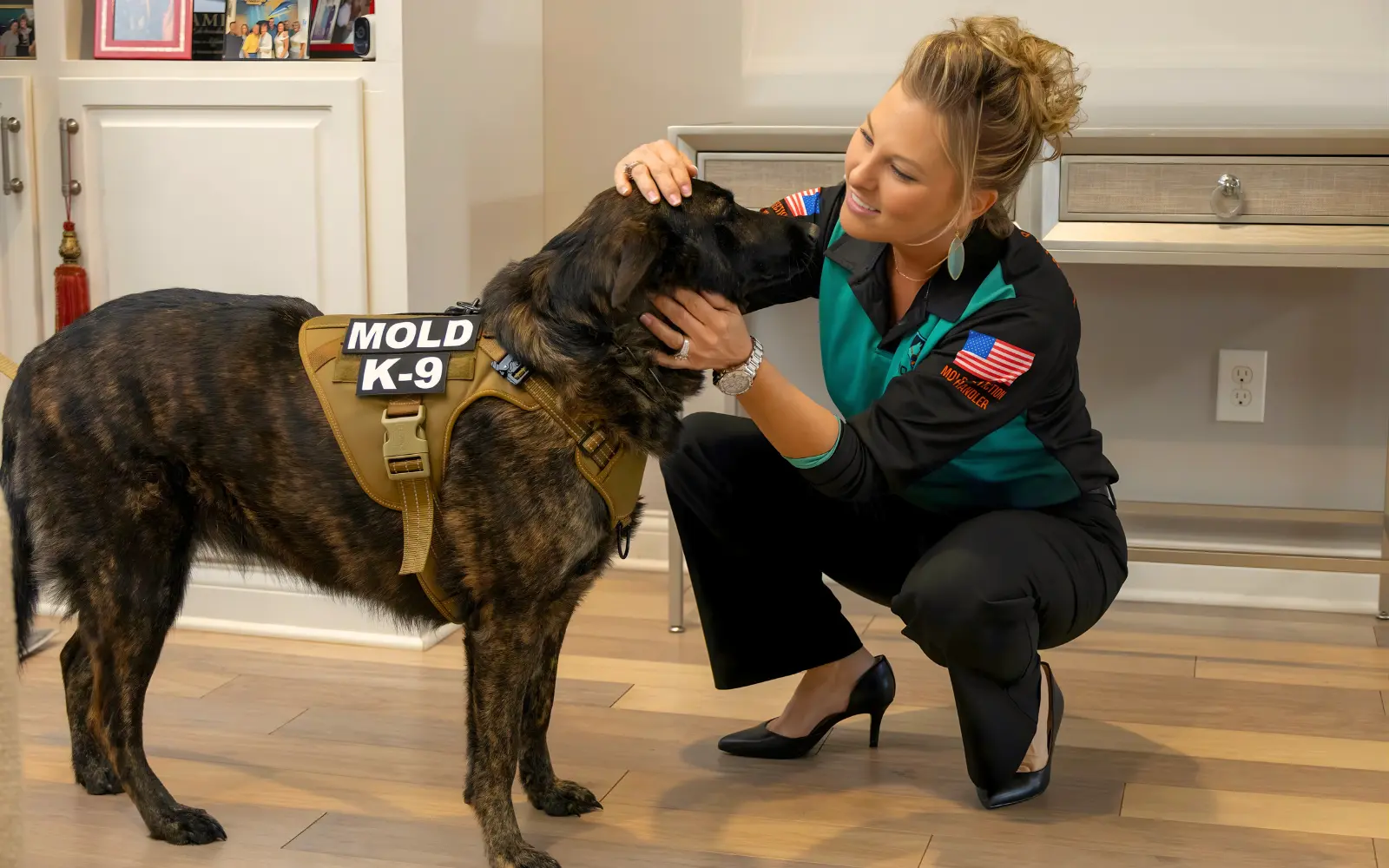
For residential concerns, the best starting point is often a residential mold dog inspection, especially when the concern is hidden mold in living spaces, bedrooms, basements, bathrooms, kitchens, or HVAC areas.
Related read: Visual mold inspection vs mold dog inspection
If you need to know where hidden mold may be growing, book a mold dog inspection and get clearer next steps the same day.
Industrial Hygienist vs Mold Dog: Which Should Come First?
This is where the conversation needs to stay fair.
Mold Dog Network isn’t saying industrial hygienists are unnecessary – Caleb is very clear about this. Industrial hygienists can be extremely valuable, especially when a homeowner needs a third-party remediation scope, documentation, or a protocol for a remediation company to follow.
But an industrial hygienist and a mold dog inspection don’t solve the same problem.
“Industrial hygienists are phenomenal tools… [but] I think we solve two different things.”
Caleb Jones
An industrial hygienist may be the right call when you need:
- A formal remediation protocol
- Third-party documentation
- Moisture source evaluation
- Professional sampling
- A scope for remediation work
- Post-remediation verification planning
A mold dog inspection is the better first call when you need:
- Help locating hidden mold
- Same-day inspection findings
- Non-invasive source detection
- A clearer idea of where remediation should focus
- Help when testing says “mold,” but no one knows where it is
The best way to decide is to ask what question you need answered first.
If your question is, “What exact scope should a remediation company follow?” an industrial hygienist may be appropriate.
If your question is, “Where is the hidden mold?” a mold dog inspection may be the better starting point.
In some cases, the strongest approach is to use both. A mold dog inspection can identify areas of concern, and an industrial hygienist can use that information to help write a more targeted scope. Caleb even described a case where an industrial hygienist reviewed a home after the canine inspection and included the dog’s alert areas in the recommended scope.
That’s the kind of process homeowners need more of: not professionals competing with each other, but tools being used in the right order.
In Kentucky, Ohio, Indiana, and Tennessee-area homes, the below pages can help homeowners find the right team for their area:
Related read: Industrial hygienist vs mold dog
Not sure whether to call an industrial hygienist or a mold dog first? Start with the question: do you need a scope, or do you still need to find the mold?
When Lab Testing Still Makes Sense
A trustworthy comparison of mold testing vs mold dog inspections shouldn’t pretend testing has no role.
It does.
Lab testing can be useful when you need to identify the type of mold present in a sample. That may matter for homeowners working with medical professionals, especially if there are concerns around environmental exposure. It can also be useful after remediation, when the goal is to confirm whether work was successful.
Caleb put it simply.
“Laboratory testing still has a very valuable use.”
Caleb Jones
The key is using lab testing at the right stage.
Before hidden mold is located, lab testing may give you information without direction. It might tell you a type of mold was present in a sample, but it may not show where the source is. After the source is located and remediation is performed, testing can become more useful because the relevant areas are open, accessible, and ready to be checked.
This is where post-remediation validation matters.
The IICRC’s S520 standard addresses professional mold remediation processes, and related standards discussions describe Post-Remediation Verification as an inspection and assessment performed after remediation by an independent indoor environmental professional.
In plain English: once remediation is complete, someone should verify that the work actually solved the problem.
Caleb also mentioned that mold dogs can sometimes be used as part of post-remediation validation, because MDN’s canines are trained on actively growing colonies, not dead, treated, or removed mold. In some cases, homeowners use both lab testing and a follow-up canine inspection to feel more confident before rebuilding.
That matters because nobody wants to close walls back up and later wonder whether active mold was left behind.
So no, mold dog inspections don’t make lab testing irrelevant. A better way to say it is:
Use a mold dog inspection to help find the source. Use lab testing when you need sample-specific confirmation, mold type information, or post-remediation validation.
That’s a much clearer, more practical way to use both tools.
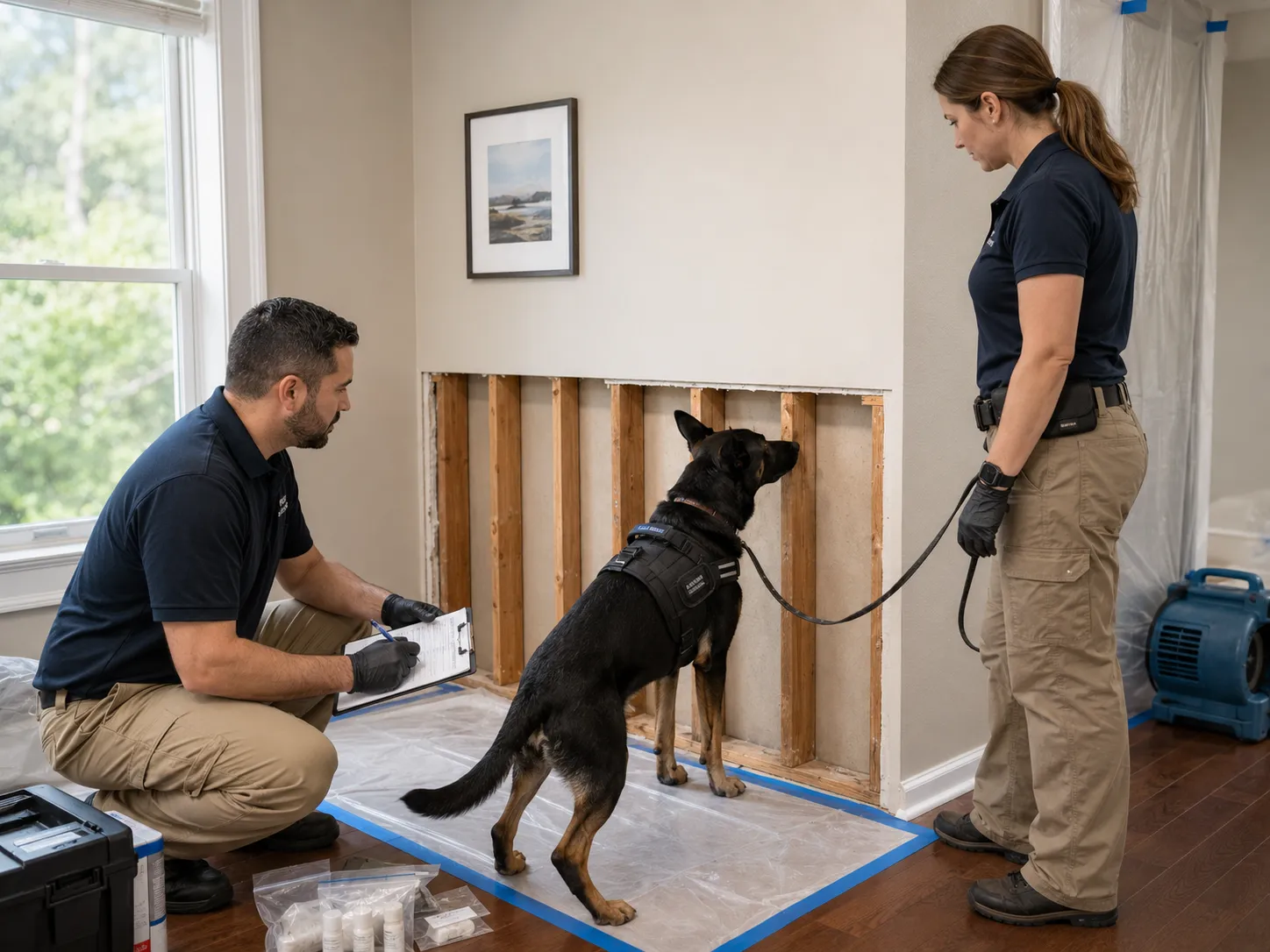
Related read: Do mold tests tell you where the mold is?
Use testing where it helps most: confirmation, species identification, and validation after the hidden source has been located.
So, Which Is Better for Finding Hidden Mold?
If your main goal is finding hidden mold, a mold dog inspection is often the better fit.
That doesn’t mean it’s always the only step. It means it’s the tool designed to answer the location question.
Caleb explained that traditional tests may tell you whether there’s a problem, but they don’t always answer where it is or how severe the hidden source may be.
“The canine kind of solves a lot of problems in the industry.”
Caleb Jones
Here’s the simplest way to decide.
Choose mold testing if…
You may want mold testing if:
- You need to know what type of mold was found.
- You’re working with a healthcare provider and need more information.
- You need post-remediation validation.
- You have visible mold and want to identify it.
- You need formal documentation from a lab.
- You’re verifying that remediation work was successful.
Mold testing is especially useful when the sample location is known and accessible. It’s less useful when the issue is hidden and nobody knows where to sample.
Choose a mold dog inspection if…
You may want a mold dog inspection if:
- You smell mold but can’t see it.
- Your mold test was negative but something still feels wrong.
- Your air sample was “normal,” but symptoms or odors continue.
- You suspect mold behind walls, under flooring, or inside HVAC systems.
- You’ve already paid for testing but still don’t know where the mold is.
- You want same-day, location-focused findings.
- You want to avoid unnecessary exploratory demolition.
- You’re buying a home and want to check for hidden mold during due diligence.
This is where Mold Dog Network’s service is intentionally focused. MDN is not trying to be everything at once. The job is to find the mold so the homeowner can make informed next decisions.
That’s also why the process works well for people who’ve already tried other routes. Many MDN clients have done the free visual inspection. They’ve had a remediation company out. They’ve had air samples. They may even have positive test results. But they still don’t know where the hidden mold is.
A mold dog inspection helps close that gap.
And for homeowners who are tired of guessing, that’s often the answer they’ve been trying to get all along.
Related reads: Thermal imaging vs mold dogs and what is the 5-minute mold test?
If your main question is “where is the mold?”, a mold dog inspection is often the clearer next step.
Final Thoughts: Testing Has a Place, But Hidden Mold Needs a Location Strategy
Mold testing and mold dog inspections both have value. They just don’t do the same job.
Air testing can capture what’s in the air during a sample window. Swab testing can identify what’s on a specific surface. Lab testing can tell you what type of mold was found. Industrial hygienists can provide formal scopes and third-party protocols.
But when the real problem is hidden mold, the question often becomes much more direct:
Where is it?
That’s the question a mold dog inspection is built to answer.
If you’ve been living with musty smells, confusing mold test results, inconclusive inspections, or the feeling that your home isn’t right, you don’t have to keep guessing. A trained mold detection dog can help locate areas of concern quickly, non-invasively, and with same-day findings.
Mold dogs aren’t magic, and no inspection method is perfect. But when hidden mold is suspected, they can provide a level of location-focused certainty that traditional mold testing often can’t.
Stop guessing where the mold may be hiding. Schedule a mold dog inspection with Mold Dog Network and get location-focused answers.