
How Long Do Mold Spores Stay Airborne Indoors?
When homeowners ask, “How long do mold spores stay airborne indoors?”, they’re usually not asking out of curiosity.
They’re asking because they’re worried.
Maybe there’s a musty smell in the house. Maybe someone opened a wall and found mold. Maybe the HVAC system seems to spread an odor every time it runs. Maybe symptoms feel worse at home, and now you’re wondering what’s floating through the air you’re breathing.
That’s completely understandable.
Mold spores can travel through indoor air. They can move through rooms, settle on surfaces, get stirred back up, and continue circulating when airflow, cleaning, HVAC systems, or disturbance brings them back into the air.
But here’s the most important thing to understand: airborne spores are only part of the story.
The bigger question is whether there’s an active mold source inside the home that keeps releasing odor, spores, or particles into the environment.
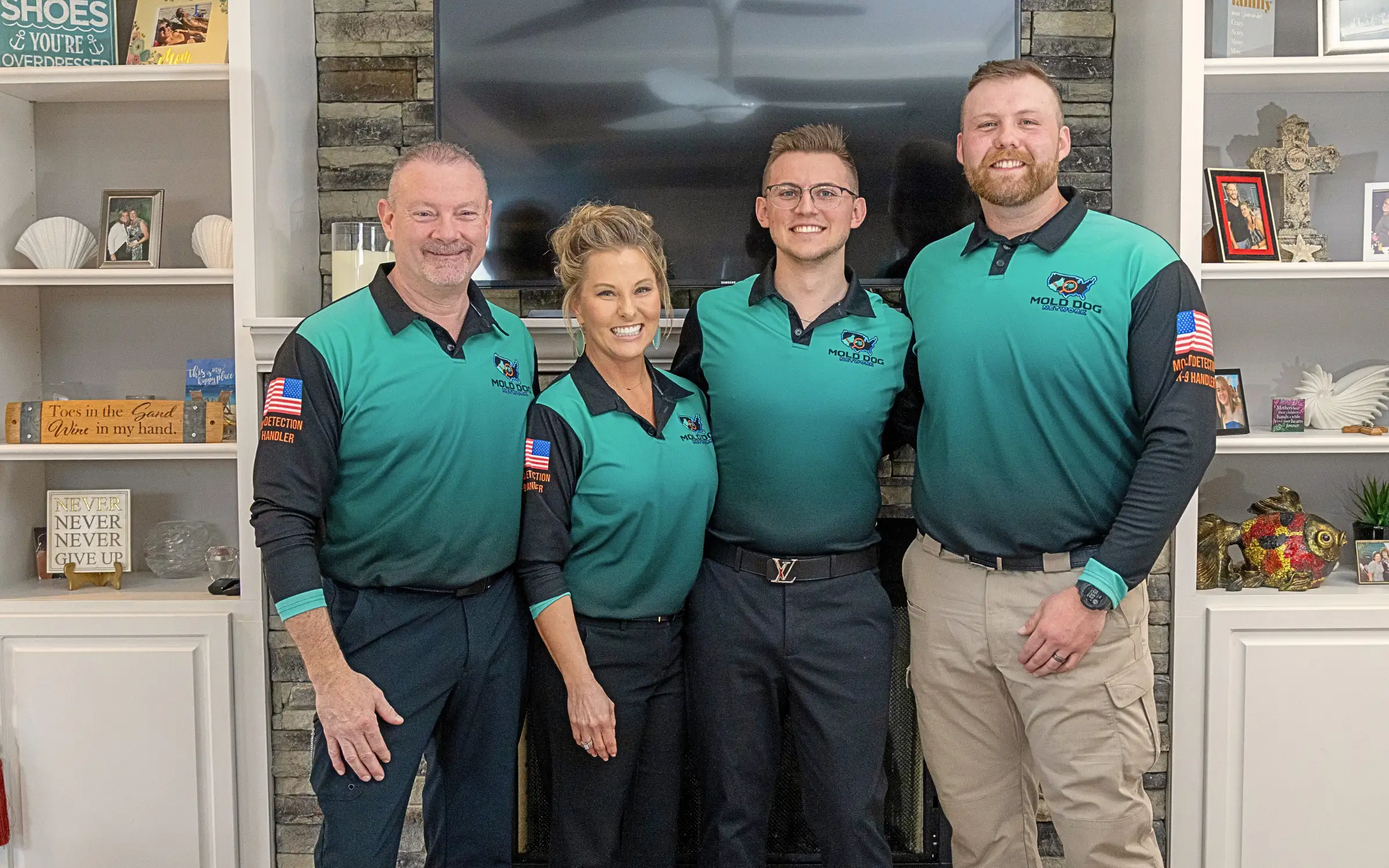
Tina Craig, co-owner of Mold Dog Network, explained how air movement inside a home can matter during inspections:
“[It’s about] the way that a house breathes and rotates the air…”
Tina Craig
That’s why Mold Dog Network focuses on finding the source. Air can move. Spores can settle. Odors can travel. But if hidden mold is still growing behind a wall, under flooring, inside an HVAC-related cavity, in an attic, or around a chimney, the concern may keep coming back.
This guide explains how mold spores behave indoors, what keeps them airborne, why air testing may not locate the source, and how a mold dog inspection can help you stop guessing.
- So, How Long Do Mold Spores Stay Airborne Indoors?
- Why Airborne Spores Can Come Back After They Settle
- HVAC Systems Can Keep Mold Odor and Particles Moving
- Why Air Testing May Not Tell You Where Mold Is Hiding
- When Airborne Mold Spores Become a Bigger Concern
- How Moisture Control Helps Reduce Airborne Mold Problems
- How Mold Dogs Help Find the Source Behind Airborne Mold Concerns
- Don’t Just Ask How Long Spores Stay Airborne – Find What’s Releasing Them
So, How Long Do Mold Spores Stay Airborne Indoors?
There isn’t one simple, universal answer.
Mold spores can stay airborne for different lengths of time depending on the home, the airflow, the size of the spores and particles, humidity, ventilation, HVAC use, cleaning activity, foot traffic, and whether mold is being disturbed or actively growing.
Some spores may settle onto surfaces. Others may stay suspended longer if air is moving. Once they settle, they can become airborne again when disturbed by walking, vacuuming, dusting, fans, HVAC airflow, or demolition.
So instead of thinking, How many hours until the spores are gone?, it’s more useful to ask:
Is something in the house still releasing mold spores or mold odor?
The EPA explains that mold reproduces by creating tiny spores that travel through indoor and outdoor air.
That means mold spores are part of normal air. The problem is when indoor moisture allows mold to grow and amplify inside the home.
Tina put the moisture issue plainly:
“Humidity and water, the things that give mold the breeding ground or the idea that it wants to make your home its home, are not biased.”
Tina Craig
That’s the part homeowners shouldn’t miss. Airborne mold spores matter, but moisture matters more. If the moisture source is still active, mold may continue producing spores, odor, and contamination.
If you’re worried about airborne mold spores, the most important step is finding whether there’s an active source. A mold dog inspection can help locate where mold odor is coming from.
Why Airborne Spores Can Come Back After They Settle
Mold spores and particles don’t always stay floating forever.
They can settle onto surfaces like floors, furniture, clothing, bedding, dust, carpets, curtains, HVAC components, and personal belongings. But settled particles don’t necessarily mean the concern is over.
They can become airborne again when disturbed.
That may happen when you:
- Walk through a room
- Vacuum or sweep
- Dust furniture
- Open doors or windows
- Run ceiling fans
- Turn on the HVAC system
- Move stored belongings
- Pull up flooring
- Open a wall
- Disturb moldy materials during DIY cleanup
This is why some homeowners feel like the home gets dusty again almost immediately after cleaning.
Tina described a pattern Mold Dog Network hears from homeowners:
“We see a much higher level of particulate buildup in homes that are infested with microbial growth.”
Tina Craig
Dust alone doesn’t prove mold. Homes can be dusty for plenty of reasons, including pets, poor filtration, construction dust, old ductwork, dry air, or normal household activity.
But if dust returns quickly alongside musty smells, water history, HVAC odors, or symptoms that feel worse indoors, it’s worth looking deeper.
The EPA notes that completely eliminating all mold and mold spores indoors is virtually impossible. The practical goal is controlling indoor moisture so mold growth doesn’t continue.
That’s why simply cleaning the air or wiping surfaces may not be enough if hidden mold is still active somewhere.
If dust, odors, or symptoms keep returning after cleaning, don’t just clean the air again. Find out whether hidden mold is continuing to feed the problem.
HVAC Systems Can Keep Mold Odor and Particles Moving
HVAC systems can make airborne mold concerns more confusing because they move air through the home.
A musty smell from a vent doesn’t always mean the duct itself is the mold source. The HVAC system may be carrying odor from somewhere else, such as an attic, crawl space, wall cavity, return area, drain pan, sweating coolant line, or nearby hidden mold source.
That’s why homeowners often say things like:
“It only smells bad when the AC runs.”
“The smell moves from room to room.”
“The vent smells musty, but the duct looks clean.”
“The whole house feels worse when the system is on.”
Tina said HVAC systems are a common area of concern:
“We see that HVAC systems, if not put in correctly, and if they’re not operated and taken care of can present a real problem.”
Tina Craig
HVAC-related mold concerns may come from condensation, dirty components, poor drainage, standing water in drain pans, high humidity, duct insulation issues, or hidden moisture near coolant lines.
Tina also described coolant lines sweating inside drywall or ceiling cavities, creating hidden moisture where nobody could see it. That kind of slow moisture buildup can allow mold to grow inside a cavity while the visible room looks clean.
The EPA explains that condensation can signal a moisture problem and that moisture control is the key to mold control.
So, if you’re worried about how long mold spores stay airborne indoors and the HVAC seems involved, the question becomes: Is the system spreading particles, or is it pointing back to a hidden source?
If mold odors seem worse when the air runs, a mold dog inspection can help determine whether the HVAC system, nearby cavities, or another hidden source is involved.
Why Air Testing May Not Tell You Where Mold Is Hiding
Air testing can be useful, but it has limits.
It measures what’s in the air at the time and place the sample is taken. That snapshot can provide information, but it may not tell you where mold is growing. It may also miss hidden mold if spores aren’t entering the sampled air during that specific testing window.
That’s important because many homeowners ask about airborne mold spores after receiving confusing or inconclusive test results.
The air test may show something elevated but not tell you where the source is. Or it may come back “normal” even though the house still smells musty and symptoms still seem worse indoors.
Asking how long mold spores stay airborne indoors can only take you so far. The bigger issue is whether there’s hidden mold behind a wall, under flooring, around a chimney, in an attic, inside a crawl space, or near HVAC equipment that keeps contributing to the air.
Tina explained why humans and tools can struggle with hidden mold:
“Humans go into these properties with experience, textbook training, field training and they go in with tools… they’re using devices to try to make up for the God-given device that a canine owns.”
Tina Craig
That doesn’t mean testing is useless. It means air testing and source-finding answer different questions.
Air testing may tell you something about the air at one moment. A mold dog inspection helps locate where mold odor is strongest.
If air testing gave you numbers but not answers, Mold Dog Network can help locate where the mold odor is strongest so you know what to investigate next.
When Airborne Mold Spores Become a Bigger Concern
Airborne mold concerns deserve more attention when they show up with other warning signs.
You may want to investigate further if you notice:
- A musty smell that won’t go away
- Visible mold growth
- Recent water damage
- Hidden leaks or past flooding
- Odor that gets worse when the HVAC runs
- Dust or particles returning quickly after cleaning
- Symptoms that seem worse inside the home
- Failed or inconclusive air tests
- A history of remediation that didn’t solve the issue
- Mold disturbance from DIY cleanup, demolition, or renovation
Mold Dog Network doesn’t diagnose health conditions. But many homeowners call because they feel worse at home, especially when the cause hasn’t been found.
Tina described the seriousness of what some families report:
“A lot of people will express that they’re having major health decline…“
Tina Craig
Not every symptom is caused by mold. But if symptoms seem worse in the home and better away from it, and there are musty odors, water history, or hidden mold concerns, it’s reasonable to investigate.
Sometimes these symptoms are part of a larger mold problem. For more information about large-scale mold contamination, read Can a House Full of Mold Be Saved?
If airborne mold concerns are paired with musty smells, water damage, or symptoms that feel worse at home, it’s time to look for the source.
How Moisture Control Helps Reduce Airborne Mold Problems
If mold is actively growing indoors, airborne spores and particles may continue to be part of the problem.
That’s why moisture control matters so much.
You can clean surfaces, change filters, run air purifiers, and ventilate the home, but if a hidden moisture source is still feeding mold, the issue may come back.
Practical moisture-control steps include:
- Fix leaks quickly
- Dry wet materials promptly
- Keep humidity controlled
- Use ventilation in bathrooms and kitchens
- Maintain HVAC systems
- Keep condensate lines and drain pans clear
- Address crawl space moisture
- Check attic ventilation and roof leaks
- Avoid disturbing suspected mold without a plan
- Fix the source before replacing finishes
EPA guidance says damp or wet surfaces should be completely dried within 24–48 hours, and the water problem or leak should be fixed.
Tina’s warning is simple but important:
“You either way you go you do not want to have the mold making your home its home.”
Tina Craig
That’s why Mold Dog Network focuses on locating hidden mold odor. You can’t fix a moisture source you haven’t found. And you can’t confidently remediate hidden mold if you don’t know where it’s hiding.
If you can’t find the moisture source, Mold Dog Network can help locate hidden mold odor so you know where to focus repairs or remediation.
How Mold Dogs Help Find the Source Behind Airborne Mold Concerns
Mold dogs don’t measure airborne spore counts.
They do something different: they help locate the source.
During a mold dog inspection, a trained handler and mold detection dog inspect the home systematically. The dog searches for mold scent signatures. If the dog detects that scent, it gives a trained alert. The handler documents the alert area and provides a report the homeowner can use for next steps.
Tina explained how focused the dogs are on scent:
“They don’t care what a wall looks like. They don’t care what the layout of a house looks like… All they want is that scent.”
Tina Craig
That’s especially helpful when airborne mold concerns are confusing.
Maybe the air test didn’t match the smell. Maybe the HVAC seems to move the odor. Maybe dust keeps coming back. Maybe one room feels worse, but there’s no visible mold. Maybe there was remediation before, but the home still doesn’t feel right.
A mold dog inspection can help identify whether hidden mold odor is present in specific areas such as:
- Walls
- Flooring
- Ceilings
- Chimneys
- Cabinets
- HVAC-related areas
- Crawl spaces
- Attic access points
- Other unexpected moisture-holding areas
For homeowners, that means less guessing and a clearer direction for remediation, further testing, or moisture repairs.
If you’re worried about mold spores in the air, schedule a mold dog inspection to find out where the active source may be hiding.
Don’t Just Ask How Long Spores Stay Airborne – Find What’s Releasing Them
Mold spores can travel through indoor air. They can settle on surfaces and become airborne again when disturbed. HVAC systems, cleaning, airflow, humidity, and hidden mold sources can all affect what’s happening inside the home.
But the most important question isn’t only how long mold spores stay airborne indoors.
It’s this:
What’s releasing them?
If there’s no active indoor source, cleaning, filtration, and moisture control may help the home return to normal. But if hidden mold is still growing behind a wall, under flooring, inside an HVAC-related cavity, in a crawl space, in an attic, or around a chimney, the concern may keep coming back.
We get it. It’s stressful to worry about what you’re breathing and not know where the problem is coming from.
Mold Dog Network helps homeowners locate hidden mold odor non-invasively so the next step can be focused.
If you’re worried about airborne mold spores, Mold Dog Network can help you stop guessing and find the hidden source. Schedule your mold dog inspection today.