
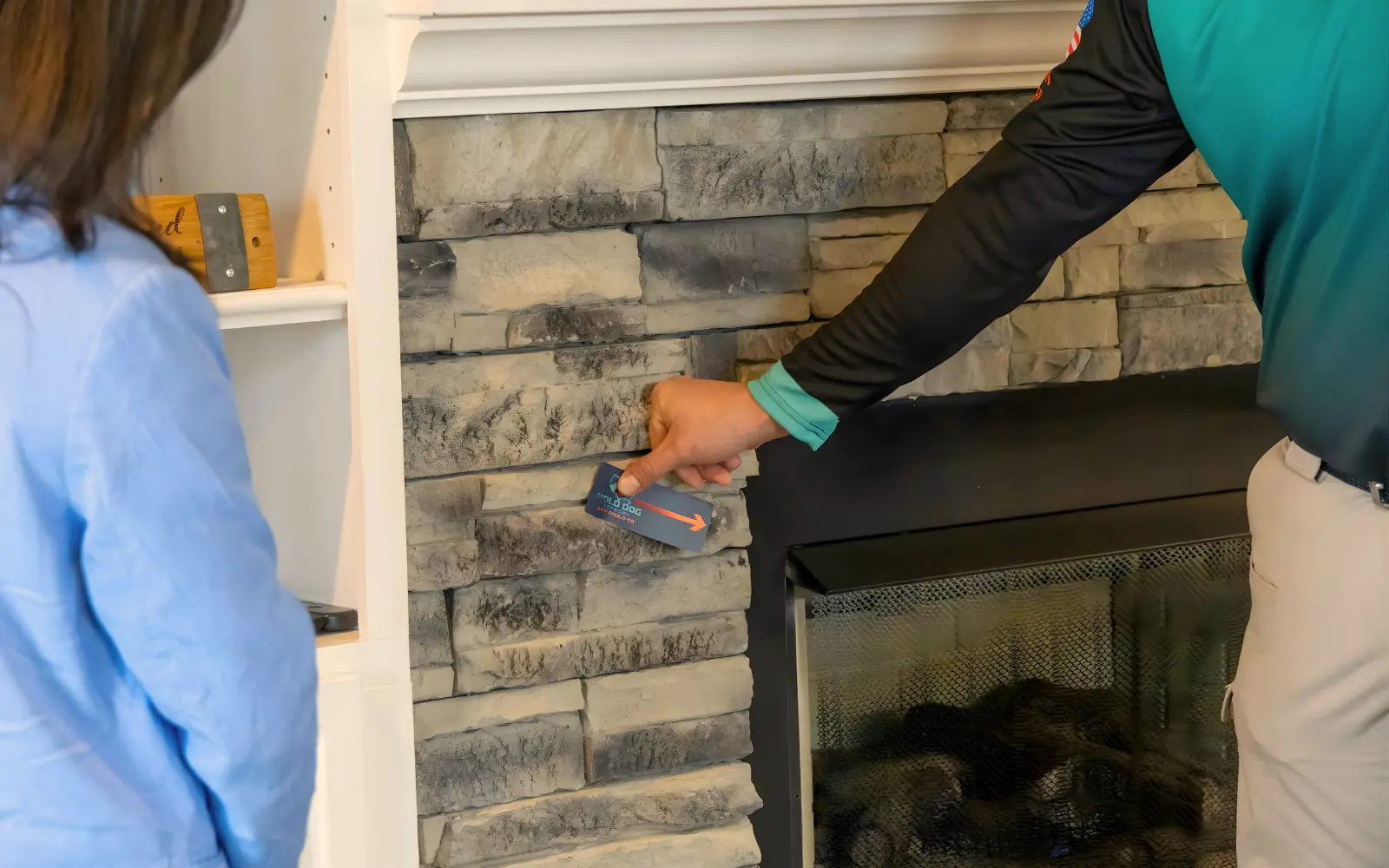
How Do Mold Dogs Find Mold Behind Walls?
If mold is sealed behind drywall, how could a dog standing in the room possibly know it’s there?
It sounds strange at first. The dog can’t see through the wall, and neither can the handler. So if there’s no visible mold, no obvious staining and nothing you can point to, what is the dog actually finding?
The answer is scent.
Mold detection dogs are trained to recognize specific mold-related target odors. During an inspection, the handler systematically guides the dog along accessible wall areas, floors and other parts of the room so the canine has the opportunity to detect those odors.
The dog isn’t “seeing” what’s inside the wall. It’s responding to the scent it encounters while searching that area.
That distinction matters because hidden mold is often exactly that: hidden. It may be inside a wall cavity after a plumbing leak, behind drywall that still looks perfectly normal from the room side, or in another concealed area where a visual inspection can’t tell you much.
For homeowners, that can leave you with an uncomfortable choice: keep guessing, or start opening walls just to see what’s there.
A mold dog inspection gives you another option.
Rather than starting with exploratory demolition, a trained canine-handler team can search the room methodically, mark areas where the dog alerts and give you a more specific place to investigate next.
As Caleb Jones, co-owner of Mold Dog Network, explains, the process is much more structured than simply bringing a dog into the home and hoping it picks something up.
“Our handler uses a leash, leads the canine in a perimeter… and inspects the wall cavities.”
Caleb Jones
So, how do mold dogs find mold behind walls?
It comes down to three things working together: a dog trained on the right target odor, access to the wall areas being searched, and a handler who knows how to cover the room systematically.
Mold Dogs Find Hidden Mold by Following Scent, Not by Seeing Through the Wall
When homeowners ask how mold dogs find mold behind walls, it’s tempting to picture the dog somehow “seeing” what’s concealed inside the structure.
That’s not what’s happening.
The dog is performing scent-detection work.
During training, Mold Dog Network’s canines are introduced to mold-related target odors and rewarded when they successfully locate them. Caleb says MDN trains its dogs across odors associated with multiple common mold families found in indoor environments.
Once the dog understands that finding its target odor leads to a reward, that same skill can be applied during a real inspection.
So when a mold detection dog works along a wall, it isn’t looking through the drywall. It’s searching for the mold-related odor it has been trained to recognize.
“They’re just gonna tell you that the mold that they’re trained to alert on is present in the environment.”
Caleb Jones
That distinction is important.
The dog isn’t expected to identify the exact mold species behind the wall. Caleb specifically explains that MDN’s dogs aren’t trained to give one alert for Stachybotrys and another for Penicillium.
Their role is much more focused: recognize the trained target odor and indicate where they’re encountering it.
Why walls are such an important place to search
A wall can look completely normal on the room side while moisture has entered the cavity behind it.
A slow plumbing leak, roof problem or previous water event may affect drywall, wood and other materials without leaving an immediately obvious patch of visible mold.
The U.S. Environmental Protection Agency identifies areas such as the backside of drywall, pipe chases and other damp spaces behind walls as places where hidden mold may be found. The EPA also recommends drying wet or water-damaged materials within 24–48 hours to help prevent mold growth.
Source: https://www.epa.gov/mold/brief-guide-mold-moisture-and-your-home
That’s exactly why “I don’t see anything” doesn’t always settle the question after a leak.
And it’s where understanding how mold detection dogs find hidden mold becomes useful.
Rather than relying only on what can be seen from the finished side of the wall, the canine-handler team searches for another clue: the trained target odor associated with hidden mold.
An alert still isn’t a map of everything inside the cavity. It doesn’t tell you the precise dimensions of growth or automatically tell you what remediation is required.
What it can do is narrow the problem from:
“There could be mold somewhere behind one of these walls.”
to:
“The detection dog alerted while searching this particular area.”
When you’re trying to decide where further investigation should begin, that’s a much more useful place to start.
If there’s been a leak, water damage or another reason to suspect mold inside a wall, a mold dog inspection can help narrow down the areas that deserve closer investigation before opening finished surfaces at random.
Why MDN Searches Along the Wall Instead of Letting the Dog Wander
A mold detection dog may be capable of picking up the target odor, but how the dog moves through the room affects how useful the inspection is.
Caleb explains that dogs are naturally motivated to find the strongest available scent because that’s the quickest route to the reward they’ve been trained to expect.
In a mold inspection, that can create a problem.
If a dog were simply released into the room, it might cut diagonally across the space toward the heaviest odor source and pass smaller areas that still need attention.
“Our handler uses a leash, leads the canine in a perimeter… and inspects the wall cavities.”
Caleb Jones
That’s why Mold Dog Network uses a leashed search rather than letting the dog wander freely.
The handler controls the route and works the dog around the accessible perimeter of the room so each wall area has a better chance of being searched deliberately.
The room is searched systematically
Caleb describes the process as methodical.
The handler guides the dog along the walls, then works a broader pattern through the room where appropriate so floor and ceiling areas can also be covered.
If the dog alerts, the location is marked.
Then the team keeps going.
That last part is important because one alert doesn’t automatically mean there aren’t other problem areas nearby.
Caleb says a property may contain several separate mold sources. If the canine were allowed to focus only on the strongest odor first, weaker sources could potentially be passed over.
“They may be prone to go straight from a diagonal across a room to where the heaviest scent is, but they could pass over two or three different areas that are having smaller issues but still need to be addressed.”
Caleb Jones
So the goal isn’t:
“Find one mold source as quickly as possible.”
It’s:
“Give the dog the opportunity to search the areas that need to be searched.”
That distinction is central to what happens during a mold dog inspection.
The dog supplies the scent-detection ability.
The handler controls the coverage.
A strong canine nose can’t properly evaluate a section of wall if the dog is never brought near it. Likewise, finding a heavy scent source on one side of the room doesn’t mean everything else should automatically be treated as clear.
If you’re concerned about mold behind multiple walls, look for an inspection process that systematically covers the room rather than simply following the strongest odor first.
Why You’ll Be Asked to Move Furniture Away From the Walls
Before a mold dog inspection, Mold Dog Network may ask you to move furniture roughly two to three feet away from the walls where possible.
That isn’t just to make the room easier to walk through.
It’s part of giving the canine-handler team proper access to the wall areas they’re trying to search.
“We asked them to move the furniture away from the walls two to three feet to give us a perimeter to be able to search all of the wall cavities.”
Caleb Jones
If a large sofa, cabinet or heavy piece of furniture is pressed directly against the wall, the dog can’t search that section with the same access it would have along an open perimeter.
That matters because mold dogs find mold behind walls by detecting their trained target odor while working along the wall area.
The better the access, the more complete that search can be.
This connects directly to how accurate mold detection dogs are.
Caleb includes inaccessible areas and furniture that can’t be moved among the reasons a real-world inspection isn’t treated as 100% perfect. A strong detection dog still needs to be brought close enough to the relevant areas to evaluate them properly.
So if MDN asks you to pull furniture away from the wall, it isn’t busywork.
You’re helping create the search path the team needs.
There’s another side to property preparation too: removing obvious mold sources that could distract from the hidden structural issue you’re actually trying to find.
Caleb gives several examples.
An old wet sponge may contain mold. So can a shower drain that hasn’t been cleaned in a while. Dirt and debris inside window tracks can also support mold growth.
A trained dog may correctly detect those sources.
The problem is that they may not be the reason you booked the inspection.
“If a canine alerts on a window, we want to make sure it’s an issue underneath the window and not that she’s alerting on the window track.”
Caleb Jones
Imagine a dog alerts beside a window and nobody has cleaned the track beforehand.
Is the alert related to hidden moisture damage beneath the window?
Or is the dog accurately detecting mold growing in debris sitting inside the track?
Without proper preparation, that becomes harder to interpret.
Caleb makes the same point with a kitchen sponge.
“You need to know if mold is hidden somewhere in the house, not that you have a moldy sponge sitting on your sink.”
Caleb Jones
That’s why MDN asks homeowners to take steps such as:
- moving furniture away from walls where practical
- disposing of old or moldy sponges and damp cleaning materials
- sanitizing shower drains
- cleaning window tracks
- improving access to the areas the dog needs to search
The goal isn’t to make the dog alert as many times as possible.
The goal is to make each alert as useful as possible.
If obvious, non-structural mold sources have already been dealt with and the dog then alerts at a particular wall, the homeowner has a much more meaningful location to investigate.
Before your mold dog inspection, improving access to walls and removing obvious nuisance mold sources can help the canine-handler team focus on the hidden problem you’re actually trying to locate.
What Happens When a Mold Dog Alerts at a Wall?
Once the dog detects its trained target odor, it needs to give the handler a clear signal.
Mold Dog Network generally uses a sit or down alert.
Caleb says that’s intentional because subtle behaviors could be easy for a handler to miss while the dog is moving along a wall.
“Whenever the canine sits down, that’s a very strong visual tell to tell the handler to stop.”
Caleb Jones
A sitting or lying-down alert creates a clear break in the search.
The dog stops.
The handler knows that area needs to be marked and documented.
But an alert beside a wall still needs to be interpreted correctly.
What the alert means
In practical terms, an MDN alert means:
The dog has detected the mold-related target odor it was trained to recognize while searching that area.
That can be extremely useful when the concern is hidden mold.
Instead of having an entire room described as “possibly affected,” you now have a more specific location where the canine encountered its trained scent.
For a homeowner, that may change the next question from:
“Which wall are we supposed to investigate?”
to:
“The dog alerted at this section, so this is where we should focus first.”
What the alert doesn’t mean
A mold dog alert isn’t a complete diagnosis of everything behind the drywall.
It doesn’t automatically tell you:
- exactly where hidden growth begins and ends
- how large the affected area is
- which mold species is present
- how much material needs to be removed
- whether the entire wall needs remediation
- what health impact the mold may or may not be having
Caleb specifically explains that MDN’s dogs don’t give different alerts for different mold species.
“They’re just gonna tell you that the mold that they’re trained to alert on is present in the environment.”
Caleb Jones
That makes the canine alert a location tool, not a species test or remediation protocol.
There can also be smaller behavioral details that an experienced handler starts to recognize after working with the same dog repeatedly.
Caleb gives the example of one MDN handler, Zach, and his dog Mika. Zach has noticed that when Mika alerts and the scent appears stronger higher up, she may sit and then look upward toward that area.
That shouldn’t be treated as a universal rule for every mold dog.
It’s an example of how individual canine-handler teams learn one another’s behaviors over time while still relying on the formal trained alert.
The alert is documented
The finding doesn’t disappear once the canine team leaves the room.
During the inspection, handlers use temporary markers so they can identify alert locations while continuing to work with the dog.
Once the room is complete, the dog can take a break while the handler returns to those areas.
Those locations are photographed and incorporated into the digital report.
“They’ll go through and they’ll photo document all of the areas that the canine alerted on and we put it into a digital report that we give to the client.”
Caleb Jones
If you want to understand that next stage in more detail, read what happens after a mold dog alerts.
An alert doesn’t mean you should immediately tear out the wall.
It means you now have a specific area to investigate instead of opening finished surfaces at random.
If opening multiple walls just to find the source feels like an expensive guessing game, schedule a mold dog inspection for hidden mold and narrow the search to specific areas first.
Mold Dogs Don’t Need to See the Mold to Help Locate It
So, how do mold dogs find mold behind walls?
They don’t see through drywall, and they don’t somehow know the exact shape of what’s hidden inside a cavity.
They work by scent.
The dog is trained to recognize mold-related target odors, while the handler deliberately guides it along accessible wall areas and other parts of the room.
When the dog encounters that target odor, it gives a clear alert that can be marked and documented.
That process can be especially useful when you suspect something is happening behind a wall but have no visible proof.
Maybe there was an old plumbing leak.
Maybe a window has let water in.
Maybe there’s a persistent musty smell in one room and nobody has been able to explain it.
In those situations, the problem often isn’t simply knowing that mold can grow behind walls.
The real problem is knowing where to look.
A mold dog alert doesn’t tell you the exact species, full size of the hidden growth or remediation scope.
What it can do is narrow a large area of uncertainty down to somewhere much more specific.
That can help you avoid starting with random exploratory demolition and give the next professional involved a clearer place to investigate.
Mold Dog Network’s role is straightforward: find the hidden mold so you have better information about what to do next.
If you’re staring at a perfectly normal-looking wall but still suspect mold may be hidden behind it, schedule a mold dog inspection and find out where the search should actually begin.