
Mold in Commercial Buildings: Signs Business Owners Should Watch For
A ceiling leak has been repaired, but the musty smell keeps returning. Staff mention the same room, and you’re unsure whether the previous work addressed everything. It’s frustrating to hear the concern again after you thought the repair had settled it.
Mold in commercial buildings is one possibility worth investigating when moisture problems persist. Odors, staining, and occupant concerns need interpretation rather than assumptions about the cause.
Tina, co-owner of Mold Dog Network, explains why workplaces deserve attention and how a systematic search can help. Our guide to common places mold hides provides more context about concealed locations.
- Which Signs in a Commercial Building Deserve Investigation?
- Where Can Hidden Mold Be Located in a Commercial Property?
- What Should Owners Gather Before an Inspection?
- How Can a Mold Dog Help Investigate a Commercial Building?
- What Should Happen After Areas of Concern Are Identified?
- Turn Recurring Clues Into a Focused Investigation
Which Signs in a Commercial Building Deserve Investigation?
A recurring musty odor, damp material, or known leak gives you a specific concern to investigate. Looking only for visible mold can leave questions about concealed areas unanswered.
Clues worth recording include:
- Water staining or deteriorating wall and ceiling finishes.
- Damp carpeting or other materials.
- Condensation or moisture that repeatedly returns.
- Leaks without a clear record of drying and follow-up.
- Reports of concerns in particular rooms or equipment areas.
Tina explains why workplaces are part of Mold Dog Network’s service offering:
“And then we go to work and we spend eight to ten hours a day in our office environment.”
Tina Craig
Her point is that the places people spend their working day deserve attention alongside their homes. The building’s condition matters even when the source of a concern isn’t obvious.
These observations don’t establish mold in commercial buildings on their own. Odors and staining can have different causes, and a report of feeling unwell doesn’t identify what caused it.
NIOSH recommends responding to worker concerns and communicating about assessments and remedial actions. Record what was reported and where, then arrange the appropriate building investigation. Health concerns may also need medical assessment.
Ask people to describe the location and timing of what they noticed. Recurring observations can help focus the investigation, even when different occupants describe the same area in different ways.
Respond to active water problems promptly. You don’t need to wait for an additional mold inspection before arranging help for an ongoing leak.
Dealing with recurring odors or unresolved moisture concerns at your premises? Contact Mold Dog Network to discuss whether a commercial inspection could help.
Where Can Hidden Mold Be Located in a Commercial Property?
Commercial interiors can conceal materials behind finishes, above ceilings, beneath flooring, and around building equipment. The appropriate investigation depends on the layout and moisture history.
The EPA’s commercial-building guidance identifies concealed surfaces and components that can support hidden growth. Some locations overlap with Tina’s general inspection observations.
Record the location of the visible clue without assuming it marks the source. A stained ceiling tile may lead to questions about materials above it, while dampness beside equipment may require attention to the surrounding floor or wall as well as the equipment itself.
Those supporting guides discuss homes, but the distinction between exposed surfaces and concealed materials is useful in commercial properties too. Repair decisions need to fit the specific building and system.
Where a property has an attic or crawlspace, discuss how it can be assessed safely. Tina explains:
“The canines do detect on the crawl spaces and the attics.”
Tina Craig
She also makes clear that direct entry depends on safe access. An alert from an accessible point can guide follow-up without defining every affected surface beyond it.
Likewise, an odor or alert near a vent doesn’t establish that every duct is contaminated. Investigating mold in commercial buildings means identifying which materials and areas actually need further assessment.
Unsure which concealed areas need attention? Share the building layout, access limitations, and moisture history with our commercial inspection team.
What Should Owners Gather Before an Inspection?
Building records help explain what happened before the current concern. Gather roof and plumbing repair details, HVAC service information, previous assessments, and records of water events and drying work.
Include dated reports showing where odors, dampness, or damage were noticed. A clear location is more useful than a general description that the building smells wrong.
Tina emphasizes a practical question about earlier moisture events:
“How fast did they take care of that water intrusion or that humidity level?”
Tina Craig
Ask what became wet, what was assessed, and how drying or cleanup was evaluated. A repaired leak doesn’t, by itself, explain the condition of every material it affected.
Historical research illustrates why water history deserves attention. EPA’s BASE study reported past water damage in 85% of its sampled office buildings. The study examined 100 randomly selected public and commercial office buildings and was conducted in 1994–1998. That’s historical water-damage evidence, not today’s national mold prevalence or proof about your premises.
When investigating mold in commercial buildings, records help turn a broad concern into specific questions. If your business leases its space, coordinate access to restricted or shared areas with the appropriate owner or facilities contact.
Have repair records but still no clear explanation for the concern? Ask Mold Dog Network what information would help plan a commercial inspection.
How Can a Mold Dog Help Investigate a Commercial Building?
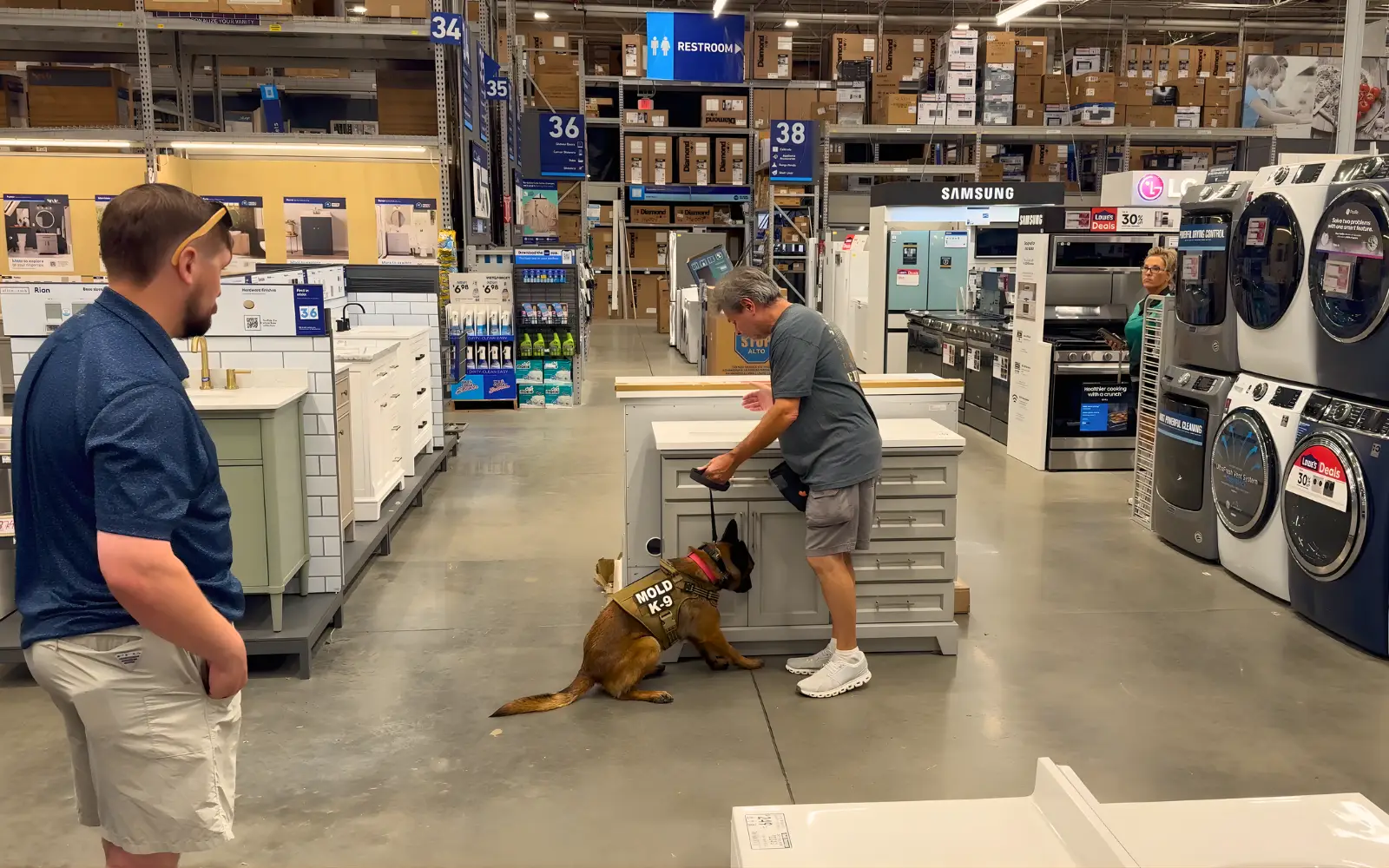
A trained dog and handler search accessible areas systematically. The handler documents trained alerts so there’s a record of locations that may need further investigation.
Asked whether the approach changes between homes, offices, and vehicles, Tina explains:
“The process is the same.”
Tina Craig
Our commercial mold dog inspections help investigate suspected mold in commercial buildings without beginning with exploratory demolition. The approach adapts to the layout, safe access, and agreed scope.
Before booking, discuss the areas to be covered, site conditions, access arrangements, and scheduling. Identify a suitable site contact and explain any restricted spaces or operational requirements. Don’t assume an inspection of accessible rooms includes every sealed void or internal equipment component.
Findings help direct the next assessment
An alert directs attention; it doesn’t establish species, every affected boundary, or the complete repair scope. Access and odor movement can influence the search, and dogs aren’t infallible.
Our role is to help locate suspected hidden mold. The findings can guide appropriate professionals investigating moisture sources, affected materials, and necessary work.
A canine report doesn’t establish a medical diagnosis, legal compliance, or suitability for unrestricted occupancy. Those questions need the appropriate assessment rather than an assumption based on a scent alert.
Ask how the documented locations will be explained to whoever handles the next assessment.
Want help narrowing the areas requiring investigation? Contact Mold Dog Network to discuss the scope of a commercial mold dog inspection.
What Should Happen After Areas of Concern Are Identified?
The next steps depend on what further assessment establishes. A location identified during a scent search is a starting point for investigation, rather than a complete specification for remediation.
Match the work to the confirmed conditions
The appropriate professionals need to investigate the moisture source and affected materials. Depending on the conditions, that may involve planned opening, containment, cleaning, drying, repairs, or removal.
Tina’s observations repeatedly return to concealed moisture:
“That moisture loves to hide.”
Tina Craig
Repairing a visible surface or masking an odor doesn’t establish that the underlying problem is resolved. A useful response to mold in commercial buildings addresses the moisture conditions alongside the affected materials.
Mold Dog Network’s detection service is separate from leak repairs, occupational health assessments, and remediation. Keep the findings available to the professionals carrying out the next stage.
Keep people informed and check the result
NIOSH recommends keeping records of findings and corrective work, informing workers about assessments and responses, and monitoring areas after repairs. EPA guidance supports planning remediation around the moisture problem and affected materials.
Ask what was confirmed, which areas received work, and how the completed work will be evaluated. If dampness or odors return, record where and when so the next investigation has useful context.
Occupancy, reopening, insurance, and legal questions need the appropriate professional advice. A canine inspection alone doesn’t determine those outcomes.
Ready to investigate before committing to a repair plan? Contact Mold Dog Network to discuss your commercial inspection concerns.
Turn Recurring Clues Into a Focused Investigation
Odors, leaks, and occupant concerns deserve a clear response. They don’t establish mold in commercial buildings on their own, and a clean-looking interior doesn’t settle every question about concealed materials.
Tina’s workplace observations highlight why these environments deserve attention. Gather the building history, define what needs investigating, and understand what each assessment can establish.
Use findings to guide appropriate follow-up, communicate what’s being done, and check whether the moisture problem has been resolved. That gives owners and managers a practical way to move from a recurring complaint toward a plan based on the building’s actual conditions.