
Mold Dog Inspections: How Mold Detection Dogs Find Hidden Mold
You’ve probably heard of dogs trained to find drugs, explosives or missing people. But a dog trained to find mold behind a wall??
If that’s a new concept to you, it’s reasonable to have questions.
Can a dog really tell there’s mold somewhere you can’t see? What exactly is it smelling? Does the dog just wander around the house until something catches its attention? And how much trust should you put in an alert?
Those are important questions, especially if you’ve already spent money trying to work out whether hidden mold is present in your home.
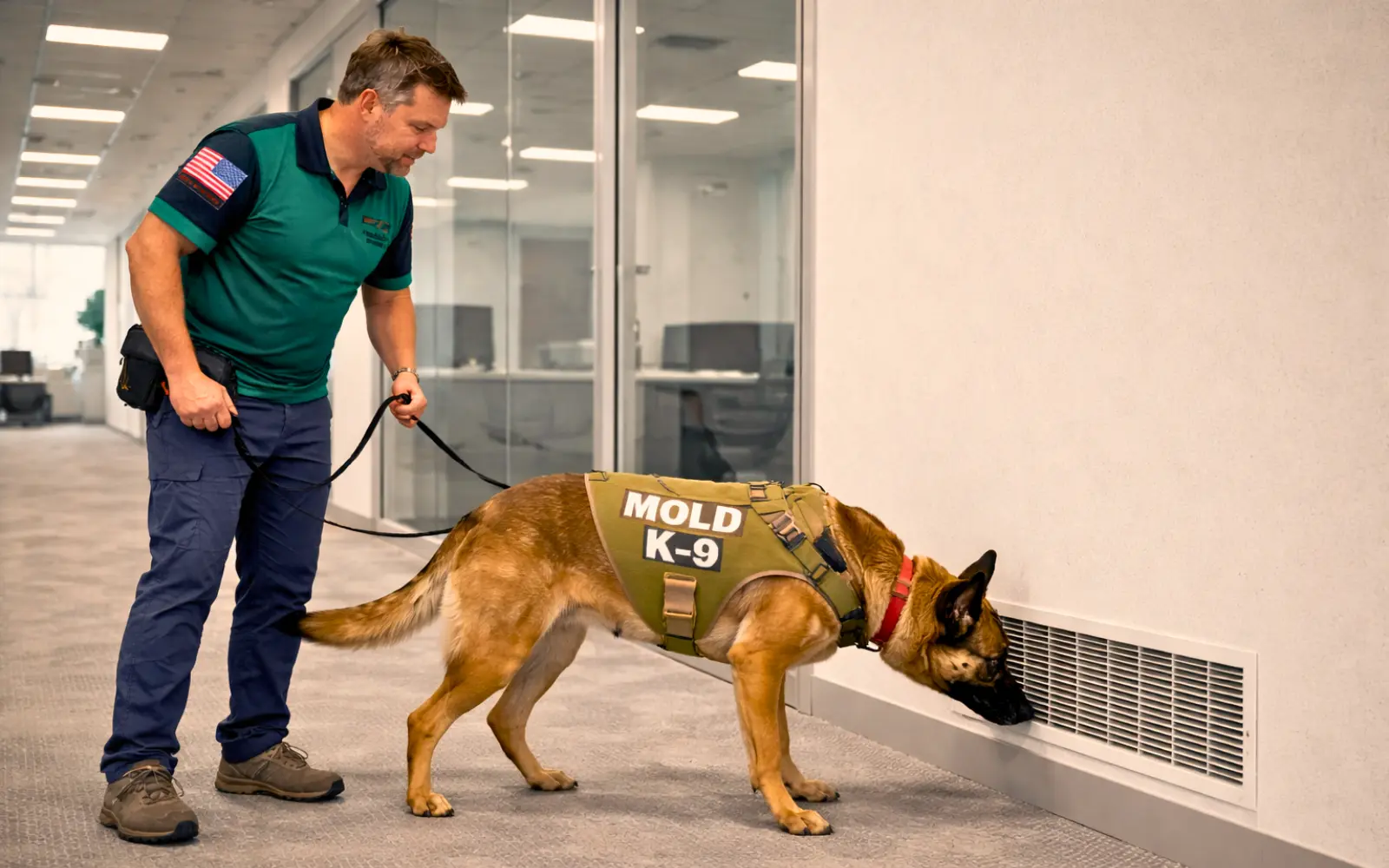
A mold dog inspection isn’t a matter of bringing a pet into a property and asking it to sniff around. Mold detection dogs are selected for their drive to work, trained on specific target odors and paired with handlers who follow a systematic inspection process.
For Mold Dog Network co-owner Caleb Jones, that process is the part homeowners need to understand.
The dog’s nose is obviously important. But so are its training, the way the handler moves it through each room, the behavior it uses to alert, the preparation of the property and the way those alerts are documented afterward.
When all of those pieces work together, mold detection dogs can help narrow down hidden mold locations without starting by cutting open walls or pulling up floors.
Here’s how it works.
Watch the full interview here!
- Mold Detection Dogs Aren’t Pets Being Asked to “Find Mold”
- MDN looks for dogs that actually want to work
- What Are Mold Dogs Actually Trained to Smell?
- How a Mold Dog Inspection Searches an Entire Room
- A systematic room search
- What Does a Mold Dog Alert Actually Look Like?
- How Accurate Are Mold Detection Dogs and What Can Affect the Result?
- What a mold dog inspection can (and can't) tell you
- What Happens After the Dog Finds a Suspected Mold Location?
- MDN's job is to find the mold
- Stop Guessing Where Hidden Mold Might Be
Mold Detection Dogs Aren’t Pets Being Asked to “Find Mold”
One of the easiest ways to misunderstand mold dog inspections is to focus on the fact that the inspector has four legs.
Yes, the dog’s sense of smell is the tool that makes the inspection possible. But the underlying concept of scent detection is already used in demanding working environments.
“It’s a very similar procedure to how bomb dogs, cadaver dogs, drug dogs are trained.”
Caleb Jones
The comparison matters because it puts the work in context. MDN isn’t suggesting mold is somehow equivalent to explosives or narcotics. The point is that dogs can be trained to recognize a target odor and search for it on command.
Research into canine olfaction helps explain why they’re so effective at scent work. During inspiration, around 12–13% of airflow is directed toward the olfactory portion of a dog’s nose, where odors can be sampled. Canine sniffing also creates specialized airflow patterns that support odor acquisition and localization. This physiology is described in research on canine olfaction published in Frontiers in Veterinary Science and work published in the Journal of the Royal Society Interface.
But a strong nose alone doesn’t make a mold dog.
MDN looks for dogs that actually want to work
Caleb says the selection process starts with drive.
A successful detection dog needs to enjoy searching. Finding the target odor leads to a reward, so the dog needs enough hunt drive to keep working through rooms and repeatedly searching areas even when the answer isn’t immediately obvious.
That’s why MDN generally works with breeds such as Labrador Retrievers and Belgian Malinois.
The goal isn’t to choose an intimidating-looking dog. It’s to find a dog with the working characteristics needed for scent detection: focus, drive, trainability and the ability to operate safely in real homes and buildings.
Caleb puts it simply: you don’t want a dog whose favorite occupation is lying on the couch. You want a dog that wants the job.
After general obedience work and an assessment of whether the dog is suited to detection, scent-specific training begins.
Caleb explains that MDN’s training process exposes its dogs to odor targets representing 16 families of mold commonly associated with indoor environments. The dog isn’t being taught the scientific name of each mold or asked to identify one species from another. It’s learning that finding its trained target odor earns its reward.
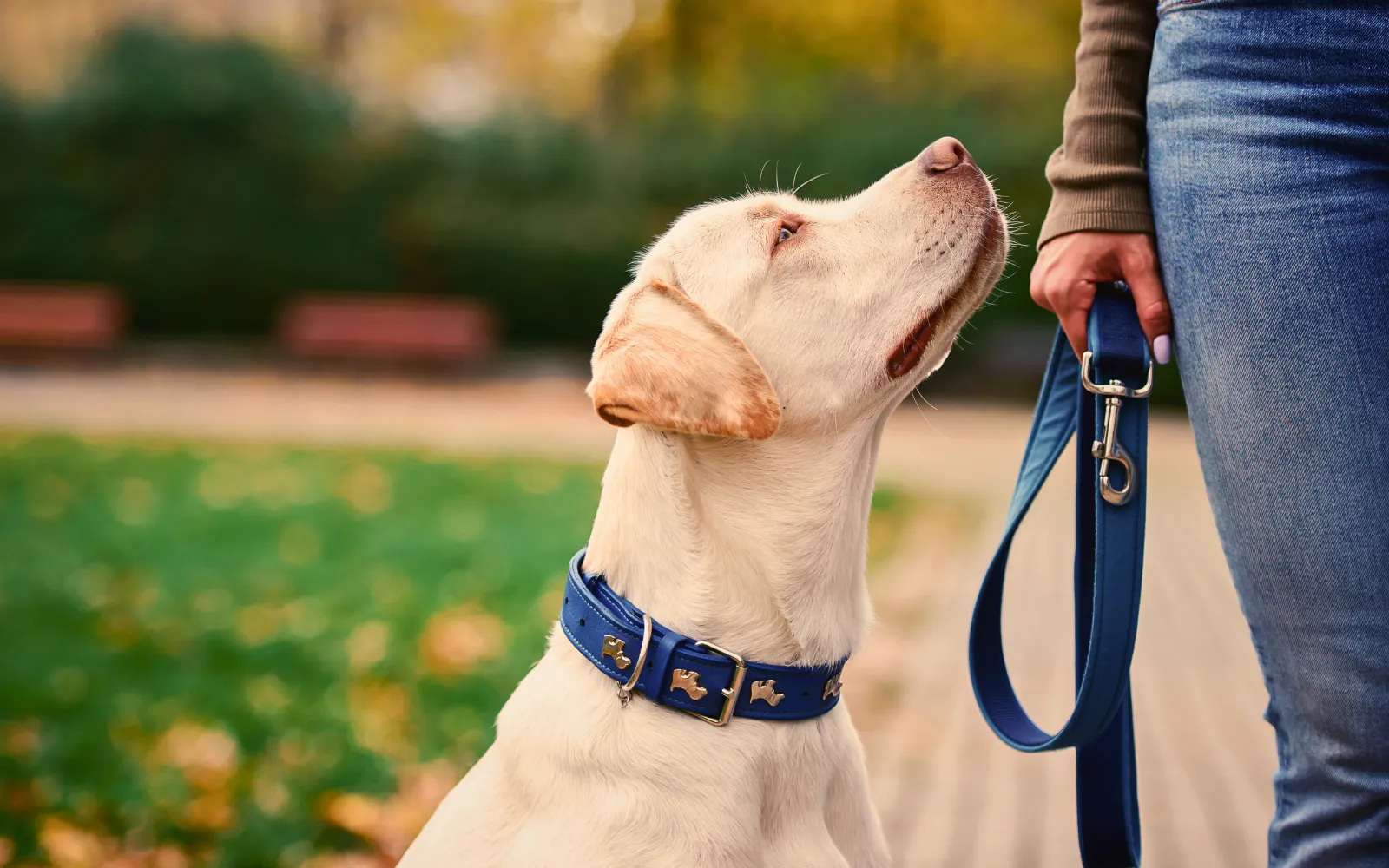
That reward may be food or a toy depending on the individual dog and team.
And the training doesn’t end when the dog starts doing paid inspections. Detection skills have to be maintained. The dog and handler continue working together so the behaviors used during inspections remain consistent.
Curious whether a mold dog could help with your property? Schedule a mold dog inspection with Mold Dog Network and have a trained canine-handler team search for the source rather than relying on guesswork.
What Are Mold Dogs Actually Trained to Smell?
This is where mold dog inspections get more interesting.
Most homes contain some mold spores. The EPA notes that mold spores occur naturally in indoor and outdoor air, and that eliminating every mold spore from an indoor environment isn’t realistic. What matters is whether moisture allows mold to begin growing indoors.
So if a mold dog simply reacted every time it encountered an ordinary background mold spore, it wouldn’t be particularly useful.
Caleb describes MDN’s training target differently:
“The canine is only trained to alert on living mold colonies.”
Caleb Jones
In practical MDN terms, the goal is for the dog to respond to the odor associated with established mold growth rather than react indiscriminately to the normal background spores people carry into buildings on clothes, shoes and other belongings.
An alert isn’t a lab analysis. The dog isn’t telling you, “There are X spores per cubic meter,” or identifying a particular mold species by name. It’s indicating that its trained target odor is present in the area it’s searching.
Why preparation before the inspection matters
There’s another side to this.
An actively moldy sponge is still mold.
So is growth in a dirty shower drain.
If the dog is trained to find mold odor, it may correctly alert to one of those sources even though that isn’t the hidden building problem the homeowner paid to investigate.
That’s why MDN asks homeowners to prepare certain areas before the dog arrives.
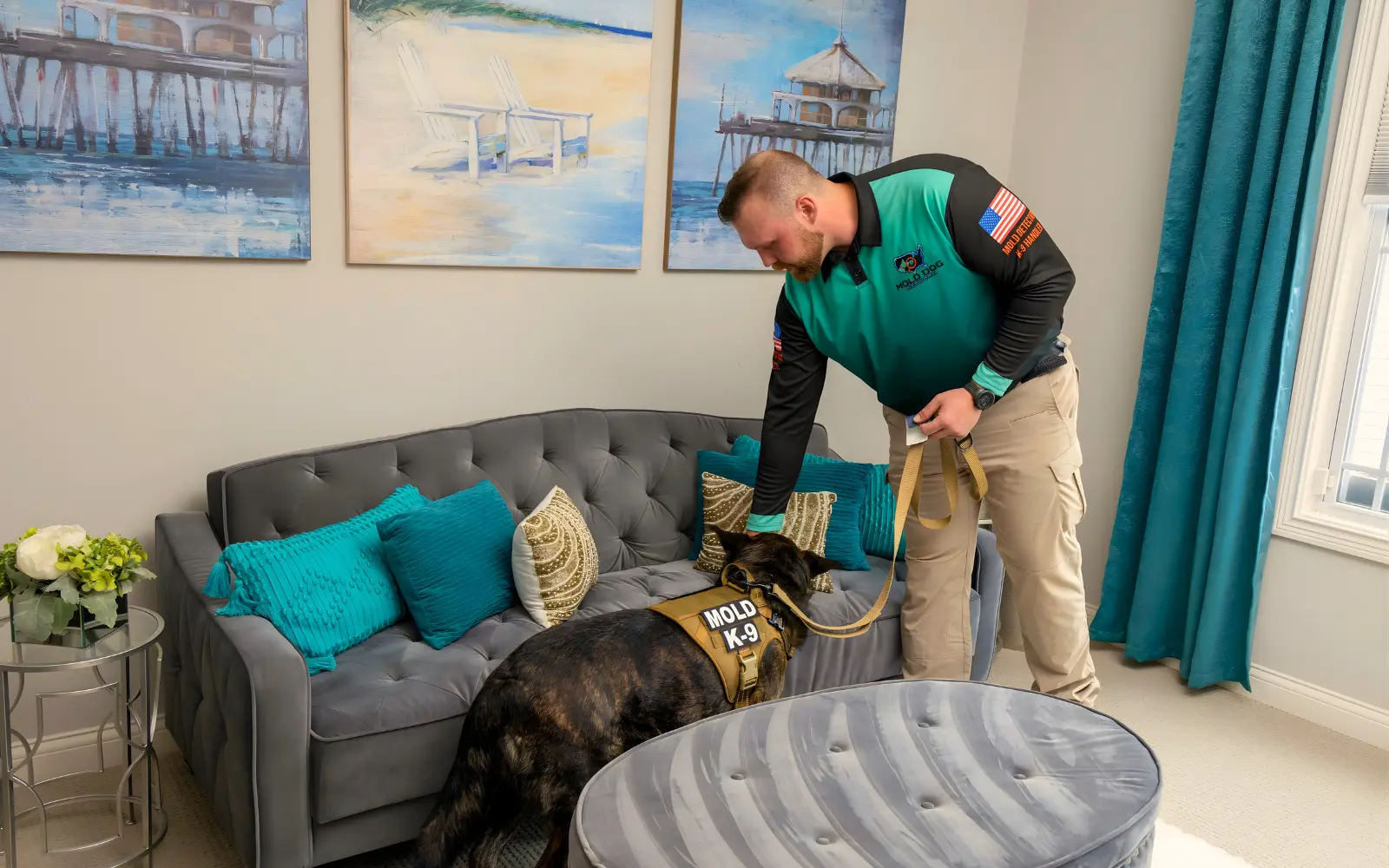
That can include:
- disposing of old sponges or damp cleaning materials that may have mold growth
- cleaning and sanitizing shower drains
- cleaning debris from window tracks
- moving furniture approximately two to three feet away from walls where possible
- making accessible surfaces available for the dog-handler team to search
Caleb says MDN’s background in the mold remediation industry helped shape those protocols.
If a dog alerts beside a kitchen island, for example, you want confidence that the team has narrowed the odor toward the structure itself, not simply discovered the moldy sponge sitting beside the sink.
“You need to know if mold is hidden somewhere in the house, not that you have a moldy sponge sitting on your sink.”
Caleb Jones
Water history matters here too.
The EPA recommends drying water-damaged areas and materials within 24–48 hours to help prevent mold growth. It also specifically identifies hidden locations such as the back of drywall, beneath carpets and pads, around pipes inside walls and within ductwork as areas where mold can be concealed. (Source)
The objective isn’t to prove that mold exists somewhere in the world around you. It’s to narrow down the areas in your property that may contain growth worth investigating further.
If there’s been water damage and you still don’t know what’s happening behind the finished surfaces, a mold dog inspection can help narrow the search before you start opening walls or flooring.
How a Mold Dog Inspection Searches an Entire Room
So, does the handler open the front door, unclip the leash and tell the dog to go find mold?
No.
In fact, Caleb says MDN deliberately uses leashed inspections because allowing the dog to choose its own route could reduce the completeness of the search.
“We always use leashed inspections because we feel that we want the handler to be able to have control over where the canine is going to search.”
Caleb Jones
A dog naturally wants to find the target that earns its reward. According to Caleb, that can mean it gravitates toward the strongest available scent.
Imagine there’s one significant mold source on the far side of a room but two smaller sources along the route toward it. Left entirely to its own devices, the dog may have an incentive to head toward the strongest target first.
That’s not what the homeowner is paying for.
The job is to search the room, not just find the easiest source.
A systematic room search
Caleb describes the MDN inspection pattern as deliberate and methodical.
- The handler controls the search route.
The dog remains on leash so the handler can direct it through the areas that need to be checked. - The team works the perimeter.
The dog is guided along walls rather than being allowed to cut straight across a room toward a stronger scent. - Wall areas are searched in sequence.
This is one reason homeowners are asked to move furniture away from the walls where practical. - Floor and ceiling areas are incorporated into the search.
Caleb describes handlers using a broader zigzag-style pattern where appropriate so the inspection isn’t restricted to one horizontal line around a room. - Alerts are marked before the team moves on.
That gives the handler a way to return to each location for documentation. - The process is repeated room by room.
The difference between this and casual sniffing is important.
The dog supplies the scent-detection ability. The handler supplies coverage, consistency and control.
It also explains why access matters. A dog can’t meaningfully search a section of wall that’s blocked by furniture it can’t get near. It can’t inspect a locked or inaccessible space. Those physical limitations have to be considered when interpreting the inspection as a whole.
Moisture conditions inside a property also deserve attention. The EPA recommends keeping indoor relative humidity below 60%, ideally between 30% and 50% where possible, because moisture control is one of the main ways to discourage indoor mold growth. (Source)
Hidden moisture is part of what makes mold difficult to find in the first place. A finished wall can look perfectly normal from the room side while a pipe has been leaking inside the cavity.
That’s why a systematic mold dog inspection can be so useful when you know something happened, but you don’t know exactly where the resulting problem is.
Don’t want someone choosing a wall to open based on a hunch? Schedule a mold dog inspection designed to systematically search accessible areas before invasive investigation begins.
What Does a Mold Dog Alert Actually Look Like?
The dog has been guided along a wall. Then it stops.
What happens next?
MDN generally trains its dogs to give an obvious change in behavior – usually sitting or lying down – when they locate their target odor.
“We use a sitting alert for the most part, a sitting or laying down alert… whenever the canine sits down, that’s a very strong visual tell.”
Caleb Jones
There’s a practical reason for choosing a clear alert.
Imagine a dog whose trained behavior was simply to stare slightly longer at one point on the wall. The handler is moving. The dog is moving. The leash is moving. It’s easy to miss something subtle.
Worse, a handler could accidentally keep walking and pull the dog away from the odor it was trying to indicate.
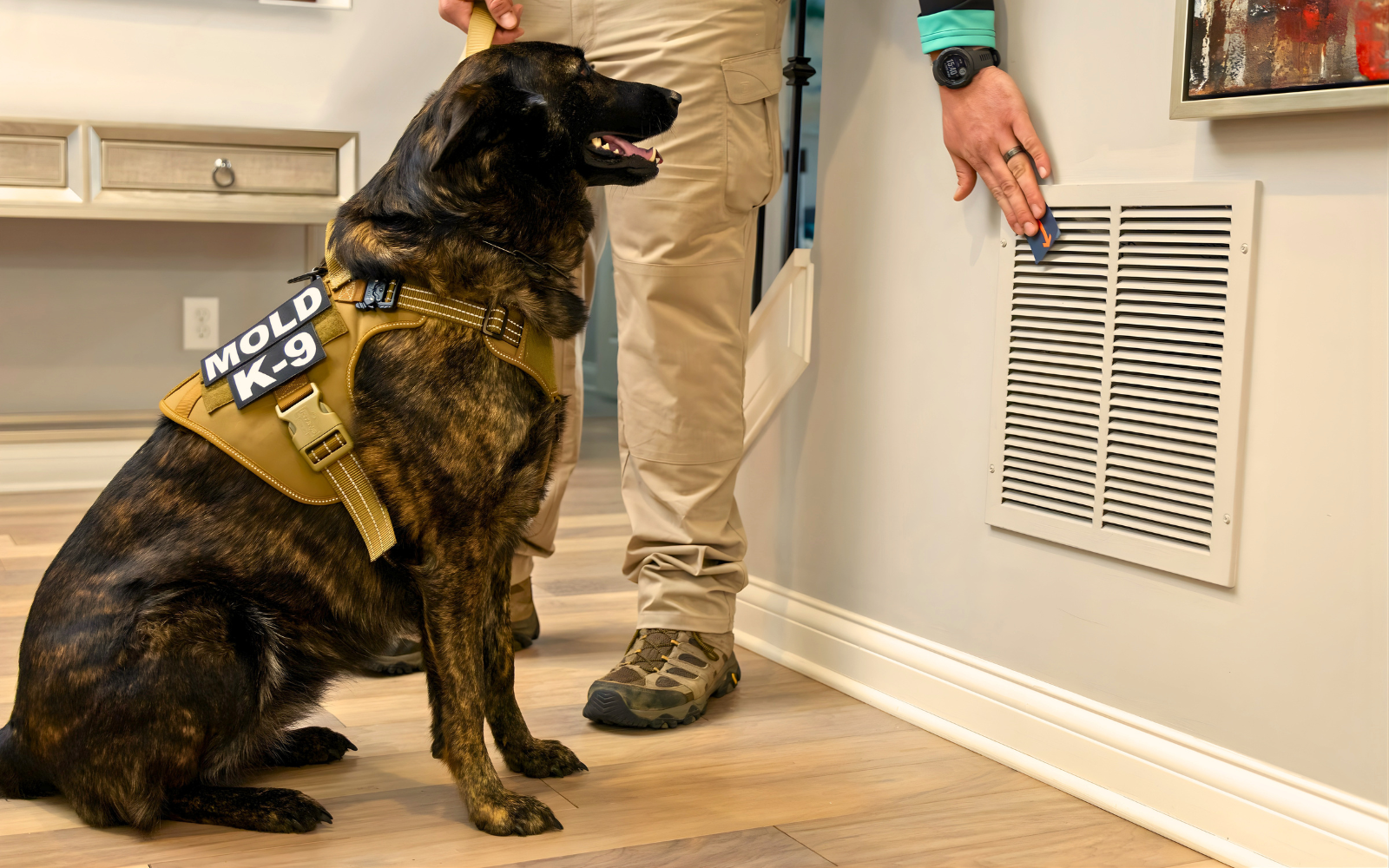
A sit or down creates a much clearer moment: the dog has stopped searching and is indicating a location.
There are also nuances that develop as a particular dog and handler gain experience together.
Caleb describes one of MDN’s handlers, Zach, working with his canine partner Mika. Zach has noticed that when Mika appears to be following odor coming from higher in an area, she may sit and then look upward toward where the scent seems stronger.
That isn’t presented as a universal “mold is in the ceiling” signal that applies to every detection dog. It’s an example of something more important: handlers learn their individual dog’s behaviors over time.
The relationship works in both directions.
The dog has to understand what the handler is asking it to search. The handler has to recognize the dog’s trained alert while also noticing the smaller behavioral cues that come from working together repeatedly.
That’s one reason MDN has looked favorably on handlers with previous professional canine experience, including military or law-enforcement backgrounds.
Caleb doesn’t describe that experience as an absolute hiring requirement. What matters is that the person understands what it means to have a working canine partner.
The dog doesn’t clock out at five and disappear until the next morning. The handler is responsible for its exercise, care and continued training. Skills have to be maintained, and consistency matters if the team is going to keep producing reliable work.
That may be less dramatic than the idea of a super-powered nose that instantly points to mold through drywall.
But it’s far closer to how the inspection really works.
A mold dog inspection is a trained dog and trained handler completing a search together.
If previous inspections have left you with vague suspicions instead of useful locations, a trained mold detection team can help turn “somewhere around here” into specific areas that can be documented and investigated.
How Accurate Are Mold Detection Dogs and What Can Affect the Result?
No mold inspection method is perfect.
Mold dogs aren’t either.
That’s something Caleb is explicit about, and it’s important that homeowners hear it before they book rather than after.
“We list a ninety to ninety-five percent accuracy on finding mold in hidden areas that the canine is passing through. Like you said, nothing is a hundred percent.”
Caleb Jones
That last sentence matters as much as the percentage.
A 90–95% accuracy range shouldn’t be translated into “the dog can’t miss.”
There are real limitations.
Where can the remaining uncertainty come from?
Inaccessible areas. If the canine team can’t physically reach a location, it can’t properly search it.
Furniture and stored belongings. If a wall remains completely obstructed, the team may not get the access it would have under ideal inspection conditions.
Property preparation. Mold growth in drains, cleaning tools or other irrelevant sources can distract from the building-related problem a homeowner actually wants located.
Environmental conditions. Odor moves through real buildings, not controlled laboratory boxes. Air movement and physical barriers can influence where scent is encountered.
Individual dog and handler factors. Both members of the team are living participants. Good training and consistent protocols reduce variability, but they don’t turn an inspection into a mathematically perfect process.
Caleb’s way of putting the percentage in perspective is useful: if you’re going to say something is 90% accurate, you also have to accept that there’s potentially 10% room for error.
It’s also important to understand exactly what “accuracy” means in MDN’s context.
The dog is being used primarily as a location tool.
It isn’t producing a laboratory mold count. It isn’t diagnosing a health condition. And it isn’t identifying the mold species from its alert behavior.
Its job is to help locate the target odor so a homeowner has a more specific place to focus next.
Compared to other inspection methods that average 30 – 40% accuracy, mold dogs are the clear winner!
What a mold dog inspection can (and can’t) tell you
It can help:
- identify accessible areas where the trained dog detects its target mold odor
- narrow the search when mold may be concealed
- document multiple alert locations throughout a property
- give homeowners more specific information to take into their next step
It can’t:
- guarantee that every mold source in every inaccessible space will be found
- diagnose mold-related illness
- tell you a mold species simply from the dog’s alert
- replace every type of laboratory testing or professional assessment in every situation
- automatically determine the correct remediation scope
For skeptical homeowners, that distinction should actually make the service easier to evaluate.
You don’t need to believe a mold dog is magic.
You need to understand the task it’s trained to perform and decide whether that task solves the problem in front of you.
If your problem is “I suspect hidden mold, but nobody can tell me where it is,” location is exactly the information you’re missing.
If you need more than a visual guess about where hidden mold may be located, talk with MDN about whether a 90%+ mold dog inspection is the right next step for your property.
What Happens After the Dog Finds a Suspected Mold Location?
An alert beside a wall is useful in the moment.
But you still need that information after the dog and handler leave.
MDN therefore documents the areas where the canine alerts during the inspection.
While actively working through a room, handlers use temporary markers so they can quickly identify alert locations without interrupting the dog’s search every few seconds.
Once the room is complete, the process changes.
The dog can take a break while the handler returns to those areas and photographs the findings.
“They’ll go through and they’ll photo document all of the areas that the canine alerted on and we put it into a digital report that we give to the client.”
Caleb Jones
That digital record matters because temporary stickers are just that: temporary.
You may want to remove them. One might get knocked off. You may have guests coming over and not want markers stuck around the house.
The report gives you a lasting record of where alerts occurred.
MDN’s job is to find the mold
This is also where Mold Dog Network draws an important line around its service.
Caleb and the MDN ownership team have experience in the mold remediation industry, and that background has influenced how the company’s inspection protocols have developed.
But Mold Dog Network itself isn’t intended to turn every inspection into hours of open-ended remediation consulting.
“Mold Dog Network is exclusively around finding hidden mold within a living environment. Like, that’s the company idea, that’s the company service.”
Caleb Jones
The distinction is deliberate.
Think about another type of detection dog. You wouldn’t expect the bomb-dog handler to find an explosive and then become the person responsible for dismantling it.
The specialty is detection.
For MDN, the core job is similar in principle: find the suspected hidden mold locations and document them clearly.
Depending on the property and what happens next, a homeowner may choose to take those findings to a remediation company, an industrial hygienist or another qualified professional. Additional targeted testing may also make sense in some circumstances.
MDN may be able to point clients toward trusted professionals in markets where relationships have been established, but the inspection itself is about giving the homeowner clearer information first.
That can be especially valuable after a long period of uncertainty.
Maybe you’ve smelled something for months but can’t find it. Maybe there was an old leak nobody properly investigated. Maybe someone told you mold could be behind a wall, but the only way they’ve suggested checking is to start opening things up.
A mold dog alert doesn’t make every decision for you.
It gives you a place to start making those decisions.
Ready to stop guessing? Schedule a mold dog inspection and get documented alert locations you can use to decide what needs to happen next.
Stop Guessing Where Hidden Mold Might Be
Mold detection dogs can seem unusual when you first hear about them.
Once you see the process behind the dog, the idea becomes much easier to understand.
These aren’t pets being allowed to wander around until something smells interesting. MDN selects dogs with strong working drive, trains them on target mold odors and pairs them with handlers who control the search.
The inspection follows a deliberate route.
The dog provides a clear trained alert.
The handler marks and documents that location.
And importantly, Mold Dog Network doesn’t claim the process is perfect. MDN states a 90–95% accuracy range for areas its teams can properly inspect and acknowledges that inaccessible spaces, environmental conditions and other factors can affect the result.
That’s the right way to think about a mold dog inspection.
Not as magic.
Not as a promise that a dog can see through every wall.
But as a highly specialized form of scent detection designed to answer one of the hardest questions homeowners face when they suspect hidden mold:
Where is it?
If you’ve been dealing with a musty smell, a history of water damage, inconclusive inspections or the frustrating feeling that something in the house still hasn’t been found, knowing where to focus can change what happens next.
Mold Dog Network’s role is straightforward: find the hidden mold so you have better information to move forward.