
What Does a Mold Inspection Involve? A Step-by-Step Guide
If you think you might have mold in your home, the inspection process can feel a little intimidating.
You may already be dealing with a musty smell, past water damage, confusing test results, or symptoms that seem worse indoors. The last thing you need is another vague answer.
A good mold inspection should be structured. It should help you understand where the concern may be coming from and what to do next. But the process depends on the type of inspection. A visual inspection looks for visible clues. Testing analyzes samples. Mold dog inspections are different because they focus on locating hidden mold odor.
Caleb Jones, co-owner of Mold Dog Network, explained one of the biggest challenges with traditional inspection methods:
“You can only access and test what you can see.”
Caleb Jones
That’s why a mold dog inspection can be so useful when mold may be hidden behind walls, under floors, inside cabinets, or near HVAC-related areas.
Step 1: The Inspection Starts With the Story of the Home
Before anyone starts looking at walls, floors, cabinets, or vents, the inspector needs to understand what’s happened in the home.
That means asking the right questions. Is there a musty smell? Was there a leak under the sink? Did a dishwasher overflow? Has the roof leaked? Did the basement flood? Have there been HVAC moisture problems? Has the home already been tested or remediated? Do symptoms seem worse at home and better when you leave?
Those details matter because mold often follows moisture. A small plumbing issue or old leak can point the inspection toward areas that deserve closer attention.
Caleb put it simply:
“It’s really the invisible problems and stuff that you need to be addressing.”
Caleb Jones
That’s especially true when the home looks clean on the surface but still feels wrong.
If you’re unsure whether now is the right time to book, see when you should get a mold inspection.
Share the full history of the home so the inspection starts with the right clues.
Step 2: Preparing the Home Before the Dog Arrives
Before a mold detection dog begins searching, Mold Dog Network asks homeowners to prepare the home. This isn’t busywork. It helps reduce confusion and gives the dog-handler team the best chance of identifying true hidden mold concerns.
Preparation may include:
- Moving furniture two to three feet away from walls where possible
- Opening windows and cleaning window tracks
- Cleaning or sanitizing sink drains
- Cleaning or sanitizing shower drains
- Removing pets from the property
- Having people step outside while the dog works
Caleb explained that some areas of the home can hold normal debris, moisture, or odor sources that may complicate the inspection. Window tracks, for example, can collect outdoor dust, debris, and natural mold spores. Drains can also hold odor sources.
“There are a lot of areas in the home that need to be addressed before [our canines] go in to make sure that the client is getting an accurate representation of a hidden issue in the house.”
Caleb Jones
This is one reason mold dog inspections are more structured than many homeowners expect. The goal isn’t to create panic or mark every suspicious smell. It’s to give the homeowner a cleaner, more useful picture of where hidden mold odor is likely coming from.
Follow the prep steps carefully so the dog and handler can focus on the areas that matter.
Step 3: The Dog and Handler Search the Home
Once the home is prepared, the dog and handler begin the search.
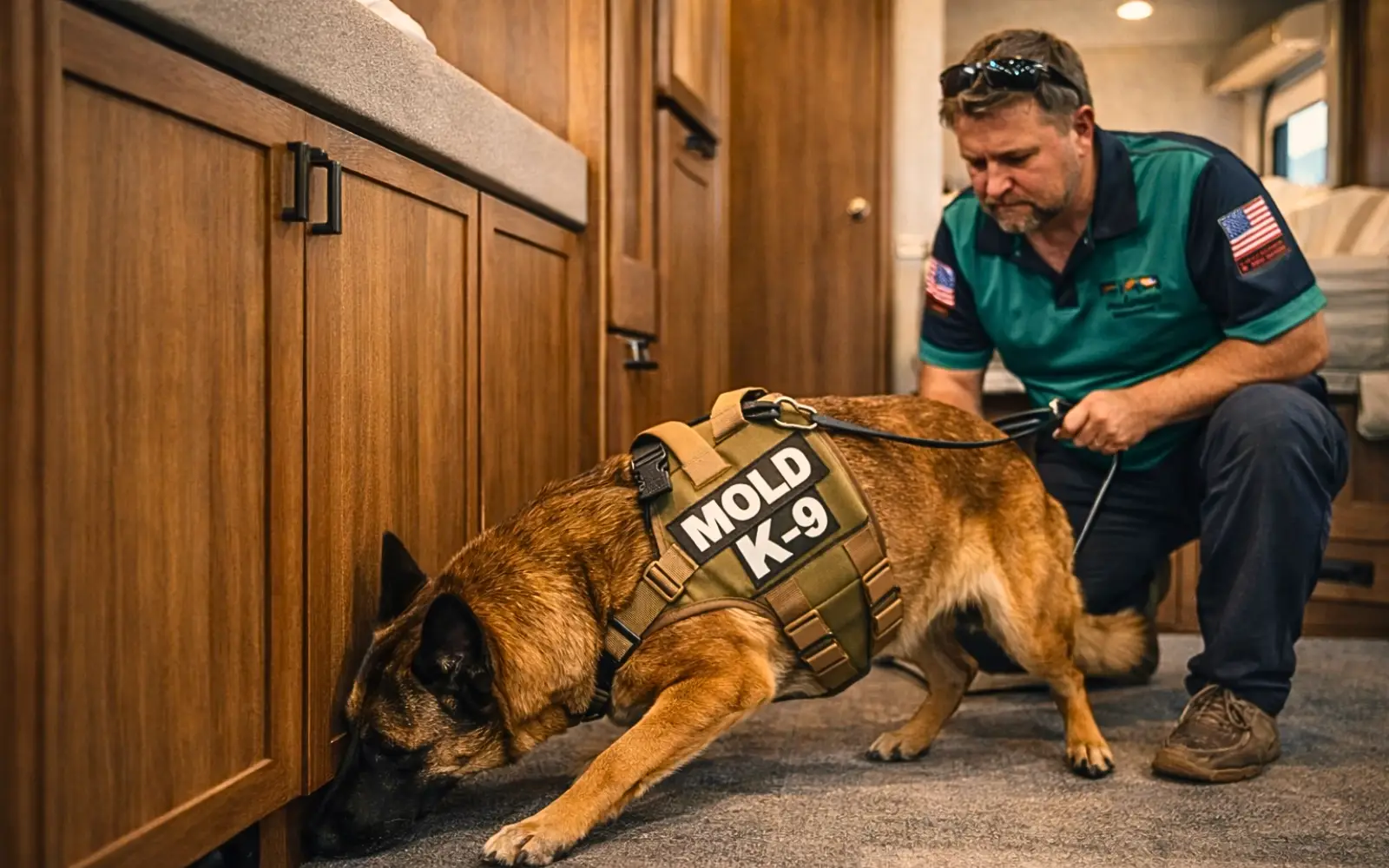
The dog works with a trained handler using a set room-by-room process. People and pets stay out of the property during the inspection so the dog can focus without distractions. The handler guides the dog through the home and watches closely for trained alert behavior.
This isn’t the same as a dog casually noticing a musty smell. Mold detection dogs are trained to locate the odor associated with mold growth.
“Mika is trained to find mold. That is what she’s trained to find. No matter where that mold is, that is her main target and main focus.”
Caleb Jones
During the inspection, the dog may search wall cavities, flooring, cabinets, plumbing-adjacent areas, HVAC-adjacent spaces, and other places where mold can hide. These are often the same areas that visual inspections struggle with because the problem may be behind finished materials.
That’s the key difference. A mold dog inspection isn’t waiting for mold to be visible. It’s focused on source location.
For homeowners comparing options, this is also where it helps to understand mold inspection vs mold testing.
Step 4: What Happens When the Dog Alerts?
When the dog alerts, it means the dog has indicated mold odor in that area.
The handler doesn’t immediately tear anything open. Instead, the alert location is marked and documented so the homeowner has a clear record of where the dog responded.
“Whenever [our dog] goes through and they alert on a cavity or a cabinet or flooring or anything like that, [the handler] will pause and put a sticker, a safe sticker on that area just to mark it and say, [they] alerted here.”
Caleb Jones
Alerts may happen near walls, cabinets, flooring, cavities, or areas connected to past water damage. In mold dog inspections, those alerts are meant to help narrow the search. They don’t automatically mean an entire room needs to be demolished.
That’s important. If there’s one alert on one side of a wall and another alert nearby, the homeowner may be dealing with one source area rather than several separate problems. The alert is a starting point for smarter investigation, not a reason to panic.
The value is direction. Instead of guessing where to open, test, or remediate, the homeowner has a more focused place to begin.
Step 5: What Do You Receive After the Inspection?
After the inspection, the homeowner receives documentation of what happened.
Mold Dog Network records the inspection and provides photo documentation showing where the dog alerted. That gives the homeowner something more useful than a vague verbal summary. It creates a clear record that can be reviewed, shared, and used to plan next steps.
“We make sure to record all of the interactions and the inspection during the course of it, just to make sure that the client has the evidence.”
Caleb Jones
The report may help guide further investigation, remediation conversations, lab testing decisions, or choices about whether to open a specific wall, cabinet, or flooring area.
It’s also important to be clear about what the inspection does and doesn’t do. A mold dog inspection helps locate mold odor. It doesn’t diagnose health symptoms. It doesn’t identify mold species like a lab test. And it doesn’t mean every marked area requires the same response.
For more on the next step, see what happens after mold is found.
Review the report carefully and use it to make your next step more targeted.
Why a Mold Dog Inspection Can Feel Different From a Traditional Inspection
A traditional mold inspection often depends on what can be seen. That can be helpful when there’s visible staining, exposed framing, obvious water damage, or mold growing on a surface.
But hidden mold is different.
Air tests depend on what’s captured during the sampling window. Swabs only test the exact surface sampled. Visual inspections can’t see through drywall or flooring. That’s where a mold detection dog can add another layer of information.
Caleb compares the concept to other working scent dogs:
“Canines finding odor sources is not a new concept. We’re just applying it in a new industry.”
Caleb Jones
The EPA says wet or damp materials dried within 24–48 hours after a leak or spill will usually not grow mold. But when moisture sits inside materials longer than that, hidden mold becomes harder to rule out from the surface alone. And mold dogs are great at finding hidden mold.
That doesn’t mean mold dogs are magic or that every other method is useless. It means the method should match the problem. If mold is visible, a visual inspection or surface test may be enough. If the concern is hidden mold, mold dog inspections can help locate where the odor is coming from.
For a broader overview, see what mold inspections include, cost, and when you need one.
Choose a mold dog inspection when you need help finding hidden mold, not just documenting what’s visible.
Conclusion: A Good Mold Inspection Should Give You Direction
A mold inspection shouldn’t leave you more confused than when you started.
The process should help you understand what may be happening in the home, where the concern may be located, and what step makes sense next. Mold Dog Network’s process includes preparation, a trained dog-handler search, alert marking, recording, and photo documentation.
That structure matters when the mold isn’t visible.
Mold dog inspections are especially useful when there’s a musty smell, past water damage, failed testing, or a concern that mold may be hidden behind finished materials.
Ready to stop guessing? Schedule a mold dog inspection with Mold Dog Network and find out where hidden mold may be located.