
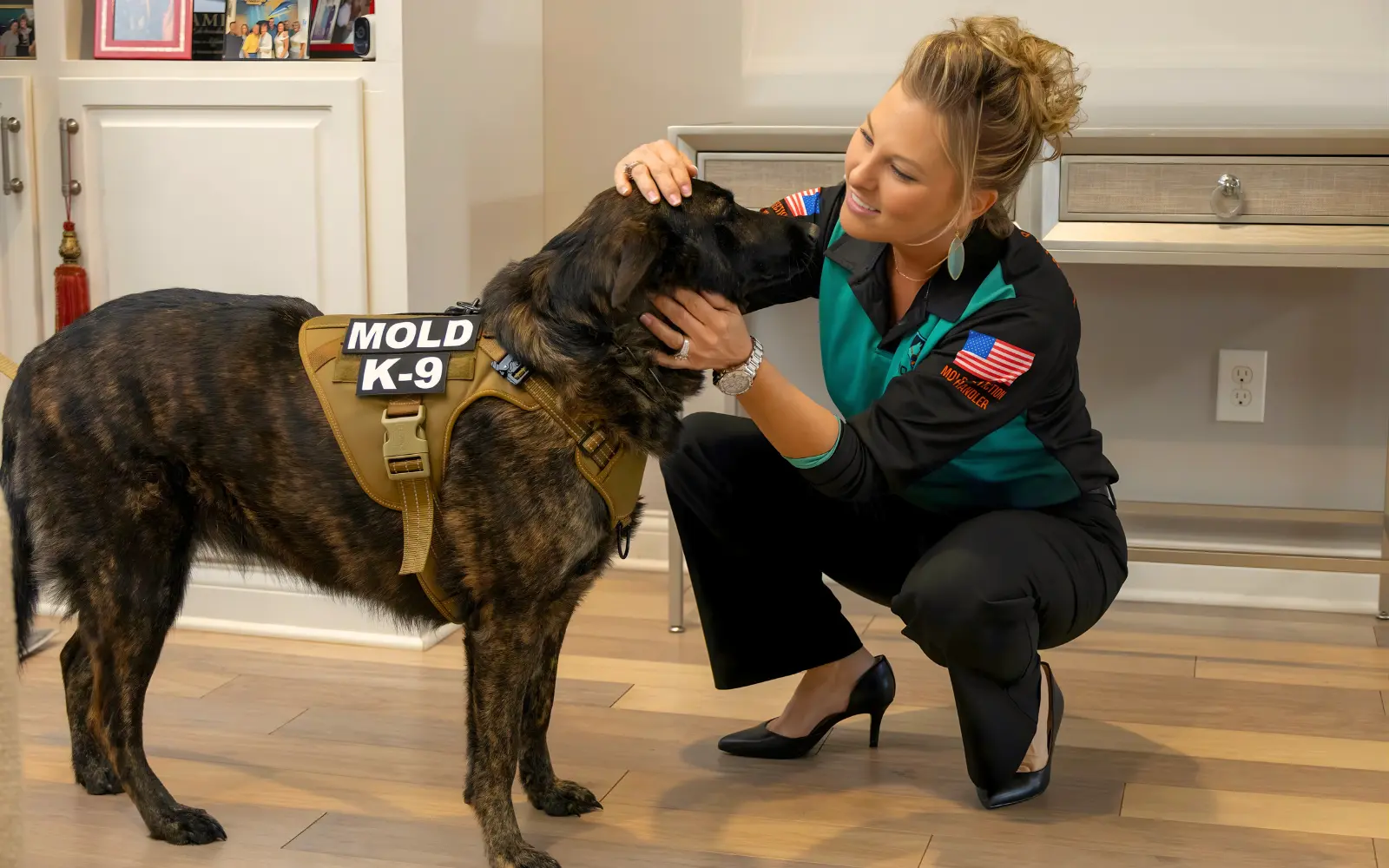
Mold Inspections: What They Include, What They Cost, and When You Need One
Most homeowners don’t wake up excited to schedule a mold inspection.
They call because something isn’t adding up.
Maybe there’s a musty smell that never fully goes away. Maybe your allergies, headaches, fatigue, or breathing symptoms seem worse at home and better when you leave. Maybe there was a leak under the sink, a dishwasher overflow, a roof issue, or a damp basement. Or maybe you’ve already paid for testing, repairs, or remediation, but you still have the same uneasy feeling: “Something’s being missed…”
Caleb Jones, co-owner of Mold Dog Network, came to mold detection dogs after years in remediation. He’d already worked with visual inspections, air quality testing, swab testing, moisture readings, and selective demolition. Those tools can all be useful. But when mold is hidden, they have one major limitation.
“You can only access and test what you can see.”
Caleb Jones
That’s why so many homeowners struggle to get clear answers. Mold often grows where people can’t easily look: behind drywall, under flooring, inside cabinets, around plumbing, in HVAC systems, or behind areas repaired too quickly after water damage.
Timing matters too. The EPA explains that if wet or damp materials are dried within 24–48 hours after a leak or spill, mold will usually not grow. Once moisture sits longer than that, especially inside building materials, the situation becomes harder to evaluate from the surface alone.
A mold dog inspection is designed to answer the question many homeowners are really asking: Where is the mold hiding?
Instead of starting with guesswork, broad demolition, or another test that may not identify the source, trained mold detection dogs search for the odor of mold growth and alert their handler when they locate it. For homeowners stuck between symptoms, smells, failed tests, or unresolved water damage, that can be the difference between continuing to wonder and finally knowing where to look next.
Watch the full interview here!
- What a Mold Inspection Should Tell You
- What Does a Mold Dog Inspection Include?
- How Much Does a Mold Inspection Cost?
- Mold Inspection vs. Mold Testing: Where Traditional Methods Fall Short
- When Do You Need a Mold Inspection?
- Real World Example: When Mold Stayed Hidden After Two Remediation Attempts
- Are Mold Dog Inspections Legit? Understanding Accuracy, Training, and Limits
- The Right Mold Inspection Helps You Stop Guessing
What a Mold Inspection Should Tell You
A mold inspection should do more than confirm that something looks suspicious. At its best, it should help you understand whether mold may be present, where the likely source is, and what step makes the most sense next.
That’s where many homeowners get stuck.
A visual inspection can identify staining, water damage, surface growth, damp materials, or signs that a leak happened in the past. That can be helpful, especially in unfinished areas like basements, crawl spaces, attics, utility rooms, or anywhere the structure is exposed. But once a wall is finished, a floor is covered, or plumbing is hidden inside a cabinet or wall cavity, the inspection becomes much more limited (or even useless).
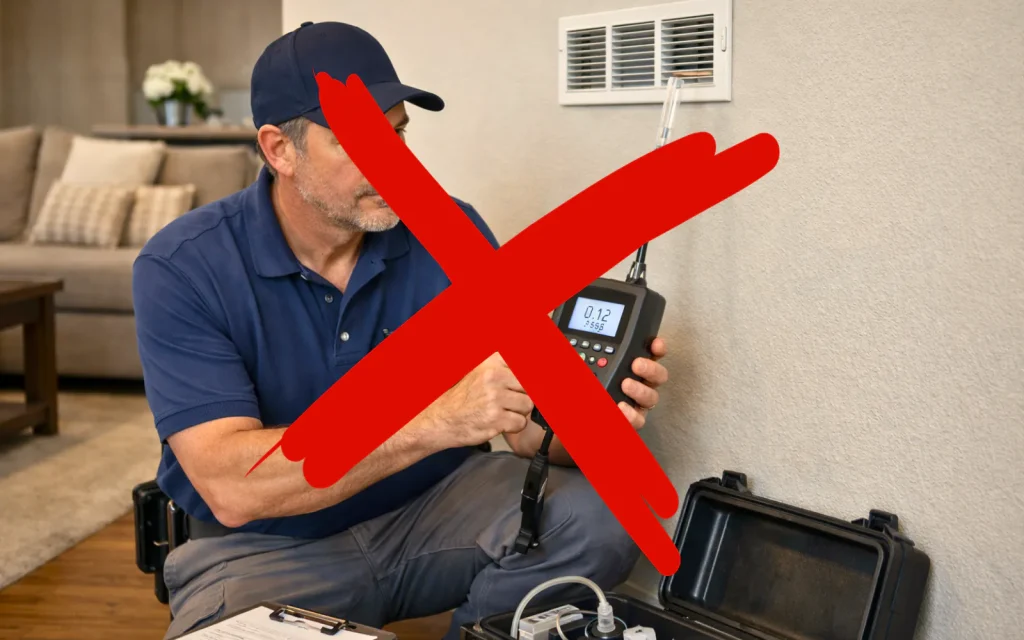
Air testing and swab testing answer different questions. A swab may identify what’s present on the exact surface sampled. Air testing may show what spores were captured during that specific testing window. Those results can be useful, but they don’t always tell you where the mold is growing.
A mold dog inspection is different because it focuses on locating mold odor at the source. The dog isn’t looking for a stain. The dog isn’t waiting for spores to float into a short air sample. The dog is trained to search for the scent associated with mold growth and alert the handler when and where that odor is found.
A good inspection should clarify whether the concern is visible, hidden, or both; whether further testing or remediation may be needed; and whether any areas shouldn’t be closed up, rebuilt, or ignored.
Caleb described the difference clearly from his experience in remediation. Before using mold detection dogs, he’d seen how much time and money could go into trying to locate mold through tools, selective demolition, and educated guesses.
“[We spent] tens of thousands of dollars and hours and hours of inspection time and cutting and demoing into clients’ walls on guesswork and extrapolations, and then [instead] you just watch a beautifully smart and effective canine walk across the wall and sit down and say, ‘Hey, it’s right here’.”
Caleb Jones
That’s the purpose of a mold inspection: not to leave you with more uncertainty, but to give you clearer direction. For anyone comparing inspection options, it helps to understand what a mold inspection involves before choosing the next step.
Schedule a mold dog inspection before opening walls or chasing unclear test results.
What Does a Mold Dog Inspection Include?
A mold inspection usually starts with the story of the home.
Before anyone looks at walls, flooring, cabinets, or vents, the inspector needs to understand what’s happened there. Was there a dishwasher leak? A roof issue? A basement flood? A slow plumbing leak behind a vanity? And did symptoms start after a renovation, storm, or remediation project? Has testing already been done? Did the results explain the problem, or did they create more confusion?
A traditional inspection may include a visual check of moisture-prone areas, visible staining, musty odors, water-damaged materials, and places where mold is commonly found. That can be useful when there are obvious signs, but when the concern is hidden mold, a mold dog inspection adds a more targeted layer.
Mold Dog Network also asks homeowners to prepare the home before the dog and handler arrive. That preparation helps make the inspection cleaner and more useful.
Before the inspection, homeowners may be asked to:
- Move furniture two to three feet away from wall cavities where possible.
- Open windows and clean the window sills and tracks.
- Sanitize sink drains and shower drains.
- Remove pets from the home during the inspection.
- Step out of the property while the dog and handler work.
Getting those details right really matters for an accurate mold dog inspection. Caleb explained that window tracks, sink drains, and shower drains can hold normal debris, moisture, and mold-like odor sources that may confuse the bigger question. If the dog alerts near a window, the homeowner needs to know that the concern is underneath that window area, not simply inside a dirty window track.
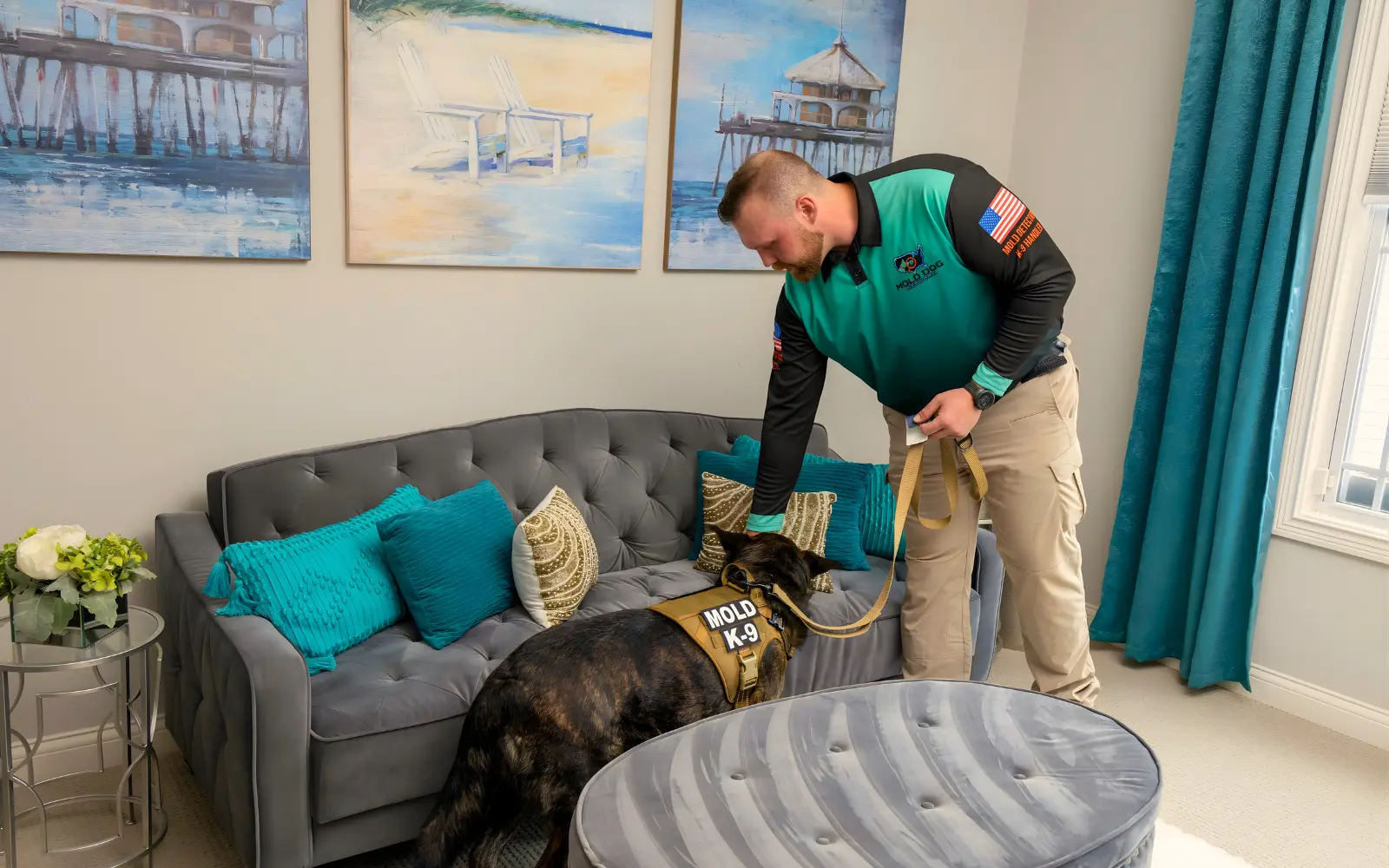
Once the inspection begins, the dog and handler move through the home using a set protocol. The dog searches wall cavities, flooring, cabinets, and other potential hidden mold locations. When the dog alerts, the handler pauses and marks the area.
“Whenever Mika [one of our mold dogs] goes through and she alerts on a cavity or a cabinet or flooring or anything like that, Zach [Mika’s handler] will pause and put a sticker on that area just to mark it and say, ‘She alerted here.’”
Caleb Jones
The inspection is also recorded, and the homeowner receives photo documentation afterward. That way, the inspection doesn’t rely on memory or vague notes. It gives the homeowner a clear record of where the dog alerted and which areas may need further investigation.
For a homeowner trying to understand the step-by-step mold inspection process, this is one of the biggest differences with Mold Dog Network: the service isn’t built around guessing. It’s built around locating the areas most likely to matter.
Book a mold dog inspection for a structured, non-invasive search of hard-to-see areas.
How Much Does a Mold Inspection Cost?
Mold inspection costs vary because not every inspection is trying to do the same job.
A basic visual inspection may cost less upfront, especially if the inspector is only looking for visible mold, staining, moisture damage, or obvious signs of a leak. Lab testing can add to the cost, depending on how many air samples, swabs, or tape lifts are taken. Industrial hygienist assessments may cost more again, especially when a formal protocol is needed.
But price only matters in context. The more important question is: will this inspection help you find the source?
That’s where many homeowners lose money. They pay for a test, get a result, and still don’t know where the mold is. Or they pay for remediation in the areas that look most obvious, only to find out later that hidden mold was left behind.
Caleb puts a lot of weight on the inspection phase because it affects everything that comes after it.
“The inspection part of the process is the most important part of mold remediation in my opinion, because it has the highest chance of causing a failure later on down the road if something wasn’t caught earlier.”
Caleb Jones
Mold Dog Network’s residential pricing is currently based on square footage. Their entry-level residential inspection is $1,250 for properties up to 2,000 square feet, $1,500 up to 3,000 square feet, $1,750 up to 4,000 square feet, with custom pricing above 4,000 square feet. Final pricing should always be confirmed directly with MDN because property type, scope, location, travel, and special circumstances may affect the quote.
Here’s the simple way to compare common options:
- Visual inspections help with obvious staining, leaks, and surface growth.
- Air or swab testing can identify what was captured or sampled, but may not locate the source.
- Mold dog inspections are best suited for hidden mold concerns where location matters most.
Cost also feels different when health concerns are involved. NIOSH notes that building dampness and mold have been associated with respiratory symptoms, asthma, hypersensitivity pneumonitis, rhinosinusitis, bronchitis, and respiratory infections. That doesn’t mean a mold inspection diagnoses illness. It means homeowners are often trying to make a careful decision about both their property and indoor environment, which makes getting the right inspection essential.
For that reason, the cheapest inspection isn’t always the most cost-effective. If hidden mold is the concern, a mold dog inspection may offer more useful direction because it’s focused on location, not just surface evidence or a snapshot of air.
For a deeper breakdown, see how much a mold inspection costs.
Choose the inspection that helps you find the source, not just the lowest upfront price.
Mold Inspection vs. Mold Testing: Where Traditional Methods Fall Short
A mold inspection and a mold test are often talked about like they’re interchangeable. They’re not.
Testing tells you something about a sample. Inspection should help you understand the home.
That difference matters because a homeowner may receive a lab result confirming mold was found, but still have no clear idea where the active source is. Or they may receive a negative air sample and assume the home is fine, even though hidden mold is growing behind a wall, under flooring, or inside an HVAC system.
Swab testing can be useful when there is visible growth on a surface, but the problem is that the result only reflects the exact place sampled. If the sample is taken from the wrong spot, it may not answer the real question.
“You could be swabbing a surface and… an inch to the right is an active mold growing colony. But if you don’t swab that active mold growing colony, there’s no guarantee that you’re going to properly identify that mold is in that cavity.”
Caleb Jones
Air testing has a similar limitation. It captures what’s in the air during a short sampling period. If spores aren’t moving through that air at that moment, the test may not reflect the hidden issue. That’s why a negative mold test doesn’t always settle the matter for homeowners who still smell something, still feel worse at home, or still have a known water damage history.
And as for visual inspections…
“I am limited to what I can physically see and potentially smell in the environment. But my senses are nowhere near as strong as what the canines are.”
Caleb Jones
Visual inspections are strongest when the problem is exposed: unfinished basements, crawlspaces, attics, visible staining, exposed framing, obvious water damage, or surface-level growth. But s we discussed, many mold problems are inside wall cavities, behind cabinets, beneath flooring, around old plumbing, above finished ceilings, or in HVAC-related areas.
“If there is an issue going on [in a] wall cavity… you will not find it, other than on straight guesswork or dumb luck, which is not what you want a home remediated on.”
Caleb Jones
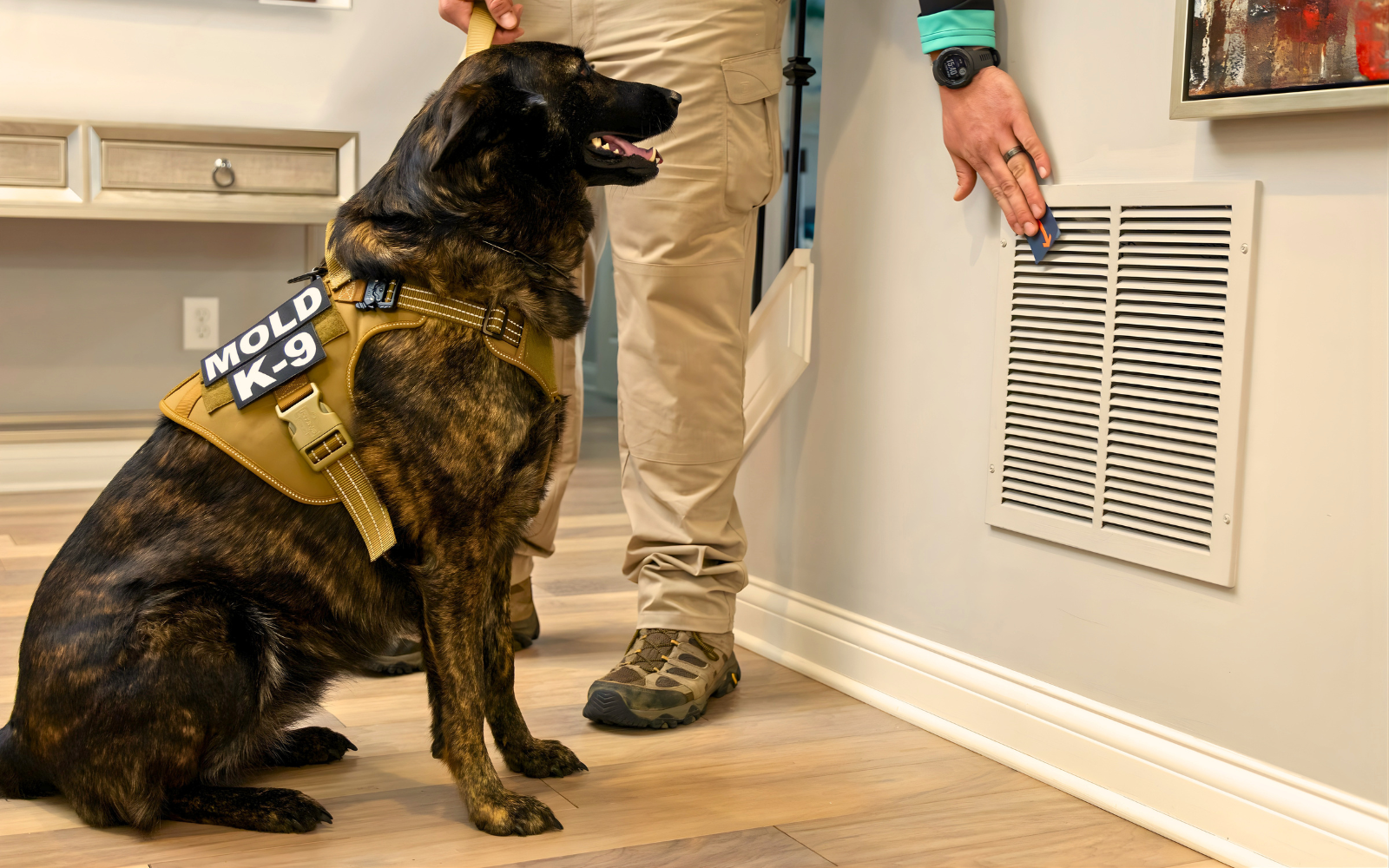
A mold dog inspection approaches the problem from a source-location perspective. The dog is trained to search for the odor associated with mold growth and alert the handler where that odor is detected. It doesn’t replace every lab test. It doesn’t identify the species of mold under a microscope. It helps answer a different and often more urgent question: where should we be looking?
The National Academies’ Damp Indoor Spaces and Health review found sufficient evidence of an association between damp indoor environments and upper respiratory tract symptoms, coughing, wheezing, and asthma symptoms in sensitized people.
For more detail, see mold inspection vs mold testing, what home inspectors may not look for, and the red flags for mold during a home inspection.
If testing didn’t explain the problem, schedule a mold dog inspection to look for hidden source areas.
When Do You Need a Mold Inspection?
You don’t need to see black mold on a wall before a mold inspection makes sense.
Many homeowners call because the house looks mostly normal, but something about the indoor environment feels off. That’s especially true when there’s been water damage, a musty smell, failed remediation, or symptoms that seem to follow a pattern inside the home.
Here are nine signs it may be time to schedule a mold dog inspection:
- Musty odor with no visible mold – this means the source may be hidden.
- Symptoms feel worse at home – MDN doesn’t diagnose illness, but home-related symptom patterns are worth investigating with medical guidance.
- A doctor suggested checking the home – Caleb said many MDN clients come through functional medicine referrals.
- Past leaks, floods, roof issues, or plumbing problems – mold often starts where moisture sat inside materials.
- Failed post-remediation testing – another hidden source may still be present.
- Damp, stale, or humid rooms – especially basements, bathrooms, laundry rooms, crawlspaces, and HVAC-adjacent spaces.
- Bubbling paint, stained drywall, warped flooring, or musty cabinets – these can point to moisture damage.
- Buying or selling a property – a clean-looking home can still have hidden mold from old leaks or repairs.
- Testing didn’t explain what you’re experiencing – a normal air test may not answer the source-location question.
Caleb shared one case where a family had already been through remediation, but hidden issues remained.
“The wife and the children started to have some health concerns and started getting sick from the level of exposure and they just could not figure out the most effective way to find all of the hidden issues in their home.”
Caleb Jones
For a deeper checklist, see signs it’s time for a mold inspection.
If these signs feel familiar, book a mold dog inspection and start narrowing down the source.
Real World Example: When Mold Stayed Hidden After Two Remediation Attempts
One of the clearest examples Caleb shared came from a homeowner in the Cincinnati area, near Northern Kentucky and Southern Ohio.
The family had already been through two remediation attempts after leaks around the home. Two remediation companies had come through. Both had failed third-party post-testing. The family was frustrated, worried, and still trying to understand why the home wasn’t clearing.
Mold Dog Network sent handler Zach and his canine Mika to inspect the home. During the inspection, Mika alerted in areas the previous work hadn’t fully addressed. One of the most important alerts was close to a previously remediated area, but just a few feet beyond the boundary where the prior company had stopped.
“An extra three feet over from where they stopped the remediation, Mika had alerted and the third remediation company started taking out that drywall… and it was just black and molded all over it on the backside.”
Caleb Jones
From the finished side, the wall may not have looked like the main issue. But once opened, the backside of the drywall showed what had been missed.
For the homeowner, the alert wasn’t just technical information. It gave confirmation. It explained why the problem had continued and why they all still felt sick. It helped the next remediation company focus on the areas that still needed attention instead of rebuilding over a hidden issue.
A mold dog inspection is especially useful in cases like this because it can help identify mold odor beyond the obvious damage zone. That matters after leaks, partial remediation, failed post-testing, or any situation where a homeowner is being told the problem is fixed while the home still doesn’t feel right.
For more on the next step after an alert, see what happens after mold is found.
If remediation didn’t solve the problem, schedule a mold dog inspection before rebuilding.
Are Mold Dog Inspections Legit? Understanding Accuracy, Training, and Limits
It’s fair to be skeptical the first time you hear about mold detection dogs.
Most people understand bomb dogs, drug dogs, and search-and-rescue dogs because they’ve seen working dogs used in serious situations. Mold dogs are less familiar. But the underlying idea is the same: a trained canine is taught to identify one target odor and communicate to the handler when that odor is present.
Caleb hears the skepticism, but he points out that canine scent detection isn’t new.
“Canines finding odor sources is not a new concept. We’re just applying it in a new industry.”
Caleb Jones
For Mold Dog Network, accuracy isn’t just about having a dog with a good nose. It depends on selection, training, handling, and daily reinforcement. Caleb explained that MDN is specific about the breeds and lineage they bring into the program, then the dogs go through obedience training before mold-source imprinting begins. That imprinting process may take four to six months, and the training doesn’t stop once the dog begins inspections.
“Every single day there’s two to three hours of training that goes into maintaining the K9’s accuracy.”
Caleb Jones
A mold dog inspection is only as strong as the dog-handler team behind it. The dog needs to know (and remember) what odor it’s looking for. The handler needs to know how to read the dog. The company needs a process that protects accuracy, reduces confusion, and documents alerts clearly for the homeowner.
At the same time, mold dogs shouldn’t be presented as magical or perfect. They don’t identify mold species like a lab test, they don’t replace every professional involved in remediation, and they don’t diagnose health symptoms. Their job is focused and powerful: locate the odor source of mold growth so the homeowner has better direction.
Schedule a mold dog inspection with a trained canine team focused on finding hidden mold.
The Right Mold Inspection Helps You Stop Guessing
Mold inspections aren’t all the same.
A visual inspection can be helpful when mold is exposed. Swab testing can identify what’s present on a specific surface. Air testing can provide a snapshot of what was airborne during the sample window. Each method has a place.
But when the problem is hidden the real question becomes harder to answer: where is the mold actually coming from?
That’s where a mold dog inspection can make the biggest difference. Instead of relying only on what can be seen or what happens to show up in a short sample, Mold Dog Network uses trained detection dogs to locate the odor of mold growth in the home. The result is a clearer starting point, less guesswork, and better direction before anyone starts cutting, rebuilding, or paying for another round of unclear testing.
If your home smells musty, feels wrong, has a history of leaks, or still has problems after previous remediation, you don’t have to keep guessing.
Ready to stop guessing? Schedule a mold dog inspection with Mold Dog Network and get clear direction on where hidden mold may be hiding in your home.