
Can Mold Grow Under Flooring? Signs You Shouldn’t Ignore
A floor can look dry on top and still be hiding moisture underneath.
That’s what makes water damage so frustrating. You clean up the leak. You run fans. You wipe everything down. Maybe the flooring looks normal again, so you tell yourself, Okay, we caught it in time.
But then a musty smell lingers. One corner feels soft. The floor starts to buckle. Or you keep wondering whether water got underneath before you could stop it.
So, can mold grow under flooring? Yes, it can. Mold can grow under carpet, hardwood, vinyl, laminate, tile, padding, underlayment, and subflooring when moisture gets trapped below the surface.
Tina Craig, co-owner of Mold Dog Network, described exactly why this happens after hidden leaks:
“It stays wet inside that chamber and grows mold and the dogs are like, it’s right there.”
Tina Craig
That’s the issue. The surface may look fine, but the chamber underneath may tell a different story.
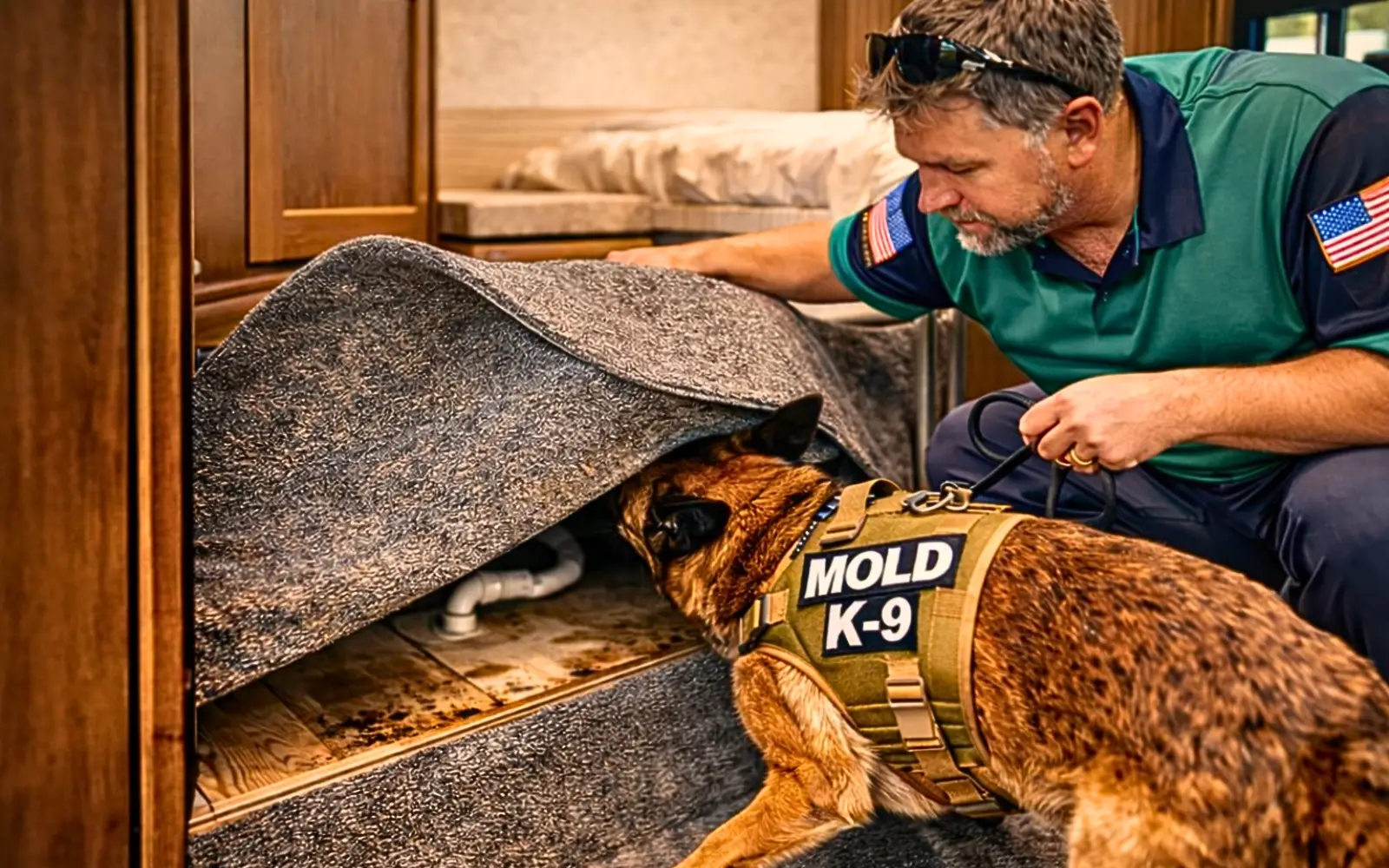
Mold Dog Network uses trained mold detection dogs to locate mold scent signatures without randomly tearing into floors, walls, or ceilings. If you’re worried about hidden mold under your floors, a mold dog inspection can help identify where the odor is strongest before you commit to pulling anything apart.
- Can Mold Grow Under Flooring?
- How Moisture Gets Trapped Under Floors
- Signs Mold May Be Growing Under Your Flooring
- Flooring Types That Can Hide Mold
- Why Pulling Up Random Flooring Isn’t the Best First Step
- How Mold Dogs Help Find Mold Under Flooring
- What to Do If You Suspect Mold Under Flooring
- Don’t Let Hidden Moisture Stay Hidden
Can Mold Grow Under Flooring?
Yes, mold can grow under flooring when moisture reaches the layers beneath the visible surface and stays there long enough.
Most flooring systems have more than one layer. Depending on the home and flooring type, there may be:
- Finished flooring
- Adhesive
- Underlayment
- Carpet padding
- Subflooring
- Wood framing
- Insulation below the floor
Any of these layers can hold moisture. Carpet padding can stay wet after the top of the carpet feels dry. Wood subflooring can absorb water. Laminate and vinyl can trap moisture underneath because they slow evaporation. Even tile, which many homeowners think of as waterproof, can hide moisture if water gets through grout lines, edges, cracks, or failed seals.
The EPA says that if wet or damp materials are dried within 24–48 hours after a leak or spill, mold will usually not grow.
The problem is that homeowners often don’t know whether the materials underneath actually dried.
Tina gave a simple example of how people treat water damage as a surface issue:
“They had a leak above and they thought, no big deal, I’ll paint the ceiling, we’re good to go.”
Tina Craig
The same thing happens with floors. The visible layer may look normal, but water may still be sitting underneath, especially after a leak, flood, appliance failure, or plumbing issue.
If your floor was exposed to water and you’re not sure the layers underneath dried, a mold dog inspection can help identify whether mold odor is present below the surface.
How Moisture Gets Trapped Under Floors
Water can get under flooring from above, below, or inside the home’s structure.
Sometimes it’s obvious. A washing machine overflows. A dishwasher leaks. A toilet backs up. A pipe bursts. A basement floods.
Other times, it’s more subtle. A refrigerator line leaks slowly. A shower pan seeps underneath tile. A crawl space stays humid. A sump pump fails while you’re away. HVAC condensation collects in a hidden cavity. A plumbing leak above the ceiling affects the floor below.
Once water gets under flooring, it may be hard to dry fully because the finished surface can act like a lid.
Common causes of moisture under flooring include:
- Dishwasher leaks
- Ice maker line leaks
- Sink or toilet overflows
- Bathtub or shower leaks
- Washing machine leaks
- Flooding
- Basement or crawl space moisture
- Sump pump failure
- Plumbing leaks above or below the floor
- Roof leaks affecting floor and ceiling cavities
- HVAC condensation
- Poor vapor barriers or subfloor ventilation
Tina said Mold Dog Network often sees homeowners underestimate water damage at first:
“A lot of times what we’ll see is somebody had a water leak and they thought, yeah, it’s not that bad. We’re gonna dry it out ourselves.”
Tina Craig
That’s completely understandable. No one wants a small leak to become a big project. But if water reached padding, underlayment, subflooring, or framing, surface drying may not be enough.
EPA guidance for carpet and backing is especially important here. The EPA says water should be removed, and in many cases carpet and padding may need to be pulled up so both surfaces can dry within 48 hours.
That doesn’t mean every spill means mold. But it does mean water under flooring should be taken seriously. Visible water damage is often one of the first signs of mold in your house.
If a leak reached flooring, padding, or subflooring, don’t rely on the visible surface alone. Mold Dog Network can help you check whether hidden mold odor remains.
Signs Mold May Be Growing Under Your Flooring
Mold under flooring can be difficult to spot because the actual growth may be below the surface. Still, there are signs that should make you pause.
You may have mold under your flooring if you notice:
- A musty smell near the floor and no visible mold growth
- Odor that’s strongest in one room, corner, or hallway
- Warped, buckled, cupped, or lifted flooring
- Soft or spongy areas underfoot
- Staining around baseboards
- Dark lines near the edges of carpet or flooring
- Loose tiles or lifting vinyl
- Swollen trim or baseboards
- A history of leaks, floods, or overflows
- Recurring dust or particulate buildup
- Symptoms that seem worse in that room
None of these signs proves mold on its own. Flooring can warp from moisture without mold. A musty smell may come from a crawl space, wall cavity, HVAC issue, or old carpet. Dust can have many causes.
But when these clues show up together, especially after water exposure, they’re worth investigating.
Tina mentioned an unusual dust pattern Mold Dog Network hears about from homeowners:
“You’ll hear the homeowner occupants say, I dusted two days ago and I have to dust again because it looks like I’ve gone a month without dusting.”
Tina Craig
That doesn’t mean dust proves there’s mold under the floor. But if a home has a musty odor, recurring dust, water history, and health complaints, those clues may point toward a hidden mold problem.
Health concerns are another reason people start looking for mold. Mold Dog Network doesn’t diagnose medical conditions, but the CDC states that mold can cause symptoms such as stuffy nose, sore throat, coughing, wheezing, burning eyes, or skin rash in some people, while others may have no reaction.
So, the question isn’t just Can mold grow under flooring?
The better question is: Did moisture get under this floor, and is there evidence that something still isn’t right?
If your flooring smells musty, feels soft, or changed after water exposure, it’s worth finding out whether mold is hiding underneath.
Flooring Types That Can Hide Mold
Different flooring materials hide moisture in different ways. The risk depends on the water source, how long the material stayed wet, what’s underneath, and whether the area dried properly.
Carpet and padding
Carpet is tricky because the surface can feel dry while the padding underneath stays damp.
Padding acts like a sponge. If it absorbs water, it can hold moisture against the subfloor. That creates a hidden area where musty odors and mold growth may develop.
You may notice a smell when walking into the room, dark edges near the baseboards, dampness under furniture, or a soft feeling underfoot.
Hardwood and engineered wood
Wood flooring can absorb moisture and show changes like cupping, buckling, staining, or gaps. But mold may also grow below the boards or on the subfloor, especially if water traveled underneath and didn’t dry fully.
Engineered wood can be especially concerning if moisture gets between layers or sits below the surface.
Vinyl, laminate, and floating floors
Vinyl, laminate, and floating floors can trap moisture underneath because the surface may slow evaporation. Water can travel under planks, sit on underlayment, and affect the subfloor.
The top may look clean while moisture remains below.
That’s why a musty smell from a vinyl or laminate floor after a leak shouldn’t be ignored.
Tile
Tile often gives homeowners a false sense of security. The tile surface may resist water, but grout lines, cracked tiles, edges, failed seals, or moisture under backer board can still create problems.
A bathroom floor, laundry room floor, or kitchen tile area may hide moisture underneath if water gets past the surface.
Subflooring and crawl-space-facing floors
Sometimes the moisture isn’t coming from above. It’s coming from below.
Homes over crawl spaces can have moisture coming up into the floor system from ground humidity, poor vapor barriers, plumbing leaks, or inadequate ventilation.
Tina said crawl spaces are often a major concern:
“For families that are on crawl spaces, that’s a big deal because those are very often problematic.”
Tina Craig
If your floor smells musty and there’s a crawl space underneath, the source may be below the living area rather than inside the room itself.
No matter what kind of flooring you have, the question is whether moisture got trapped underneath. A mold dog inspection can help identify the areas worth investigating first.
Why Pulling Up Random Flooring Isn’t the Best First Step
When you suspect mold under flooring, it’s tempting to start pulling things apart.
You want answers. You want to know what’s under there. You want the smell gone.
But pulling up random flooring can create problems.
You may open the wrong area. You may expose moldy materials without containment. You may spread contamination if mold is present. You may create unnecessary repair costs. And even after damaging the floor, you still may not find the actual moisture source.
That’s why finding the source first matters.
A mold dog inspection gives you a more targeted starting point. Instead of opening the floor everywhere, the dog helps identify where mold odor is strongest.
Tina described the value of getting out of the guessing game:
“No more of that. The guessing game is over. You now know what you’re dealing with.”
Tina Craig
That’s the kind of certainty homeowners need before making decisions about demolition, remediation, repairs, or further testing.
A dog alert doesn’t replace remediation. It doesn’t fix the moisture issue. But it can help narrow down where the next professional should look.
Before pulling up floors, use a mold dog inspection to narrow down where mold odor is strongest so the next step can be focused.
How Mold Dogs Help Find Mold Under Flooring
Mold dogs are trained to search for mold scent signatures. They’re not looking for visible staining. They’re not guessing based on where a leak “probably” went. They’re following scent.
During a mold dog inspection:
- The dog and handler inspect the room systematically.
- The dog searches for the scent signature associated with mold growth.
- If the dog detects that scent, it gives a trained alert.
- The handler documents the alert location.
- The homeowner receives a report that can guide next steps.
Tina explained how scent-focused these dogs are:
“They don’t care what they’re sniffing. It could be anything. It can be a car. It could be an airplane. It could be a building. It could be a couch. They don’t care. All they want is that scent.”
Tina Craig
That’s why mold dogs can be so helpful when flooring looks normal but the homeowner still suspects hidden mold. The dog isn’t making decisions based on the surface. It’s trained to locate odor.
For homeowners, this can mean fewer guesses, fewer unnecessary openings, and a clearer path toward remediation or repairs.
We find the source so the next step can be targeted.
If you suspect mold under flooring, Mold Dog Network can help you locate the likely source before you commit to opening the floor.
What to Do If You Suspect Mold Under Flooring
If you’re worried about mold under flooring, start by gathering clues. The more specific you can be, the easier it is to understand what may be happening.
Do:
- Note where the odor is strongest
- Check for past leaks, spills, floods, or overflows
- Look for buckling, cupping, soft spots, stains, or swollen trim
- Pay attention to whether the smell changes after rain or HVAC use
- Keep indoor humidity controlled
- Avoid covering the smell with fragrance
- Schedule an inspection if the concern persists
- Fix the moisture source before remediation
Don’t:
- Ignore musty odors after a water event
- Assume dry flooring means dry subflooring
- Pull up large areas without a plan
- Paint, seal, or cover over suspected moisture
- Remediate without addressing the leak or humidity source
The goal is to move from suspicion to direction.
Tina described the value Mold Dog Network provides this way:
“The cool thing about Mold Dog Network is you’re gonna know if you have a problem and you’re gonna know where the problem hides.”
Tina Craig
That’s what matters when you’re worried about hidden mold under a floor. You don’t want vague fear. You want to know where to look.
If you’re worried mold is growing under your flooring, schedule a mold dog inspection and get a clearer idea of where to investigate.
Don’t Let Hidden Moisture Stay Hidden
Mold can grow under flooring when moisture gets trapped beneath the surface.
The top of the floor may look dry while padding, underlayment, adhesive, subflooring, or framing stays damp. Musty odors, soft spots, buckling, stains, past leaks, and symptoms that seem worse in one room are all reasons to investigate further.
We get it. Nobody wants to pull up floors unless there’s a real reason. Flooring repairs are disruptive, expensive, and stressful.
That’s why Mold Dog Network helps homeowners locate hidden mold odor before unnecessary demolition begins.
If you suspect mold under flooring, don’t keep guessing and don’t start tearing things apart blindly. Mold Dog Network can help you find the source and move forward with a clearer plan.
Schedule your mold dog inspection today.