
Mold in HVAC Systems: Why It’s Hard to Find and Easy to Spread
Sometimes the house smells fine, until the air kicks on.
Then you notice it.
A musty smell from the vents. A stale odor that seems to move from room to room. A smell that’s worse when the AC runs. Or maybe one room feels heavier than the rest of the house, even though you can’t see mold anywhere.
That’s what makes mold in HVAC systems so frustrating. The source may not be obvious. It may be inside the equipment, around ductwork, near a drain pan, around a sweating coolant line, inside a ceiling cavity, or somewhere else entirely that the HVAC system is pulling from or pushing through the home.
Tina Craig, co-owner of Mold Dog Network, says HVAC systems are one of the areas they pay close attention to during hidden mold inspections.
“We see that HVAC systems, if not put in correctly, and if they’re not operated and taken care of can present a real problem.”
Tina Craig
The tricky part is that HVAC systems move air. So even if the source is localized, the smell may feel like it’s everywhere.
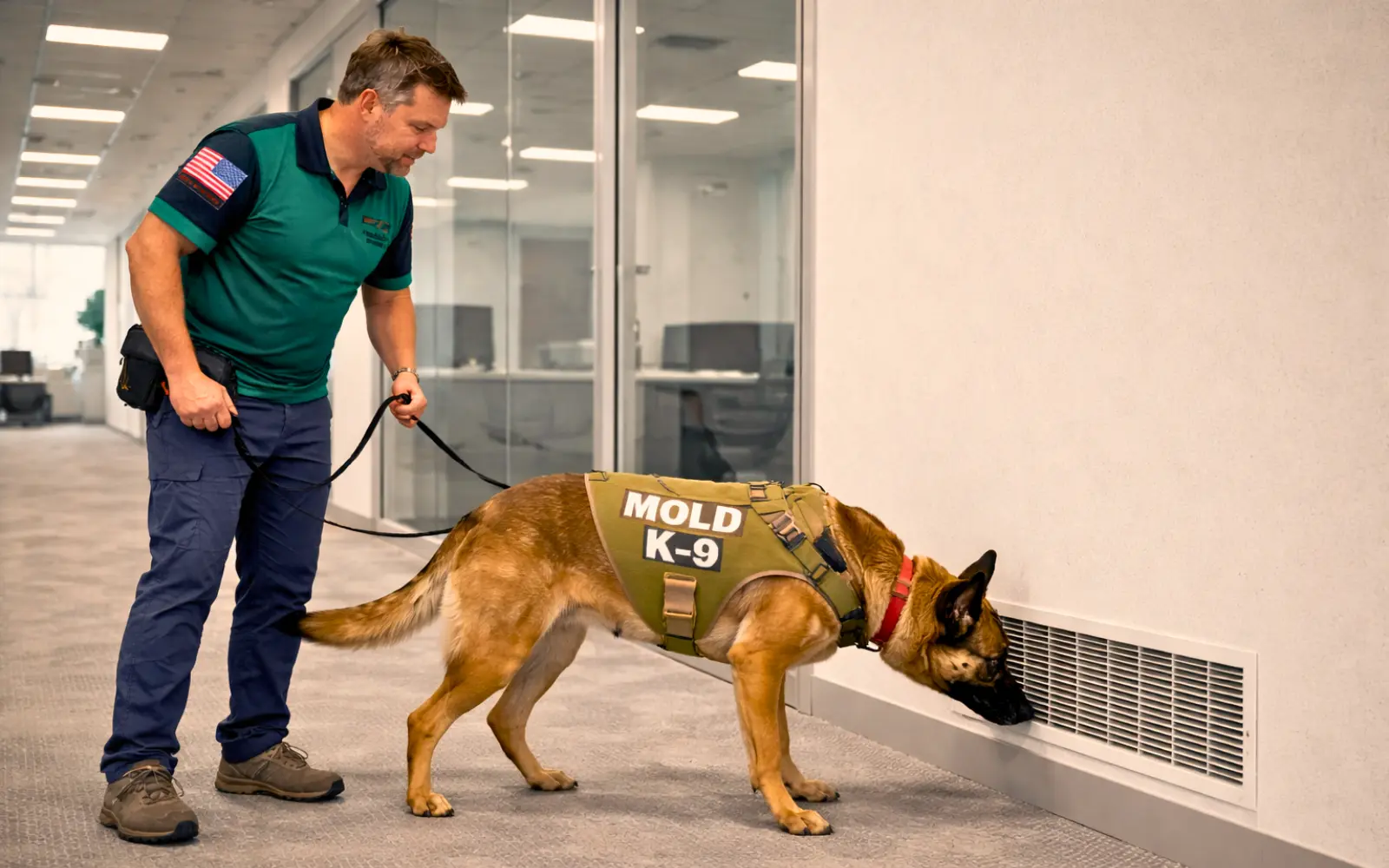
Mold Dog Network uses trained mold detection dogs to locate mold scent signatures non-invasively. That means instead of guessing whether the issue is in the ducts, the air handler, a wall cavity, or another hidden moisture source, the dog helps identify where the mold odor is strongest.
We find the source so the next step can be focused.
- Can Mold Grow in HVAC Systems?
- Why HVAC Mold Is So Hard to Find
- Common Causes of Mold in or Around HVAC Systems
- Can HVAC Systems Spread Mold Through the Home?
- Why Cleaning the Ducts May Not Solve the Mold Problem
- How Mold Dogs Help Locate HVAC-Related Mold
- What to Do If You Suspect Mold in Your HVAC System
- Find the Source Before Mold Spreads Further
Can Mold Grow in HVAC Systems?
Yes, mold can grow in or around HVAC systems when moisture is present.
That moisture may come from condensation, a clogged drain line, standing water in a drain pan, dirty coils, poor filtration, high indoor humidity, duct insulation problems, or hidden moisture around HVAC components.
HVAC systems naturally involve temperature changes. Cold surfaces meet warm humid air. Condensation forms. Air moves through equipment, ducts, vents, returns, filters, and surrounding cavities. When moisture isn’t controlled, mold can become part of the system or the areas around it.
Potential HVAC-related mold areas include:
- Air handlers
- Evaporator coils
- Drain pans
- Condensate lines
- Ductwork
- Returns
- Supply vents
- Filter areas
- Duct insulation
- Ceiling cavities around HVAC lines
- Wall cavities around coolant lines
- Crawl spaces or attics connected to HVAC equipment
The EPA explains that moisture control is the key to mold control, and condensation can be a sign of high humidity or a moisture problem.
That matters because not every HVAC mold issue starts with a dramatic leak. Sometimes it starts with a little bit of moisture forming again and again.
Tina described this kind of hidden moisture problem when talking about coolant lines:
“Now that’s not a rush of water, okay? That’s just moisture building up inside of a cavity inside the house.”
Tina Craig
That’s one reason mold in HVAC systems and nearby cavities can be hard to catch early. You may not see a flood. You may not see staining right away. You may only notice a musty odor when the system runs.
If your HVAC system smells musty or certain rooms smell worse when the air runs, a mold dog inspection can help determine whether hidden mold odor is present.
Why HVAC Mold Is So Hard to Find
HVAC mold can be hard to find because air moves.
That sounds simple, but it changes everything.
You may smell a musty odor at one vent even though the source isn’t inside that vent. You may smell it in multiple rooms even though the mold is concentrated in one area. You may smell it only when the system runs because airflow is pulling odor from a hidden source and distributing it through the home.
The source may be:
- Inside the HVAC equipment
- Around a condensate line
- In a drain pan
- Near duct insulation
- Around a return
- Inside a ceiling cavity
- Behind drywall near coolant lines
- In an attic connected to the system
- In a crawl space where air is being pulled upward
- Near another hidden mold source that airflow is disturbing
That’s why homeowners often feel like they’re chasing the smell.
They change the filter. They clean the vent covers. They spray something. They schedule duct cleaning. But the musty odor keeps coming back because the actual source hasn’t been located. This confusing scent pattern can be one of the first signs of persistent idden mold in your house.
Visual checks can also miss HVAC-related mold. You may be able to see the vent cover, but not inside every duct. You may be able to see the air handler, but not the wall cavity behind it. You may be able to check the filter, but not the condensation issue hidden above the ceiling.
Tina explained why human inspections can be limited when mold is hidden:
“Humans go into these properties with experience, textbook training, field training and they go in with tools… they’re using devices to try to make up for the God-given device that a canine owns.”
Tina Craig
That’s not a knock on inspectors. It’s the reality of hidden mold. Humans rely on what they can see, test, access, and measure. Dogs are trained to detect scent.
If the odor seems to move from room to room, don’t assume the vent you smell is the source. Let a mold dog help trace where the scent is strongest.
Common Causes of Mold in or Around HVAC Systems
Mold in HVAC systems usually comes back to one core issue: moisture.
The exact source can vary, but these are some of the most common HVAC-related moisture problems homeowners should know about.
Condensation and high humidity
Condensation happens when warm, humid air meets a cold surface. In an HVAC system, cold coils, ducts, lines, and surrounding cavities can all become condensation points when conditions are right.
High indoor humidity makes this worse.
The EPA recommends keeping indoor relative humidity below 60%, ideally between 30% and 50%, to help control mold.
If your home feels humid, smells musty, or has condensation on vents, ducts, windows, or lines, it’s worth paying attention. That moisture may be feeding mold in or around the HVAC system.
Drain pan or condensate line problems
Air conditioners remove moisture from indoor air. That moisture has to drain somewhere.
If a drain pan holds standing water, a condensate line clogs, or the system doesn’t drain properly, moisture can build up around the equipment. Over time, that dampness can create the conditions mold needs.
Signs may include water near the air handler, a musty smell near the unit, repeated drain line clogs, staining, or visible debris in the drain pan.
Sweating coolant lines
This is one of the more hidden issues Tina described in our interview.
A coolant line may run inside a wall, ceiling box, or drywall chase. If the insulation around that line isn’t enough, the line can sweat. That moisture may collect inside the cavity where no one can see it.
Tina explained:
“So, what happens is that coolant line sweats inside of the box or inside the drywall of the ceiling or the wall that it’s brought up into.”
Tina Craig
This kind of moisture problem is easy to miss because it may not create an obvious leak. It may simply add moisture slowly, repeatedly, and quietly.
By the time anyone opens the area, mold may already be present.
Poor installation or maintenance
HVAC systems need to be installed and maintained correctly. Poor installation, poor drainage, inadequate insulation, dirty components, bad airflow, poor filtration, or neglected maintenance can all contribute to moisture and mold concerns.
Sometimes the problem isn’t technically “inside the ducts.” It’s around the system, near the system, or in a hidden cavity affected by the system.
That’s why source-finding matters.
If your HVAC system has moisture, condensation, drainage issues, or musty odors, Mold Dog Network can help locate whether mold odor is coming from the system or nearby hidden cavities.
Can HVAC Systems Spread Mold Through the Home?
HVAC systems move air. That means they can also move odors, dust, particles, and mold spores through the home.
The EPA explains that mold reproduces by releasing tiny spores that travel through indoor and outdoor air.
If mold is growing in or near an HVAC system, airflow may carry odor or particles into other rooms. That can make one hidden source feel like a whole-house problem.
But it’s important to be precise: a musty smell from the vents doesn’t automatically mean the ducts themselves are full of mold.
Sometimes the HVAC system is spreading odor from another source. For example, the system may be pulling air from a crawl space. It may be moving odor from an attic. It may be carrying smell from a wall cavity near a return. It may be disturbing a hidden mold source every time the fan runs.
Tina talked about the way air movement can help reveal hidden issues, especially in attic-related situations:
“The way that a house breathes and rotates the air, if there’s an issue going on up in that attic and that canine picks up on it, now we’ve got two indicators that that attic is having a major issue.”
Tina Craig
That idea matters for HVAC mold too. Homes breathe. Air moves. Odors travel.
So when a musty smell seems to move through the home, the solution isn’t just to cover it up or clean the nearest vent. The first step is finding where the odor is strongest and what moisture source is feeding it.
Mold spores don’t usually stay airborne forever, but if your HVAC system is constantly circulating the air, they will.
If a musty smell seems to travel through the house, a mold dog inspection can help identify whether the scent is coming from HVAC-related areas or another hidden source.
Why Cleaning the Ducts May Not Solve the Mold Problem
Duct cleaning may be helpful in some situations. But it won’t solve a mold problem if the actual moisture source is still there.
That’s the part many homeowners miss.
If the issue is a sweating coolant line inside a wall, cleaning the ducts won’t dry that wall. If the problem is standing water in a drain pan, duct cleaning won’t fix the drainage issue. If mold odor is coming from an attic, crawl space, chimney chase, or wall cavity, duct cleaning may not touch the source at all.
This is why Mold Dog Network takes a source-first approach.
Before spending money on duct cleaning as a guess, it helps to know whether the odor is actually coming from the HVAC system, around the HVAC system, or from a hidden area the system is moving air through.
Tina described the relief that comes when homeowners finally get out of the guessing game:
“No more of that. The guessing game is over. You now know what you’re dealing with.”
Tina Craig
That’s what matters.
Mold problems don’t get solved by masking the smell. They don’t get solved by cleaning one part of the system while moisture continues somewhere else. And they don’t get solved by opening random areas without a plan.
Controlled remediation starts with knowing where the problem is.
A mold dog inspection helps locate mold odor so the next step can be focused.
Before paying for duct cleaning as a guess, find out where the mold odor is strongest. Mold Dog Network can help point you toward the real source.
How Mold Dogs Help Locate HVAC-Related Mold
Mold detection dogs are trained to locate mold scent signatures. They aren’t relying on visible stains, assumptions, or where the homeowner thinks the issue “should” be.
That’s especially useful with HVAC-related mold because airflow can confuse the picture.
During an inspection, the dog and handler move through the home systematically. The dog may check areas around vents, returns, HVAC equipment, walls, ceilings, crawl spaces, attic access points, and other likely odor sources. If the dog detects mold scent, it gives a trained alert. The handler documents that alert area so the homeowner has a report to guide next steps.
Tina explained the dogs’ focus this way:
“They don’t care what a wall looks like. They don’t care what the layout of a house looks like… All they want is that scent.”
Tina Craig
That’s the benefit. The dog isn’t guessing based on how the vent looks. It’s working from scent.
Mold Dog Network’s homepage explains that trained mold dogs can detect mold inside HVAC systems and behind building materials without destructive testing.
Mold dogs don’t clean ducts. They don’t remediate HVAC systems. They don’t replace qualified HVAC contractors or remediation professionals.
Their job is to help locate the source.
For homeowners, that can mean fewer unnecessary openings, less guesswork, and a clearer plan for what comes next.
If you suspect mold in your HVAC system, schedule a mold dog inspection to locate where the odor may be coming from before you start opening ducts or walls.
What to Do If You Suspect Mold in Your HVAC System
If you think there may be mold in your HVAC system, start by tracking patterns.
Does the smell happen when the AC turns on? When the heat runs? When the fan-only mode is on? Is it worse in one room? Near one return? After rain? During humid weather? When the basement or crawl space smells damp?
Those details can help narrow the source.
Do:
- Note when the smell happens
- Check whether it’s worse with heating, cooling, or fan-only mode
- Look for visible condensation or staining
- Replace filters regularly
- Keep indoor humidity controlled
- Document recent HVAC repairs, leaks, or water events
- Check around the air handler, drain pan, and condensate line
- Schedule a source-focused inspection if the odor persists
Don’t:
- Ignore musty odors from vents
- Assume duct cleaning fixes everything
- Cover the smell with fragrance
- Run equipment with standing water or obvious leaks
- Open contaminated areas without a plan
- Skip fixing the moisture source
- Assume the room where you smell it is automatically the source
The goal is not panic.
Tina described what Mold Dog Network helps homeowners understand:
“You’re gonna know if you have a problem and you’re gonna know where the problem hides.”
Tina Craig
That’s exactly what you need with HVAC-related mold concerns. You don’t want to keep paying for guesses. You want to know where the odor is strongest and what area should be investigated next.
If the HVAC system keeps pointing back to mold concerns, Mold Dog Network can help you find out whether hidden mold odor is present and where it’s strongest.
Find the Source Before Mold Spreads Further
Mold in HVAC systems can be hard to find because air moves.
The smell may come from the equipment, ducts, drain pan, condensate line, sweating coolant line, wall cavity, attic, crawl space, or another hidden moisture source. And because the HVAC system moves air through the home, a localized issue can feel much bigger than it is.
We get it. A musty smell from the vents is unsettling, especially when you can’t see what’s causing it.
But you don’t have to start guessing.
Mold Dog Network uses trained mold detection dogs to locate mold scent signatures non-invasively, helping homeowners identify where hidden mold odor may be strongest before opening ducts, walls, ceilings, or floors.
If your HVAC system smells musty or seems to spread mold odor through your home, Mold Dog Network can help you stop guessing. Schedule a mold dog inspection today.